Rheinmetall stock is the listed share of Rheinmetall AG, a German defence and industrial group that sells military vehicles, ammunition, air defence and digital systems to governments. Its share price moves with contract timing, delivery capacity and margins, not only with headlines about defence budgets. The gap between orders won and cash collected is the thing to understand.
Key takeaways
- Rheinmetall sells vehicles, ammunition, air defence and digital systems, mostly to governments.
- Its reported backlog was €78.012 billion at 30 September 2026, including expected orders not yet placed.
- On 5 November 2026 the company cut 2026 sales guidance to about €13.2 billion, citing delays.
What Rheinmetall does
Rheinmetall AG runs five divisions: Vehicle Systems, Weapon and Ammunition, Air Defence, Digital Systems and Naval Systems. Its main customers are German and international armed and security forces, including Germany's armed forces and allied armies. It also supplies civilian mobility, automotive and energy products through its Power Systems activities, which the company labels discontinued operations.

The shares trade on Xetra and German stock exchanges under the ticker RHM, with ISIN DE0007030009. The company reports in euros, is headquartered in Düsseldorf, and its official share page lists DAX and EURO STOXX 50 membership.
For the first nine months of 2026, segment sales were Vehicle Systems €3,898 million, Weapon and Ammunition €2,705 million, Air Defence €731 million, Digital Systems €1,328 million and Naval Systems €679 million, with Naval Systems included from its acquisition closing on 27 February 2026.
How the money actually arrives
A signed contract is a promise of future work, not a sale. Under accounting rules used by listed European companies, revenue is recognised when or as the customer obtains control of the goods or services, so the award itself is not the revenue event. Rheinmetall records some sales as work progresses. It records others when it delivers the product. For products made for a particular customer, it tracks progress by comparing costs incurred with estimated total costs.

Cash is a third timeline again. It follows the contract's invoicing and payment terms. At 30 September 2026 Rheinmetall reported €1.700 billion of contract assets. These are recognised work not yet billed. It also reported €6.669 billion of contract liabilities. These are customer payments received before sales are recognised. In the first half of 2026 the company said quarter-end customer invoicing and inventory built for later quarters weighed on operating free cash flow.
Capacity sets the ceiling on all of this. Rheinmetall's stated ambition is annual output by 2030 of 1.5 million 155 mm artillery rounds, 240,000 120 mm anti-tank rounds and 4 million medium-calibre rounds. Its new Albacete plant in Spain entered production in October 2026 with capacity for about 1.2 million projectiles and 1.8 million cartridge cases a year, after an investment of about €20 million. Construction of the Aschau propellant factory began in July 2026, with €350 million planned investment over coming years.
What the order backlog does and does not promise
Three words keep appearing in the reporting, and they mean different things.

Order intake means new firm orders won in a period. It was €18.257 billion for the first nine months of 2026, including €3.311 billion in Q3. Rheinmetall also reports nominations. This measure includes new nominations under framework agreements and was €19.131 billion for the first nine months. Backlog is work still to come.
At 30 September 2026 the Rheinmetall Backlog was €78.012 billion: €54.318 billion of order backlog and €23.694 billion of frame backlog. Frame backlog is the company's estimate of future customer orders under existing framework agreements. These agreements set terms for later orders. Resulting sales can differ depending on final order quantities. Expected customer orders stay in frame backlog until the customer places them. They then become order intake and later order backlog.
| What the backlog can tell you | What it does not guarantee |
|---|---|
| How much work customers have committed to or signalled | That every euro becomes revenue |
| How much production needs planning | The year the sales land |
| The reported stock of work | Protection from cancellation |
The cancellation point is not theoretical. In June 2026 the German Defence Ministry ended the six-ship F126 frigate programme, and Rheinmetall wrote off €2.153 billion of associated Naval Systems backlog in July.
What drives the share price
Budgets are the headline, but they sit several steps away from supplier revenue. The European Defence Agency reported €418 billion of actual defence spending by the EU's 27 states in 2025, projected at €454 billion for 2026, with €115 billion of that 2025 total going to equipment procurement. Germany's Bundestag passed an €82.69 billion Defence Ministry budget for 2026 on 28 November 2025, plus a further €25.51 billion for the Bundeswehr special fund. Even then, Bundeswehr purchases of €25 million or more need separate Budget Committee approval before a contract is concluded.
Then execution has to follow. On 5 November 2026 Rheinmetall said the Arminius order's advance payments and sales contributions would move to 2027 and that artillery-ammunition batch acceptance was delayed. The Arminius order was still in negotiations in November 2026.
Individual contracts still matter. On 29 October 2026, OCCAR commissioned Artec to deliver 35 additional Schakal vehicles for Germany and 34 for the Netherlands, with Rheinmetall's portion valued in the medium three-digit million-euro range and deliveries planned for May 2032 to November 2033. That delivery window shows how long the tail can be.
For the detail on the latest quarter, see our write-up of Rheinmetall's Q3 2026 results.
Where the share stands
Rheinmetall's investor-relations page showed its latest available Xetra closing quote as €1,003.40 on 4 November 2026. Yahoo Finance listed a Xetra closing price of €832.80 for 5 November 2026. A market-data snapshot on 5 November 2026 reported a 52-week trading range of €818.70–€1,966.00 per share and a market capitalisation of €39.57 billion, taken at 11:59 CET rather than at the close. On 5 November 2026, CNBC reported that the shares fell about 17% after the outlook cut.
For the first nine months of 2026, Rheinmetall reported basic earnings per share of €11.40, and €14.44 from continuing operations. Q3 2026 sales were €3,149 million with earnings after tax attributable to shareholders of €296 million.
A share price on its own tells you nothing about whether a company is cheap. It depends on growth, margins, how reliably profit turns into cash, and what investors already expect. Analyst price targets are dated opinions built on assumptions, and they disagree with each other.
If you'd rather spread risk than hold one company, our guide on index exposure versus single stocks covers the alternative.
Risks
- Public-sector timing. Rheinmetall's 2025 annual report says budget cuts, elections, export controls and customer financing problems can delay awards, postpone or cancel orders.
- Programme execution. Rheinmetall said Arminius advance payments and sales contributions would move to 2027.
- Supply chain and labour. The 2025 annual report identifies staff shortages, technical failures, supply interruptions and component bottlenecks as constraints on capacity.
- Export controls and geopolitics. China halted supplies of certain dual-use goods, including rare earths and chemicals, to Rheinmetall in July 2026 in response to sanctions on Russia, though the company said stockpiles meant the impact was not then material.
- Expectations. The 52-week range of €818.70–€1,966.00 reported on 5 November 2026 shows how far the share price can swing.

Some readers exclude defence exposure for ethical reasons. That is a legitimate choice and only you can make it.
This article is for information only and is not investment advice.
Frequently asked questions
What is the difference between order backlog and revenue?
Backlog is ordered or expected work not yet delivered. Revenue is work delivered and recognised in the accounts. The gap between them is where scheduling, production, testing and customer acceptance delays live. Rheinmetall's backlog stood at €78.012 billion at 30 September 2026, while Q3 2026 sales were €3,149 million.
Does higher European defence spending automatically help Rheinmetall?
No. Spending must first become an approved budget. A procurement decision and contract award must follow. Delivery must then happen. In Germany, Bundeswehr purchases of €25 million or more need separate Budget Committee approval before the contract is concluded. Frame backlog only becomes order backlog when a customer calls it off.
What is frame backlog?
It is Rheinmetall's estimate of future customer call-offs under framework agreements already in place. At 30 September 2026 it was €23.694 billion of the €78.012 billion total. Final sales from it can vary with actual call-off volumes.
Does Rheinmetall have the money to expand?
The company announced on 8 October 2026 that its renewed bank credit line had been doubled from €750 million to €1.5 billion. It invested €596 million in property, plant, equipment and intangible assets in continuing operations over the first nine months of 2026, and its September 2026 presentation showed a capex plan of 8–9% of sales, down from an earlier 16% plan.

Sources
- CNBC: Rheinmetall stock outlook and sales in Germany (5 November 2026)
- Rheinmetall AG: Q3 2026 quarterly statement (5 November 2026)
- Rheinmetall AG: Investor relations
- European Defence Agency: EU defence spending: €418 billion in 2025, projected €454 billion in 2026 (16 July 2026)
- German Bundestag: Budget Act 2026, third reading (28 November 2025)
- IFRS Foundation: IFRS 15 Revenue from Contracts with Customers
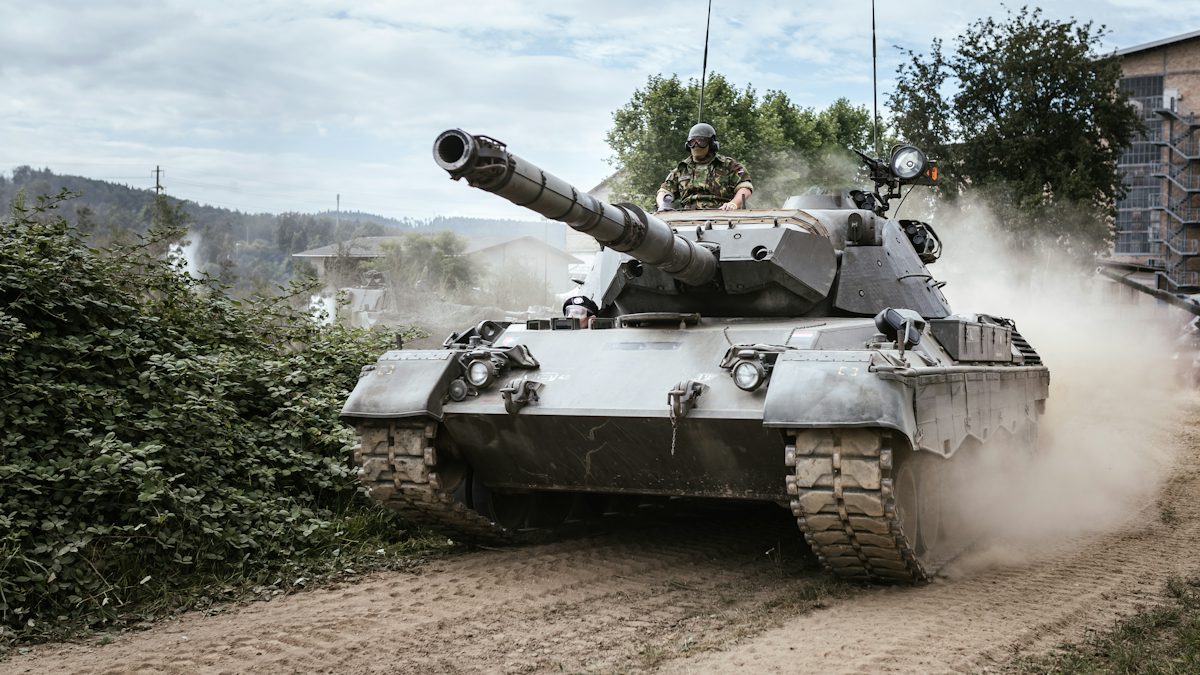
Cover photo by Kevin Schmid on Unsplash.

You might also like
Deepen your knowledge with more articles and inspiration.