
Meta's share price mainly moves with advertising growth, spending plans, legal costs and investor expectations. Meta Platforms trades on Nasdaq under META, earns almost all its money from advertising, and reports Family of Apps and Reality Labs as separate businesses. The share closed at $605.08 on 5 November 2026.
On 21 October 2026, Meta reported third-quarter revenue of $64.601 billion and net income of $9.860 billion, a figure that includes a $9.89 billion charge tied to its agreement with U.S. state attorneys general. The same release set out capital spending plans for the year that are now as big a talking point as the ads business itself.
Key takeaways
- Meta earns almost all its revenue from advertising across its Family of Apps.
- The share closed at $605.08 on 5 November 2026.
- Capital spending guidance was $135bn to $145bn for 2026.
What Meta stock is and where it trades
Meta Platforms is an American company. Its Class A common stock is listed on Nasdaq under the ticker META, and Class B shares are also outstanding. Meta is one of the Magnificent 7 stocks, the group of large US technology companies that dominate the main American indexes.
One change is coming. Meta's 21 October 2026 results release said the board had approved a publicly listed, non-voting Class C stock, with the amended charter's effective date set for 19 January 2027. The company's quarterly filing describes the issuance and the related stock dividend as future events, not as something already done.
| Figure | Value |
|---|---|
| Share price (close, 5 Nov 2026) | $605.08 |
| Market capitalisation (5 Nov 2026) | $1.55 trillion |
| Revenue (quarter ended 30 Sep 2026) | $64.601 billion |
| Diluted EPS (quarter ended 30 Sep 2026) | $3.83 |
| Operating margin (quarter ended 30 Sep 2026) | 20% |
Market capitalisation is the value of all the shares added together. Meta's was $1.55 trillion at the 5 November 2026 close, according to Stock Analysis. Earnings per share is profit divided among shares. Operating margin shows how much revenue remains after operating costs.
The two segments behind the ticker
Family of Apps
This is Facebook, Instagram, Messenger, WhatsApp and the other services. In the quarter ended 30 September 2026, the segment brought in $64.158 billion of revenue and $17.117 billion of operating income. Advertising alone was $63.061 billion of that, with $1.097 billion coming from other Family of Apps sources.

The dependence is stark over a full year. For the year ended 31 December 2025, Meta reported advertising revenue of $196.175 billion and total revenue of $200.966 billion, according to its Form 10-K.
Reality Labs
This segment covers virtual- and augmented-reality consumer hardware, software and content. It is reported separately because the numbers look nothing alike. In the quarter ended 30 September 2026, Reality Labs had revenue of $443 million and an operating loss of $4.129 billion. Across the full year ended 31 December 2025, the loss was $19.193 billion on $2.207 billion of revenue.
Meta expects full-year 2026 Reality Labs operating losses of $18 billion to $19 billion, lower than in 2025. That is the company's own forecast, not a result.
What moves Meta's share price
The share price reflects what the market expects next, so a good quarter is not automatically a good day for the stock. Three things usually do the moving.
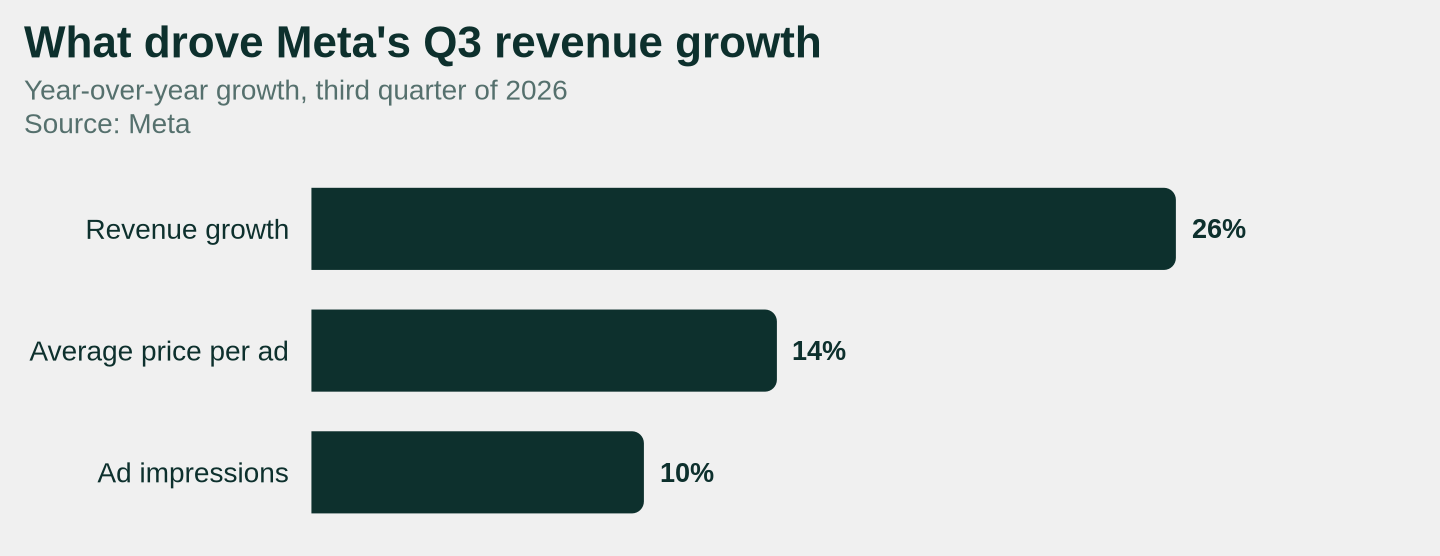
First, how advertising grows. Revenue rose 26% year over year in the quarter ended 30 September 2026. The release breaks down why: ad impressions across the Family of Apps increased 10% year over year, and the average price per ad increased 14%. Impressions are the number of ads shown. Price per ad is what advertisers paid on average for each one. Growth driven by price tends to be read differently from growth driven by volume.
Second, guidance. For the fourth quarter of 2026, Meta forecast revenue of $73 billion to $76 billion. Meta said currency movements were expected to reduce year-over-year revenue growth by approximately 1%. Meta also raised its full-year 2026 total-expense outlook to $175 billion to $179 billion, to include the $9.9 billion legal charge recognised in the third quarter.
Third, one-off items. Net income of $9.860 billion in the third quarter included that $9.89 billion charge tied to the agreement with U.S. state attorneys general, Meta said in its results release. A charge like that moves reported profit without telling you much about the ads engine.
AI spending, data centres and cash flow
This is where the debate sits. For full-year 2026, Meta forecast capital spending of $135 billion to $145 billion. This includes repayments on leases used to finance equipment. The range narrowed from $130 billion to $145 billion because Meta raised the lower end by $5 billion. Capital spending is money spent on long-lived things such as data centres, servers and chips. It takes cash out of the business today. The cost then appears gradually in later accounts and can reduce operating margin.

On 5 November 2026, an SEC filing reported that Meta completed a $15 billion debt offering with five parts maturing from 2031 to 2056. On 27 October 2026, Reuters reported that Meta planned equity offerings of up to $97.5 billion to fund AI infrastructure.
For a look at how other large technology companies handle the same spending question, see our explainer on Microsoft stock.
Risks
- Advertising made up almost all of Meta's revenue in the year ended 31 December 2025, so a drop in advertiser budgets affects most of the business.
- The AI build-out is large and upfront: $135 billion to $145 billion of capital spending is guided for 2026.
- Legal and regulatory costs can be material. Third-quarter net income included a $9.89 billion charge tied to the agreement with U.S. state attorneys general.
- Reality Labs lost $19.193 billion from operations in the year ended 31 December 2025.
- Meta completed a $15 billion debt offering on 5 November 2026.

This article is for information only and is not investment advice.
Frequently asked questions
What is Meta's ticker and which share classes exist?
Meta's Class A common stock trades on Nasdaq under META, and Class B common stock is also outstanding. A third class is planned: the board approved a publicly listed, non-voting Class C stock, with the amended charter effective 19 January 2027. Non-voting means the holder gets the economics of the share but no vote at shareholder meetings.
When does Meta report its next results?
As of 6 November 2026, Meta had not announced its next earnings date on its investor-relations events page, which said "Stay tuned for upcoming events". Its most recent results covered the third quarter of 2026 and were reported on 21 October 2026.
Why do finance sites show different price-to-earnings ratios for Meta?
A price-to-earnings ratio compares a share price with earnings per share. Providers use different price dates, earnings periods, definitions and forecast assumptions. For example, Yahoo Finance displayed diluted EPS of $29.31 alongside a trailing price-to-earnings ratio of 21.49 in November 2026, while other providers showed different trailing multiples.
What tax rate did Meta expect for the fourth quarter of 2026?
Meta said its expected fourth-quarter 2026 tax rate was 15% to 17%, absent changes to tax rules. A tax rate is the share of profit paid in tax. It can change reported profit without changing how much the business sells.

Sources
- Stock Analysis: Meta Market Cap (5 November 2026)
- U.S. Securities and Exchange Commission: Meta Platforms 2025 Form 10-K
- Meta Investor Relations: Meta Reports Third Quarter 2026 Results (21 October 2026)
- U.S. Securities and Exchange Commission: Meta Platforms Form 8-K (5 November 2026)
- Reuters: Meta launches $35 billion stock offering to fund AI expansion (27 October 2026)
- Meta Investor Relations: Investor Events
- Yahoo Finance: Meta Platforms key statistics
Cover photo by Ales Nesetril on Unsplash.

You might also like
Deepen your knowledge with more articles and inspiration.