ASML doesn't make chips. It makes the machines that print circuit patterns onto them, so the share price moves with chipmakers' factory budgets, ASML's own orders and backlog, its guidance for sales and margin, and the export rules that decide where machines can ship. For the third quarter of 2026, ASML reported total net sales of €11.662 billion and net income of €4.960 billion.
Key takeaways
- ASML reported net sales of €11.662 billion for the third quarter of 2026.
- Its sales follow chipmakers' factory budgets, so AI demand reaches ASML late and unevenly.
- Watch customer concentration and export rules: one customer was 23.9% of 2025 sales.
What ASML does, and where its shares trade
ASML designs and manufactures lithography machines that use light to print circuit patterns on chips. It also sells chipmakers the related hardware, software and services. The company was founded in 1984 and is headquartered in Veldhoven in the Netherlands. In its October 14, 2026 results release, it described its workforce as more than 45,500 full-time equivalent employees.
A European reader will see two prices for the same company. ASML's principal listing is Euronext Amsterdam, under the ticker ASML, in euros. The shares also trade on Nasdaq under ASML, in US dollars. Nasdaq listed a closing price of $1,357.97 on November 5, 2026. Its market-data page showed a market value of $522,876,875,222 on November 6, 2026.
What ASML sells: EUV, older machines and service
Lithography machines come in generations, named after the light they use. DUV is the older, longer-wavelength light, still used for a very large share of chips. EUV uses a much shorter wavelength and is needed for the most advanced ones.

The split matters, because EUV is not the whole business. In the 2025 financial year, EUV sales were €11.6 billion, about 47.4% of ASML's €24.4743 billion in net system sales. Non-EUV systems made up the rest of net system sales, including machines that measure and inspect wafers.
High-NA EUV is the next step in that family. ASML's latest published fleet count was eight High-NA systems shipped to customers by the end of 2025, six of them operating as of January 28, 2026. On July 23, 2026, Intel and ASML said selected Intel 18A layers in Oregon were dual-qualified for High-NA EUV, and that Intel was first to ship a high-volume logic product using the technology. The claim applies to selected layers and to a subset of Panther Lake processors. On September 7, 2026, Intel reported more than one million wafers processed across High-NA tool certification and testing, research and production.
The second revenue line is quieter and steadier. ASML calls it Installed Base Management. This means service and upgrade sales for machines already running at customers. In the 2025 financial year, that line was €8.193 billion, or 25.1% of total net sales of €32.6673 billion. In the third quarter of 2026, net system sales were €8.4 billion and Installed Base Management sales were €3.3 billion, on rounded figures.
Who buys the machines, and how AI demand reaches ASML
ASML sells to a small group of very large buyers. Its 2025 annual report says its largest customer contributed €7,796.7 million, or 23.9% of total net sales, and that the two largest together contributed 38.0%. The report warns that sales are concentrated among a limited group, and does not name those customers in that disclosure.

That is why AI demand reaches ASML with a delay. More AI use leads chip designers to order more advanced chips. Chipmakers then approve bigger factory budgets. Only after that do machine orders arrive, and deliveries come later again.
You can see how open those budgets still are. On its October 15, 2026 third-quarter call, TSMC said it was too early to give a 2027 figure, described investment in 2026 to 2028 as significantly higher than the prior three years, and reiterated a 2026 budget of $60 billion to $64 billion. Samsung said on October 29, 2026 that AI-infrastructure capital spending would accelerate in 2027 and reach a historic level. SK hynix said on October 28, 2026 that 2027 investment was expected to increase significantly. Micron's September 30, 2026 guidance was for net capital spending of about $25 billion in the first half of fiscal 2027, including about $11.5 billion in the first quarter.
For the demand side of that chain, see our explainer on the biggest AI companies.
What moves ASML's share price
Four kinds of numbers do most of the work.
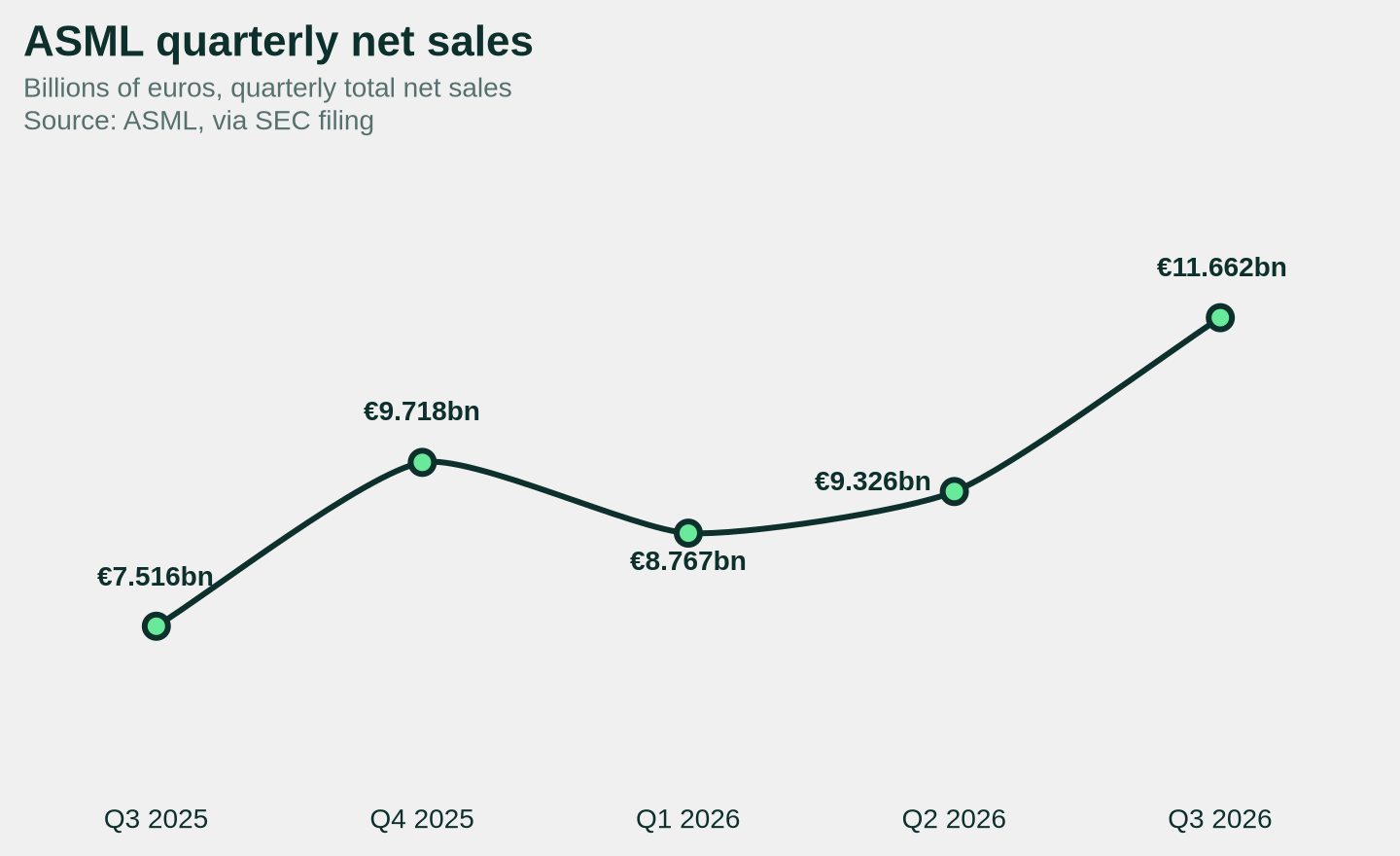
Reported sales and margin come first. Quarterly total net sales were €7.516 billion in Q3 2025, €9.718 billion in Q4 2025, €8.767 billion in Q1 2026, €9.326 billion in Q2 2026 and €11.662 billion in Q3 2026. Gross margin, the share of sales left after production costs, was 57.5% in the third quarter of 2026.
Guidance often matters more than the quarter just reported, because it is about money not yet earned. On October 14, 2026, ASML guided to fourth-quarter net sales of €14.2 billion to €15.2 billion with gross margin around 57%, and full-year 2026 net sales of €44 billion to €45 billion with gross margin around 56%. That full-year range came from raising the lower end from €43 billion to €44 billion.
Orders are the third signal. As of November 6, 2026, ASML's latest published net bookings and backlog figures were €13.158 billion for the fourth quarter of 2025 and €38.797 billion at December 31, 2025.
Expectations are the fourth. At Yahoo Finance's November 5, 2026 close snapshot for the Nasdaq ticker, the share price was $1,356.65, the trailing price-to-earnings ratio was 33.38, and the 52-week range was $946.11 to $1,999.96. That ratio compares the price with the last twelve months of profit per share. A price already reflects what investors expect, which is why results in line with expectations can still be followed by a fall.
If you want context on how a single stock compares with owning a broad index, read our guide on how to invest in the S&P 500.
China and export rules
China accounted for 23% of ASML's net system sales based on where systems were shipped in the third quarter of 2026, down from 33% for the full year 2025. The rules behind that are not a single switch. The Netherlands requires case-by-case export authorisation for specified advanced semiconductor manufacturing equipment, including lithography equipment, for exports outside the EU, with expansions effective September 7, 2024 and April 1, 2025. It is not a blanket ban. The EU's Dual-Use Regulation 2021/821 also requires authorisation for listed items, including lithography equipment meeting set technical criteria. In the United States, December 2024 rules from the Bureau of Industry and Security cover certain lithography tools for advanced-node production. The proposed US MATCH Act, which would add broader restrictions on equipment and servicing, was still pending in Congress on November 6, 2026.

Risks
- Customer demand can soften, and orders can be cancelled or delayed, risks ASML named in its October 14, 2026 release.
- Supply-chain problems are on the same company-disclosed risk list.
- Sales are concentrated: the largest customer was 23.9% of 2025 net sales.
- Export-control restrictions on shipments could limit what ships where.
- The price already carries high expectations, with a trailing price-to-earnings ratio of 33.38 at the November 5, 2026 close snapshot.

This article is for information only and is not investment advice.
Frequently asked questions
Is ASML a chipmaker or an equipment company?
An equipment company. ASML designs and manufactures the lithography machines that chipmakers use, and supplies related hardware, software and services. It does not sell finished chips. That is also why its results follow its customers' building plans rather than consumer demand for phones or servers.
What is the difference between bookings and backlog?
Bookings are the value of new orders taken in a period. Backlog is the value of orders received but not yet delivered. Neither is revenue, which is only recognised later. ASML's latest published figures, as of November 6, 2026, were net bookings of €13.158 billion for the fourth quarter of 2025 and backlog of €38.797 billion at December 31, 2025.
Can ASML build enough machines for 2027 and 2028?
Not fully, on its current plan. On October 14, 2026, ASML said its currently planned supply for 2027 and 2028 would not fully meet customer demand, and that it was investigating additional 2028 capacity. That investigation is not a confirmed capacity commitment.
Does ASML buy back its own shares?
Yes, under a share buyback program that was still current in November 2026. Its November 2, 2026 update reported purchases for October 26 to 30, with daily weighted-average prices ranging from €1,424.96 to €1,493.54 per share. A buyback reduces the number of shares outstanding, which is a different thing from a dividend. On October 14, 2026, ASML reported €4.1 billion of third-quarter share repurchases and announced a €1.88 interim dividend, payable November 4.

Sources
- ASML: ASML reports €11.7 billion total net sales and €5.0 billion net income in Q3 2026 (14 October 2026)
- ASML: Share information
- ASML: High-NA EUV reaches new readiness milestone (23 July 2026)
- U.S. Securities and Exchange Commission: ASML 2025 annual report
- Yahoo Finance: ASML Holding N.V. stock quote (5 November 2026)
- Government of the Netherlands: Export controls on advanced semiconductor manufacturing equipment to be tightened (15 January 2025)
- U.S. Securities and Exchange Commission: ASML Q3 2026 results presentation (14 October 2026)
Cover photo by Laura Ockel on Unsplash.

You might also like
Deepen your knowledge with more articles and inspiration.