
Yes, Klarna is publicly traded. Klarna Group plc trades on the New York Stock Exchange under the ticker KLAR, and its shares began trading on September 10, 2025. The company describes itself as a global digital bank and flexible-payments provider.
The shares closed at $13.54 on November 5, 2026. Their market capitalisation, the total value of all shares, was $5.13 billion at that close. That matters right now because the IPO was priced at $40 per share in September 2025, so the number you see on a quote page today has nothing to do with the offering price.
Key takeaways
- Klarna Group plc has traded on the New York Stock Exchange as KLAR since September 10, 2025.
- The November 2026 closing price was far below Klarna's IPO price.
- Lending is a material risk: Klarna recorded $378 million of provision for credit losses in the first half of 2026.
What Klarna actually is
Klarna was founded on April 10, 2005, in Stockholm by Sebastian Siemiatkowski, Niklas Adalberth and Victor Jacobsson, originally under the name Kreditor. Most people know it as the button at checkout that lets you pay later.
Today the company calls itself a global digital bank and flexible-payments provider, running an AI-powered payments and commerce network. Its official US materials list four ways to pay: in full, in four interest-free instalments, in 30 days, or over time, online and in store. In the US, Pay in 4 has no fee when payments are made on time. Late fees may be up to $7 in November 2026. Monthly financing has an APR, the yearly borrowing rate, of 0.00%–35.99% in November 2026, according to Klarna's US payments page.
For where Klarna sits among the region's listed names, see our ranking of the biggest European tech companies.
How Klarna makes money
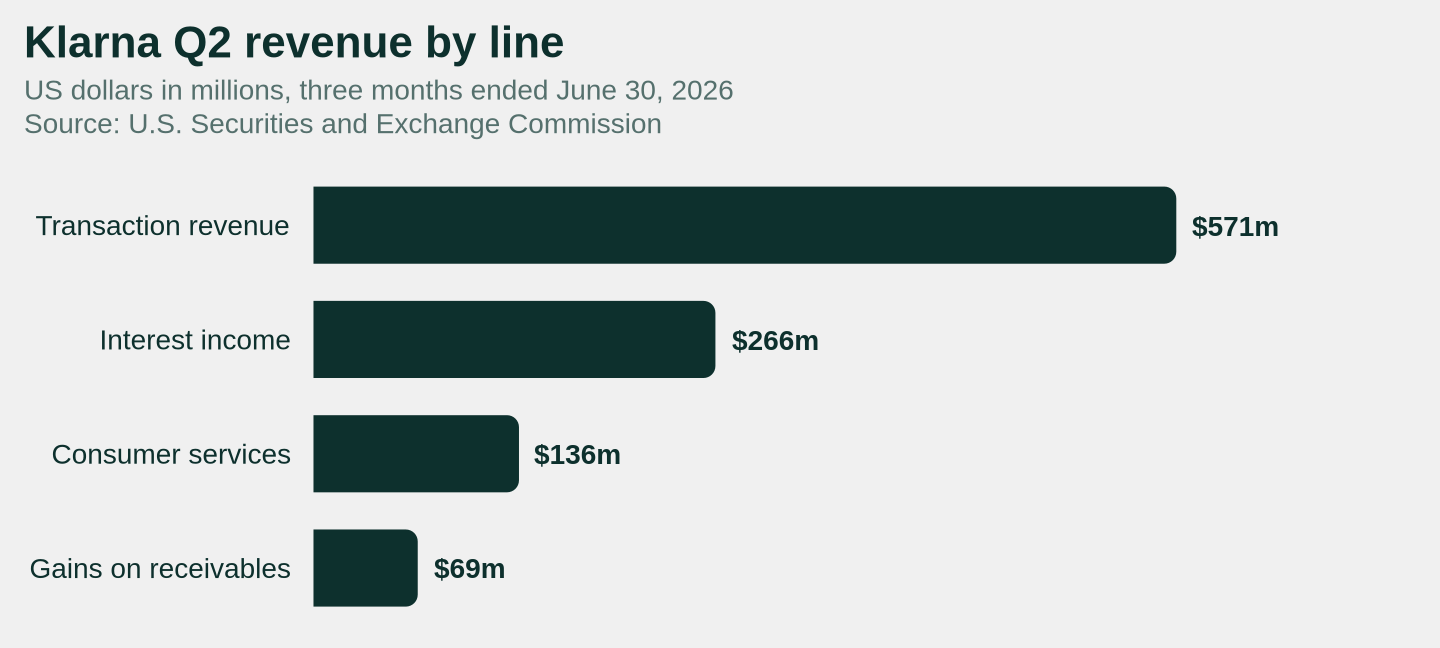
Four revenue lines made up Q2 2026 revenue. In the three months to June 30, 2026, Klarna reported $571 million in transaction revenue, $136 million in consumer service revenue, $266 million in interest income and $69 million in gains on sales of consumer receivables, according to its SEC filing. Total revenue for that quarter was $1.042 billion, with operating profit of $27 million and net income of $9 million, reported on August 18, 2026.
Merchants. Transaction revenue is the shop side. For full-year 2025, transaction revenue of $2.103 billion included merchant fees, interchange and dispute-settlement fees, plus $190 million of advertising revenue. Klarna said card fees contributed to transaction and service revenue but did not report them as a separate line.
Consumers. Consumer service revenue was $397 million in 2025, including $261 million in reminder fees and $29 million in subscriptions. Interest income was $937 million in 2025: $617 million from Fair Financing, $161 million in "Snooze" fees, $25 million in incremental merchant fees for interest-free promotional loans and $134 million from debt securities.
Selling loans on. Klarna also reported $73 million of gains on sales of consumer receivables in 2025. In plain terms, it sells part of its loan book to other investors and books the gain.
How Klarna went public
Klarna filed its IPO registration statement publicly on March 14, 2025. It announced the launch of the offering on September 2, 2025, with an expected range of $35 to $37 per share, then set the final price at $40. That was above the range and $4 above its midpoint.
The base offering covered 34,311,274 shares at $40: 5,000,000 sold by Klarna itself and 29,311,274 by existing shareholders, implying $1,372,450,960 in gross proceeds before any over-allotment, according to the final prospectus. Klarna's own share of that was small: the prospectus estimated roughly $169 million in net proceeds to the company after underwriting discounts and expenses. The underwriters exercised the full option for 5,146,691 extra shares on September 22, 2025, taking total shares sold to 39,457,965 and total gross deal proceeds to about $1.578 billion.
An IPO is simply the moment a private company's shares become buyable by anyone. After the first trading day, the price is set by buyers and sellers, not by the company. Trading started on the NYSE on September 10, 2025.
Share price, market cap and valuation
At $40 per share, the 377,255,045 ordinary shares outstanding after the base offering implied an ordinary-equity value of about $15.09 billion. The prospectus says Class B shares have no effective economic rights.
The picture in November 2026 is different.
| Figure | Value (Nov 2026) |
|---|---|
| Closing share price, November 5, 2026 | $13.54, down $0.35 (2.52%) |
| Market capitalisation at that close | $5.13 billion |
| Ordinary shares outstanding | 379.16 million |
| Price-to-sales ratio | 1.25 |
Three words worth separating. The share price is what one share costs. Market capitalisation is the total value of all shares. Price-to-sales compares that market value with revenue, and it only means something next to similar companies. Klarna's own filing reports 379,160,066 ordinary shares and 187,794,148 Class B shares outstanding as of June 30, 2026.
What moves the share price
A few things show up again and again in Klarna's own filings and news. On October 29, 2026, Klarna said it began offering its payment options at Kohl’s online and in its US app.
- How many shoppers repay on time. Klarna recorded $378 million of provision for credit losses in the six months to June 30, 2026.
- Funding costs and interest rates, which Klarna lists among its macroeconomic risks.
- New rules on buy now, pay later. In the EU, the revised Consumer Credit Directive is due to apply from November 20, 2026, extending consumer-credit protections to products that include BNPL. In the United States, the CFPB withdrew its 2024 BNPL interpretive rule on May 12, 2025. A federal BNPL bill, H.R. 9275, was referred to the House Financial Services Committee on June 11, 2026, and is still listed as introduced, not enacted.
- Distribution deals. On October 19, 2026, Klarna announced an expansion of its Fiserv partnership, saying it was already live at 100,000 US merchant locations through Clover, with availability through Fiserv's Commerce Hub announced as a forthcoming rollout.
- New products. Klarna launched Consumer FX on October 21, 2026, letting customers pay participating merchants in their own currency without an exchange fee, live across all its markets and currencies.
- Results days. Klarna announced on October 22, 2026 that it plans to publish Q3 2026 earnings before the market opens on November 17.
Risks
- Credit risk. Klarna's 2025 annual report names losses from consumers or counterparties failing to meet obligations as a material risk of its lending business. At June 30, 2026, its $9.245 billion of gross consumer receivables carried a $414 million expected-credit-loss allowance.
- Funding and liquidity. Loan demand may rise unexpectedly, and insufficient or costly funding could constrain growth or Klarna's ability to meet obligations.
- Regulation. Klarna flags complex and evolving regulation, and EU rules covering BNPL are due to apply from November 20, 2026.
- Competition from banks, card providers, payment networks and fintech platforms.
- Operational and technology risk: service disruption, cyberattacks, system failures, data leakage, supplier dependencies and human error.
This article is for information only and is not investment advice.
Frequently asked questions
Is Klarna listed on Nasdaq?
No. Klarna Group plc trades on the New York Stock Exchange, not Nasdaq, under the ticker KLAR since September 10, 2025. A quote page showing a Nasdaq listing is showing the wrong company.
How does Klarna handle loans that are not repaid?
Klarna sorts loans into risk stages. Stage 1 uses an allowance for losses expected over the next 12 months. Loans more than 30 days overdue move to Stage 2, which uses losses expected over the loan's lifetime. Loans 90 days past due or classified as fraudulent sit in Stage 3. Receivables are generally written off when balances are 180 days past due.
How can someone in Europe buy US-listed shares?
You need a broker or investment app with access to US-listed shares. KLAR is quoted in US dollars, so a euro or krona buyer also carries a currency effect, plus dealing fees and conversion costs. Tax treatment differs by country. For the general process, see our guide to buying US shares from Europe.
What is Klarna shipping beyond payments?
On November 5, 2026, Klarna said its in-app Call Status Detection feature had rolled out globally, enabled by default for iOS users across its 26 markets, while Android users must switch it on in settings. It is an in-app feature.

Sources
- Klarna: Pay in 4 (checked November 2026)
- U.S. Securities and Exchange Commission: Klarna Group plc Q2 2026 results (18 August 2026)
- U.S. Securities and Exchange Commission: Klarna Group plc final prospectus (9 September 2025)
- Klarna: Klarna and Kohl’s team up to bring flexible payment options to U.S. shoppers (29 October 2026)
- BaFin: Consumer credit and consumer financing (2026)
- Stock Analysis: Klarna Group plc statistics (5 November 2026)
- U.S. Securities and Exchange Commission: Klarna Group plc annual report 2025
Cover photo by Towfiqu barbhuiya on Unsplash.

You might also like
Deepen your knowledge with more articles and inspiration.