AMD stock is a share in Advanced Micro Devices, a chip designer. Its shares trade on Nasdaq, a US stock exchange, under the code AMD. Owning one share means owning a small piece of the company, and the price moves with what buyers expect next, not only with what AMD sells today. Here's what it makes, where the money comes from and what can go wrong.
Key takeaways
- AMD is a US chip designer whose shares trade on Nasdaq under AMD.
- Data Center was AMD's largest revenue segment in Q3 2026.
- AMD relies on TSMC for important chip supply, which adds risk.
What AMD stock actually is
A share is a slice of ownership in a company, priced all day by buyers and sellers. AMD's stock symbol is AMD and it trades on the Nasdaq Stock Exchange. Its latest official closing price was $488.78 on November 4, 2026.
At that close, the market valued the whole company at $801.64 billion. That figure is the market capitalisation, the value the market puts on all the listed shares together. It tells you how big the company is in the market's eyes. It does not tell you whether the share is cheap.
What AMD sells, in plain words
AMD designs chips and sells them to PC makers, cloud operators, console makers and industrial customers. Its annual report names Ryzen client processors, EPYC server processors, Instinct AI chips, Radeon graphics and semi-custom chips built for one customer.

| Product family | What it is | Typical buyer |
|---|---|---|
| Ryzen | Processors for laptops and desktops. A CPU runs a computer's general instructions, its software and operating system | PC makers and consumers |
| EPYC | Processors for servers | Cloud providers and large companies |
| Instinct | AI accelerators. An accelerator is hardware that speeds up AI work such as machine-learning training and generative AI | Data centre and cloud operators |
| Radeon | Graphics cards built on GPUs. A GPU uses many cores to handle tasks in parallel, for graphics, video and AI | Gamers and workstation buyers |
| Embedded and semi-custom | Chips built into other companies' products | Console, industrial and equipment makers |
How AMD makes its money
AMD reports three segments: Data Center, Client and Gaming, and Embedded. In the quarter ended September 26, 2026, Data Center brought in $8,546 million, Client and Gaming $3,722 million and Embedded $1,109 million. Total revenue for that quarter was $13.377 billion, with GAAP net income of $2.428 billion. On November 3, 2026, CNBC reported that CEO Lisa Su expected server revenue to double year over year in 2027, with data-centre AI growth accelerating faster than previously projected.
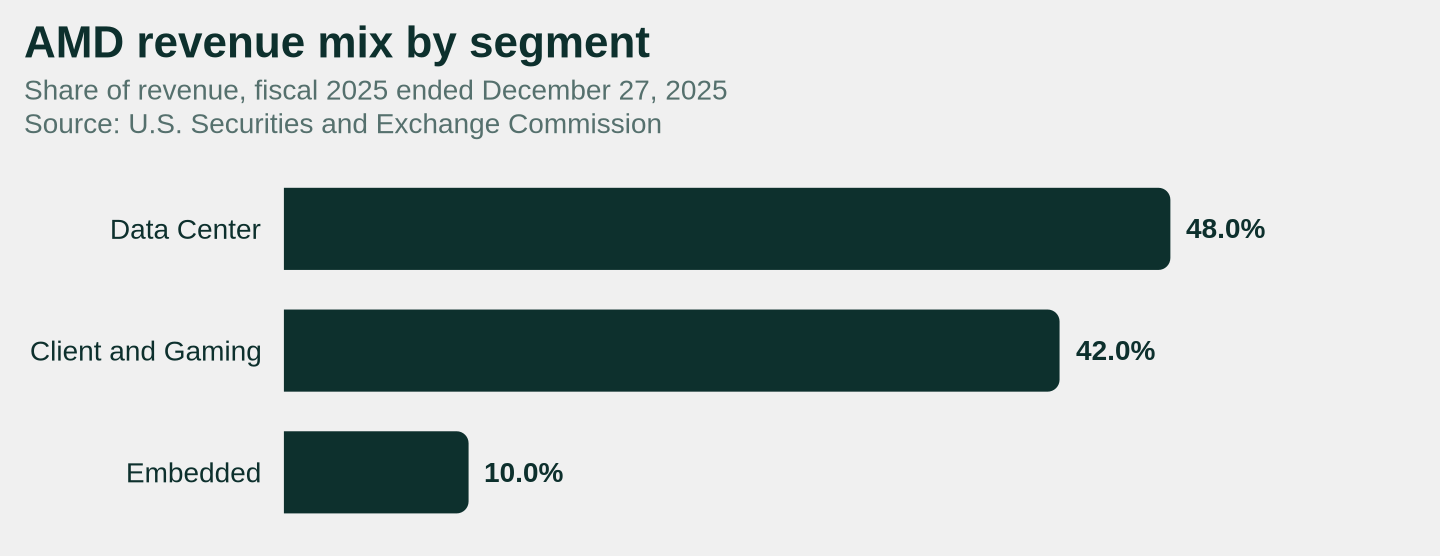

The mix has shifted. For fiscal 2025, ended December 27, 2025, Data Center was 48.0% of revenue, Client and Gaming 42.0% and Embedded 10.0%.
AMD's November 2026 earnings write-up covered the same results.
One detail matters more than most: AMD does not own the factories. Its annual report states that other companies make silicon wafers, the thin discs used to make chips, for all of its products. Nearly all assembly and final testing happens at third-party sites. The named wafer partners are TSMC, GLOBALFOUNDRIES, UMC and Samsung.
AMD against Nvidia and Intel
AMD competes in several areas, and its position differs in each.
In AI accelerators, AMD sells Instinct GPUs, Nvidia sells data-centre GPUs and Intel sells Gaudi accelerators. Market share is the portion of shipments held by a company. The available figures are third-party estimates. IDC data reviewed by Reuters estimated that in China in 2025, Nvidia held 55% of AI accelerator-card shipments and AMD 4%. Looking ahead, Bloomberg Intelligence projected Nvidia would hold 70% to 75% of the global AI accelerator market through 2030, and projected AMD would reach at least 10% by the end of the decade.
In CPUs, Mercury Research's Q2 2026 estimates put AMD at 30.3% of x86 desktop and laptop processor shipments against Intel's 69.7%, a measure that excludes Arm-based PC chips. In server CPUs the same report put AMD at 34.5% and Intel at 65.5%.
Software is part of the fight. CUDA and ROCm are software tools for programming graphics chips. A developer's existing tools and code can shape which chip gets bought. For the other side of this match-up, read our explainer on Nvidia stock.
What moves the share price
- Expectations about AI and data centre spending, since Data Center was the largest revenue segment in the quarter ended September 26, 2026.
- Big customer decisions. AMD's filing says large cloud providers and private data centres buy a substantial portion of its data-centre products.
- Partnership news. On October 27, 2026, AMD announced an expanded partnership with Meta: initial Helios rack-scale systems were installed and under testing, and AMD said it would invest $1 billion in Meta's equity offering, with broader deployment still prospective.
- Deals in progress. AMD's November 4, 2026 filing valued its pending Taalas acquisition at roughly $2.9 billion, including up to about $1.4 billion in contingent payments, and said its roughly $8.2 billion World Labs acquisition was still pending, both expected to close by the end of 2026 subject to approvals.
- The PC and gaming cycle, which rises and falls with consumer demand.

Risks
- Supply is concentrated. AMD's annual filing says it relies on TSMC for all wafers for microprocessor and GPU products at 7 nm or smaller.
- A small number of large cloud buyers can change demand quickly.
- Competition runs on two fronts at once, against Nvidia in AI accelerators and Intel in CPUs.
- Expectations are already high. Investors paid $488.78 a share on November 4, 2026, for a company valued at $801.64 billion, so growth that lands below hopes can still hurt the price.
- Currency adds a layer. The share is priced in dollars, so a euro or krona investor carries exchange-rate movement on top of the share's own moves.
This article is for information only and is not investment advice.
Frequently asked questions
Is AMD an AI company?
Partly. AI accelerators sit inside the Data Center segment, which recorded $8,546 million of revenue in the quarter ended September 26, 2026. But Client and Gaming added $3,722 million and Embedded $1,109 million in the same quarter, so PCs, consoles and industrial chips remain a real part of the business.
What is the difference between AMD and Nvidia?
Both design chips used for AI, and both sell graphics products: AMD sells Radeon, Nvidia sells GeForce and Intel sells Arc. The split shows in positioning. AMD's Ryzen and Intel's Core are consumer PC processor families, while Nvidia's cited product pages focus on data-centre CPUs and GPUs rather than a comparable desktop or laptop CPU line.
Who actually makes AMD's chips?
Outside companies make AMD's chips. Tongfu-affiliated joint ventures, Siliconware Precision Industries and King Yuan Electronics handle assembly, testing and packaging. Sanmina is AMD's preferred partner for complex AI systems.
What has AMD said about the current quarter?
On November 3, 2026, alongside Q3 revenue of $13.377 billion, AMD forecast fourth-quarter 2026 revenue of approximately $17 billion, plus or minus 3%. That is guidance from the company.
Can people in Europe buy AMD shares?
Yes, through investing platforms that give access to US-listed shares. Two practical points apply. The share is quoted in dollars, so your platform converts currency when you buy and sell, and any dividend or sale proceeds still need reporting under your own country's tax rules.

Sources
- AMD Investor Relations: Frequently Asked Questions
- Nasdaq: AMD stock quote
- Stock Analysis: AMD market cap
- AMD Investor Relations: Q3 2026 results filing (3 November 2026)
- U.S. Securities and Exchange Commission: AMD 2025 annual report
- Reuters: Chinese chipmakers claim nearly half of local market as Nvidia's lead shrinks (1 April 2026)
Cover photo by Vishnu Mohanan on Unsplash.

You might also like
Deepen your knowledge with more articles and inspiration.