Nvidia stock (NVDA on Nasdaq, a US stock exchange) is a share in Nvidia Corporation, the company that sells most of the chips and systems used to build AI data centres. The price reflects what investors expect the company to deliver next, not only what it has already earned. In its latest reported quarter, ended July 26, 2026, Nvidia made $96.221 billion in revenue. The shares last closed at $181.60 on November 5, 2026.
Key takeaways
- Data Center products were about 92.5% of Nvidia's revenue in the quarter ended July 2026.
- The share price reacts to the company's own forecast and its margins, not only to headline revenue.
- Nvidia's next results come on November 17, 2026, with gross margin guided lower at 74.0%.
What Nvidia stock is, in plain words
Buying NVDA means owning a small piece of Nvidia Corporation. The share trades on Nasdaq and is priced in US dollars. Its last reported closing price was $181.60 on November 5, 2026.

For a reader in the Nordics or the euro area, the dollar matters too. The price can rise in dollars while the gain is worth less in euros, kronor or kroner, depending on the exchange rate that day.
What Nvidia sells, and where the money comes from
Nvidia's main product is the GPU, a chip that runs many calculations at the same time. That is what training and running AI models needs. Nvidia also sells the networking gear, the servers and the software that tie thousands of those chips into one working system.

In the quarter ended July 26, 2026, Data Center revenue was $89.023 billion, up 117% year on year, according to the company's SEC filing. That was roughly 92.5% of the $96.221 billion of total revenue for the quarter. So when people talk about Nvidia, they are mostly talking about one business line.
Over a full year, the split looks similar. In its annual report for the year ended January 25, 2026, Nvidia listed two business segments. Compute & Networking had $193.479 billion in revenue. This was 89.6% of the $215.938 billion total. Graphics had $22.459 billion in revenue. This was 10.4% of the total.
The buyers are the companies building AI capacity. On October 27, 2026, Nvidia and Oracle announced that Nvidia Vera Rubin NVL72 systems and Vera CPUs were generally available on Oracle Cloud Infrastructure, while expansion of those clusters to multi-gigawatt scale remained planned. The same day, Nvidia and Meta announced an expanded collaboration on Muse, and Nvidia described a $3 billion investment in Meta's equity offering as proposed, not completed.
What moves the share price
Revenue growth is the starting point. Here is what Nvidia has reported in its recent quarters.
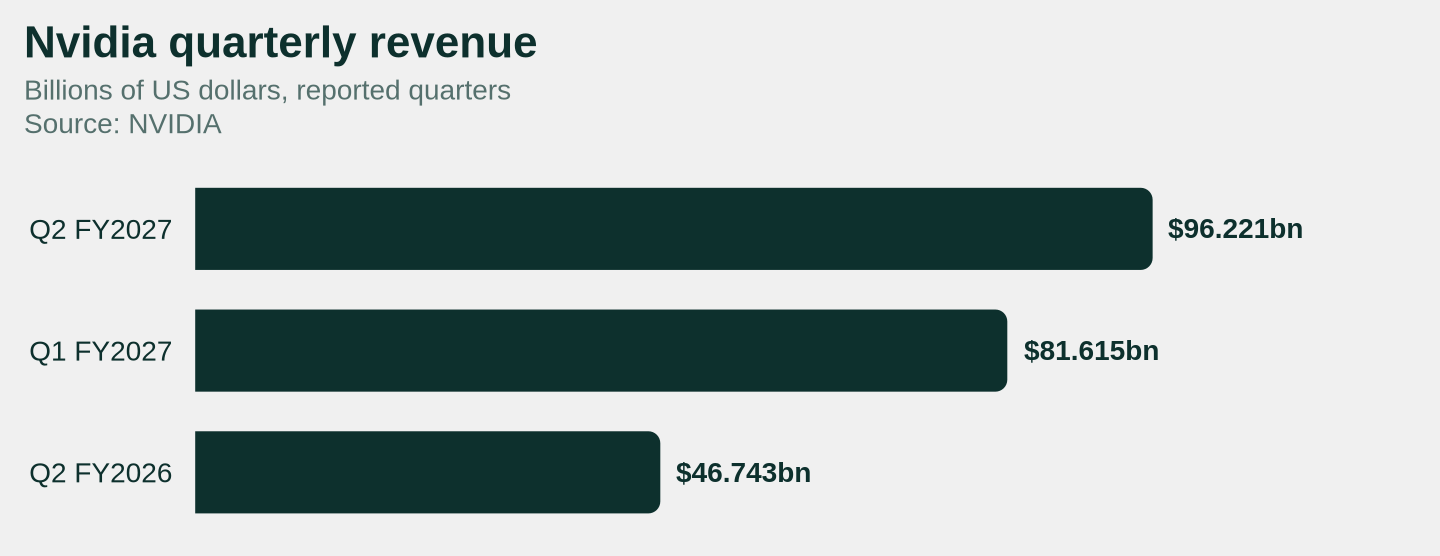
Guidance moves the price as much as the results do. Guidance is the company's own forecast for the coming quarter. For the third quarter of fiscal 2027, Nvidia guided to revenue of $108.0 billion, plus or minus 2%, assuming no Data Center compute revenue from China.
Then come margins. Gross margin is the share of revenue left after direct production costs. Nvidia reported a gross margin of 75.0% under GAAP, standard US accounting rules, in the quarter ended July 26, 2026. It reported diluted earnings per share of $2.46. This measure includes potential shares that could be issued. For the next quarter it guided to 74.0%, plus or minus half a percentage point. On the results call, CFO Colette Kress said unusually high memory prices were causing the lower margin forecast. She said margins were expected to reach their low point of 71%–72% in the fourth quarter of fiscal 2027. They were then expected to reach 72%–73% in fiscal 2028.
That gap between strong sales and a lower margin forecast is the thing to understand. A quarter can beat on revenue and the share can still fall, because the market had already priced in more.
Supply matters too. On October 21, 2026, Nvidia announced supply-chain expansion plans with its partners, including a target to increase substrate capacity 2.5 times over three years. Those are stated targets, not capacity that already exists. On October 28, 2026, Reuters reported that the US Department of Justice was examining the competitive impact of Nvidia's planned $12.93 billion acquisition of Hugging Face.
The next report: November 17, 2026
Nvidia's third quarter of fiscal 2027 ended October 25, and the company has scheduled the results for November 17, 2026 at 5:00 p.m. EST.
Three numbers already have a public benchmark. Revenue will be read against the $108.0 billion guided, gross margin against the 74.0% guided, and any Data Center compute revenue from China against a forecast that assumed none at all.
Risks
- Export rules. US licences are needed to send certain Nvidia products above set performance levels to China and Country Groups D:1, D:4 and D:5. These are US export-control destination lists. The filing names products including A100, H100, GB200 NVL72 and B200. Since April 2025, licences have been required for H20 chips and similar chips for China, Hong Kong, Macau and D:5 destinations. Nvidia said Chinese government restrictions had prevented it from selling its H20 inventory.
- China sales stay uncertain. The US Bureau of Industry and Security moved H200 and similar applications to case-by-case review, with conditions. This means each licence application is reviewed individually. Nvidia later reported that licensed H200 shipments to specific China-based customers remained limited and required US inspection. They faced a 25% tariff on US import.
- Customer concentration. In the year ended January 25, 2026, two direct customers represented 22% and 14% of total revenue, and Nvidia did not name them. Some indirect customers individually represented 10% or more of revenue.
- One business line carries the company. Data Center was about 92.5% of revenue in the quarter ended July 26, 2026, so a slowdown in AI data-centre spending would hit most of the business.
- Margin pressure. Nvidia's own forecast has gross margin falling to 74.0% next quarter, with the CFO pointing to high memory prices.

This article is for information only and is not investment advice.
Frequently asked questions
Does Nvidia pay a dividend?
Yes, a small one. Nvidia's latest dividend announcement listed a quarterly cash dividend of $0.25 per share, payable October 1, 2026, to holders of record on September 10, and as of November 6, 2026 no later payment date had been announced.
Has Nvidia split its stock?
Several times. A split increases the number of shares and lowers the price of each one, and changes nothing about the value of the company at that moment. Nvidia's first two splits were 2-for-1, distributed June 26, 2000 and September 17, 2001. A 2-for-1 split took effect April 6, 2006 and a 3-for-2 split on September 10, 2007. A 4-for-1 split began trading split-adjusted on July 20, 2021. A 10-for-1 split began trading split-adjusted on June 10, 2024.
Why are Nvidia's fiscal years ahead of the calendar?
Nvidia's financial year ends in late January, so its labels run ahead of the calendar. The year ended January 25, 2026 is fiscal 2026. The quarter ended July 26, 2026 is the second quarter of fiscal 2027. It's a common source of confusion when comparing headlines.
What is the difference between P/E and forward P/E?
The price-to-earnings ratio compares today's share price with earnings the company has already reported. Forward P/E compares the same price with the earnings analysts expect over the coming year. A low forward P/E only stays low if the forecast behind it holds.

Sources
- U.S. SEC: NVIDIA Form 10-Q for quarter ended July 26, 2026
- U.S. SEC: NVIDIA annual report for year ended January 25, 2026
- NVIDIA: Financial results for second quarter fiscal 2027 (August 26, 2026)
- NVIDIA Investor Relations: Third quarter FY27 financial results event (November 17, 2026)
- Reuters: US DOJ is inquiring about Nvidia's purchase of Hugging Face, sources say (October 28, 2026)
- U.S. Bureau of Industry and Security: Department of Commerce revises license review policy for semiconductors exported to China
Cover photo by BoliviaInteligente on Unsplash.

You might also like
Deepen your knowledge with more articles and inspiration.