On 4 November 2026, the day after the US midterm elections, the Dow Jones Industrial Average rose 3.03% to 53,356.12 and the S&P 500 rose 1.58% to 7,688.62. The rally was uneven: oil fell about 8% and chip and AI-infrastructure shares dropped. One day later, the gains were gone.
Key takeaways
- US stocks jumped on 4 November 2026, with the Dow up 3.03% to 53,356.12.
- The rise was uneven: oil fell about 8% and semiconductor shares fell 3.1%.
- A single session proves nothing: the Dow fell 3.44% the next day.
What happened to US stocks on 4 November 2026
The midterm election was held on 3 November 2026. The next day, US stocks rose sharply. CNBC reported that the Dow gained 1,569.40 points, or 3.03%, to close at 53,356.12, its best day since 9 April 2025. The S&P 500 closed up 1.58% at 7,688.62 and the Nasdaq Composite rose 1.44% to 25,736.51.

| Market or asset | Move on 4 Nov 2026 |
|---|---|
| Dow Jones Industrial Average | +3.03%, close 53,356.12 |
| S&P 500 | +1.58%, close 7,688.62 |
| Nasdaq Composite | +1.44%, close 25,736.51 |
| Brent crude (settlement) | −8.7%, $94.62 a barrel |
| US WTI crude (settlement) | −8.3%, $88.12 a barrel |
| Philadelphia Semiconductor Index | −3.1% |
Nine of the eleven S&P 500 sectors rose that day. Consumer discretionary had the strongest return at +4.3%, followed by financials at +3.5% and real estate at +3.2%. Two sectors fell: industrials at −1.1% and energy at −4.8%.
If you want the basics of this index first, read our guide on how to invest in the S&P 500.
Why stocks rose that day
The main reason reported was simple: the result was known. NPR reported that Democrats had won control of both the House and the Senate, giving the party full control of Congress and creating divided government with President Trump.

The Charlotte Observer reported that strategists linked the rally to the election result resolving uncertainty and encouraging investors to take more risk, with Terry Sandven of U.S. Bank Wealth Management saying the resulting gridlock can favour equities. CNBC reported that President Trump's acceptance of the results helped reduce fears of a long election dispute, and Thomas Hempell of Generali Investments said his conciliatory response helped avert further contestation.
The vote was not the only thing moving prices. McDonald's reported third-quarter adjusted earnings per share of $3.57 and revenue of $7.157 billion. Markets were pricing an 81.2% chance of a December increase of at least 25 basis points, according to CME FedWatch, up from 77.4% the previous session. A basis point is one hundredth of a percentage point.
Why the Dow rose more than the S&P 500
The Dow tracks 30 large US companies. The S&P 500 is much broader and holds a far larger group. The two indexes give companies different importance, so the same day can give very different percentage moves.
That gap showed up clearly on 4 November. Information technology rose only 0.5% that day, while consumer discretionary rose 4.3% and financials 3.5%.
For more on how a small group of very large technology companies dominates US indexes, see our piece on the Magnificent 7 stocks.
Why chip and AI-infrastructure stocks fell
AI infrastructure means the physical equipment needed to train and run AI models. It includes chips, servers, data centres, networking gear, power and cooling. It is not the same group as AI software companies.
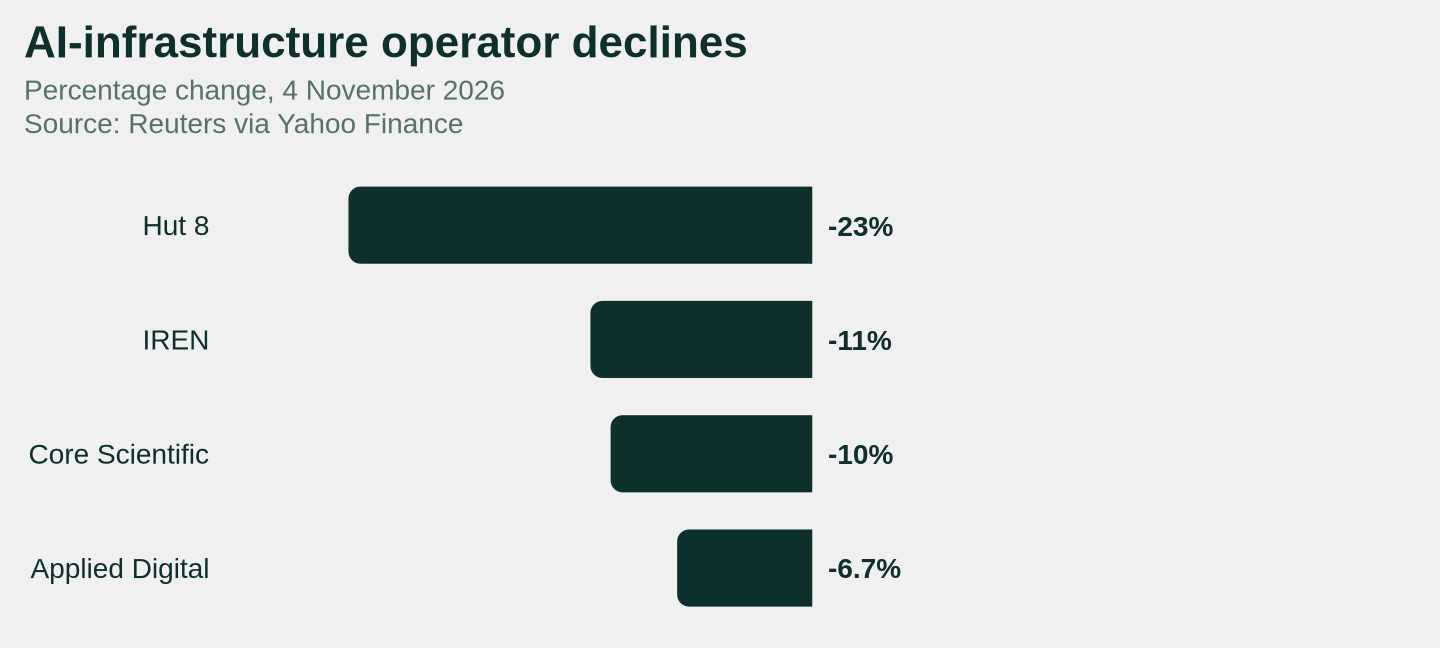
That group had a bad day. The Philadelphia Semiconductor Index fell 3.1% to a six-month low. Nvidia fell 3%, Intel 4%, Marvell and Micron 7% each and Sandisk 8%, as investors questioned whether election-driven data-centre restrictions could slow the AI buildout, Morningstar reported. Data-centre operators fell harder: Hut 8 dropped 23%, IREN 11%, Core Scientific 10% and Applied Digital 6.7%. On 2 November 2026, Reuters reported that Marvell agreed to buy Lumentum in an all-stock deal with an implied enterprise value of $115 billion.
According to the report, investors were reassessing AI-infrastructure investments after Democratic gains in key data-centre states raised fears of tighter regulation, with smaller expansion companies seen as more vulnerable to a slowdown. Morningstar said investors were reassessing what they would pay for these shares, and analysts said tougher permitting, power or water restrictions could make future data-centre projects more costly without undoing construction already funded.
The move was selective, not a retreat from everything AI. According to the report, cash-rich AI leaders gained because slower infrastructure growth could ease their cash demands, while suppliers and operators that depend on rapid expansion fell.
Why oil fell about 8%
Both benchmarks dropped hard. Brent, the international benchmark, settled down 8.7% at $94.62 a barrel, and US WTI settled down 8.3% at $88.12. These are futures settlement prices. They are prices set at the end of trading for contracts to buy or sell oil later.
Yahoo Finance attributed the selloff mainly to election-related bets that a Democratic Congress would constrain Trump's military options and make a negotiated end to the Iran war more likely, which could restore Gulf oil flows. Supply and demand also weighed on the price. JPMorgan said that recovering Middle Eastern exports and weaker demand had pushed the market into surplus, estimated at 1.1 million barrels a day in September and 1.4 million in October.
One figure pointed the other way. EIA data showed US crude stocks fell by 865,000 barrels to 409.8 million barrels in the week ended 30 October, below the five-year average, a price-supportive factor rather than a reason for the fall.
Cheaper oil helped shares. CNBC reported that falling oil prices boosted stocks, as investors anticipated pressure to end the Iran war and ease inflation pressure.
What one session tells you, and what it does not
Not much, as the next day showed. On 5 November 2026, the Dow closed at 51,523.06, down 3.44%, and the S&P 500 closed at 7,353.73, down 4.36%, erasing the previous session's gains in these indexes.

Some of what investors were betting on that Wednesday was not settled fact. Incoming governor Gina Hinojosa promised a temporary pause on Texas data-centre projects, and an end to the Iran war was speculation rather than a confirmed deal. NPR also reported that Trump's veto power and the need for bipartisan support on must-pass measures meant swift policy changes were uncertain.
Two days, two directions. That is what a short-term market reaction looks like.
Risks
- Index levels move fast: the Dow gave back its 3.03% gain and more within one session.
- Reasons given on the day were partly bets on events that had not happened, such as an end to the Iran war.
- Shares tied to AI data centres fell, with Hut 8 down 23% in a single day.
- Oil prices depend on supply and geopolitics, and JPMorgan said the market was already in surplus in October.
- Past performance does not predict future results, and the value of investments can fall as well as rise.

This article is for information only and is not investment advice.
Frequently asked questions
Do stocks always rise after midterm elections?
No. The 2026 session shows why: the Dow rose 3.03% on 4 November 2026 and fell 3.44% the next day. Election results are one input among many, alongside company earnings, interest-rate expectations and commodity prices.
Why did AI and chip shares fall while the market rose?
Because a broad index can rise on gains elsewhere. On 4 November 2026, nine S&P 500 sectors rose, led by consumer discretionary at +4.3%, while the Philadelphia Semiconductor Index fell 3.1%. According to the report, cash-rich AI leaders gained while suppliers and operators dependent on fast expansion fell.
Does divided government help the stock market?
Investors assess what becomes easier or harder to pass. On 4 November 2026, Terry Sandven of U.S. Bank Wealth Management said the resulting gridlock can favour equities. That is one strategist's view on one day, not a rule about political arrangements.
Did any chipmaker report results that week?
Yes. GlobalFoundries released preliminary third-quarter 2026 results on 4 November, reporting $1.899 billion in revenue and a GAAP net loss of $270 million for the quarter ended 30 September. GAAP is a set of standard US accounting rules. Its quarterly net revenue was $1,634 million in Q1 2026, $1,786 million in Q2 and $1,899 million in Q3.
Should people in Europe follow US midterms?
US rates, earnings and investor sentiment feed into global funds and into technology shares everywhere. The 4 November 2026 session moved oil benchmarks used worldwide, with Brent settling down 8.7% at $94.62 a barrel. It is context, not a reason to change anything.

Sources
- CNBC: Stock market today: Live updates (4 November 2026)
- NPR: 2026 midterms: Congress balance of power (4 November 2026)
- Charlotte Observer: Strategists on the market reaction to the midterms (4 November 2026)
- Morningstar: Micron and other chip stocks slip as election results hit data-centre optimism (4 November 2026)
- Reuters: Marvell to buy Lumentum in $115 billion AI data-centre deal (2 November 2026)
- Reuters: JPMorgan says exports and weak demand push oil market into surplus (4 November 2026)
- Federal Reserve Bank of St. Louis: Dow Jones Industrial Average
Cover photo by Roberto Júnior on Unsplash.

You might also like
Deepen your knowledge with more articles and inspiration.