Intel stock is a share in Intel Corporation, a US chip company listed on the Nasdaq under the ticker INTC. Buying one makes you a part-owner of a business that both designs chips and manufactures them. Intel shares closed at $54.47 on November 25, 2026, giving the company a market value of $289.51 billion at that close.
The share has moved hard this year. On October 30, 2026, Intel shares fell 28.58% to close at $65.76 after a below-expectation fourth-quarter outlook and a warning about a prolonged slowdown in PC sales. That one day explains why understanding the business matters more than watching the price.
Key takeaways
- Intel designs chips and manufactures them, and its shares closed at $54.47 on November 25, 2026.
- Quarterly results, company forecasts and factory progress can move the share price.
- Intel's dividend has been suspended since the fourth quarter of 2024, so it pays no common-stock dividend.
What Intel actually sells
Intel reports its revenue in a few blocks. For the quarter ended September 26, 2026, it reported segment revenue of $8.10 billion for Client Computing and Physical AI, $7.32 billion for Data Center and AI, $6.70 billion for Intel Foundry and $692 million for All Other. Those segment numbers include sales between Intel's own units. Total revenue was $16.5 billion after $6.29 billion of eliminations, and Foundry revenue was substantially internal.
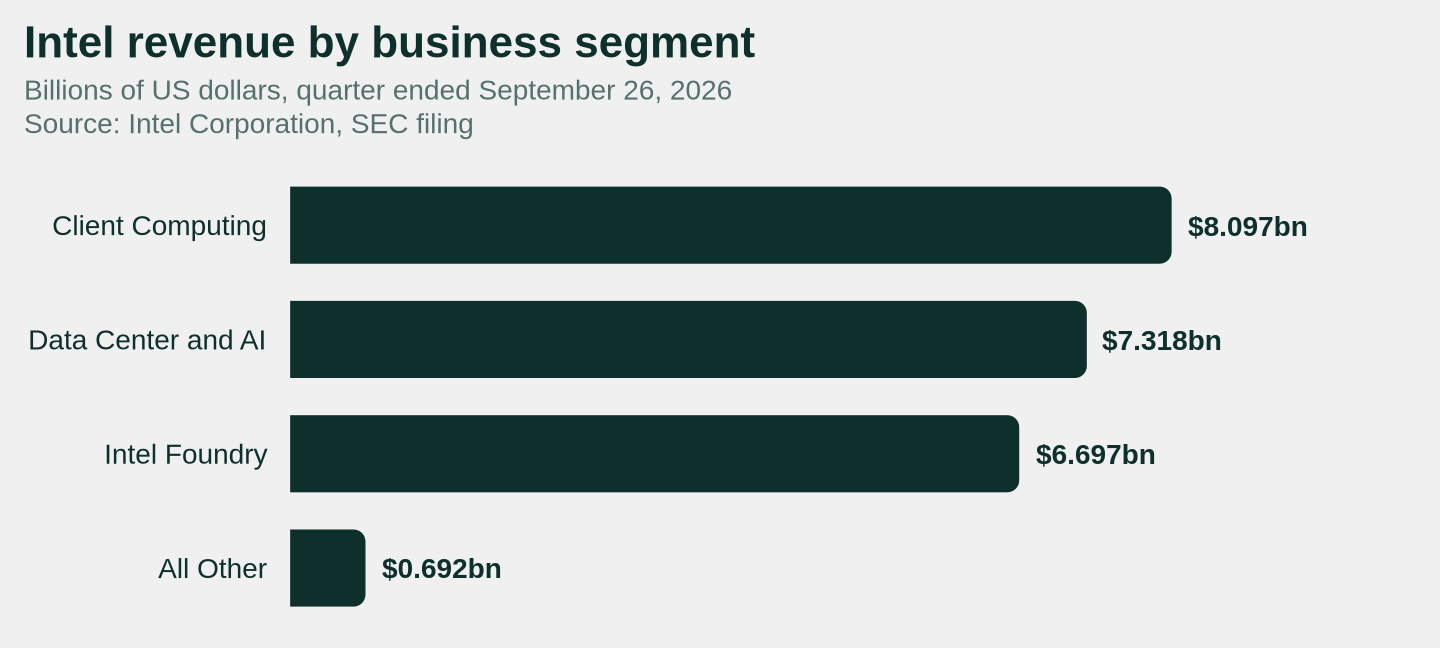
Client Computing covers the processors in laptops and desktops. Data Center and AI covers chips for servers and cloud computing. The two behave differently: PC demand follows consumers and company refresh cycles, server demand follows corporate and cloud budgets.
Intel Foundry, in plain words
A foundry manufactures chips for companies that design and sell them. A fabless designer outsources all manufacturing. An integrated device manufacturer designs and makes its own chips. Intel sits in an unusual spot: Intel Foundry provides manufacturing, testing and assembly for Intel's own product groups and for outside customers.
The name you'll see most is Intel 18A. It's a process-generation name, not a measurement of anything on the chip. In practice it's Intel's manufacturing recipe, combining a new transistor design with a new way of delivering power from the back of the chip. Intel said its first 18A products entered high-volume production in early 2026.
Two things happened on November 18, 2026. Intel CEO Lip-Bu Tan said the company had signed its first outside customer for 18A, and CNBC reported the announcement without the customer being named. Separately, Microsoft and Intel announced an expanded long-term Azure collaboration: Microsoft said it would use Intel Foundry EMIB packaging for Azure first-party silicon, and the agreement confirms multi-year Xeon supply capacity. Microsoft was identified as the first company to announce use of that packaging, not as the unnamed 18A-P customer.
Why the share price moves so much
Intel's price can react to five factors highlighted by recent disclosures.
- Results against expectations. In Q3 2026, revenue was $16.5 billion, up 21% year over year, with GAAP gross margin of 43.0%, while diluted GAAP earnings per share fell 33% to $0.60.
- Guidance for the next quarter. On October 29, 2026, Intel projected Q4 revenue of $15.0–$16.0 billion, gross margin of 37.1% and diluted GAAP EPS of $0.10.
- Cash against factory spending. Q3 2026 operating cash flow was $5.08 billion, gross capital expenditure was $4.22 billion, and company-defined adjusted free cash flow was $1.64 billion.
- Manufacturing milestones, like the 18A customer news.
- Demand mix. Intel reported strong data-center demand but expected PC-market weakness through at least the first half of 2027.
The swings are real. On April 24, 2026, Intel closed at $82.54, up about 23.6% from the previous close, after stronger-than-expected revenue guidance and reported CPU demand. The 12-month trading range was $34.68 to $142.35 as of the November 25, 2026 quote. A share price reflects what investors expect next, not what the company earned last year.
Who Intel competes with
Intel doesn't face the same rival in every market. It competes with chip designers on products and with other factories on manufacturing.
| Company | What it does | Where it meets Intel |
|---|---|---|
| AMD | Designs chips, relies mainly on third-party fabrication | PC and server processors |
| NVIDIA | Designs chips, relies mainly on third-party fabrication | Data-center GPU systems and AI accelerators |
| Qualcomm | Designs chips, relies mainly on third-party fabrication | Processor markets |
| Arm | Licenses processor designs to other chip makers | Processor markets, through Arm-based suppliers |
| TSMC | Pure-play manufacturer | Leading-edge foundry work |
| Samsung Foundry | Designs chips and manufactures for customers | Leading-edge foundry work |
That map comes from Intel's own annual filing. For a comparison with the pure manufacturer in that list, see our explainer on TSMC stock.
The numbers that matter, and the dividend
For a company building factories, cash flow and valuation ratios are relevant. Intel's trailing price-to-earnings ratio, which compares the share price to past profit, was shown as unavailable on November 26, 2026, because the company had a trailing net loss. So no positive trailing P/E was available.
Four figures describe Intel's finances. Gross margin, the revenue left after production costs, was 43.0% for the quarter ended September 26, 2026. It was 41.0% for the first nine months of 2026. Gross capital expenditure, spending on factories and equipment, was $4.22 billion in Q3 2026. Company-defined adjusted free cash flow was $1.64 billion. Segment revenue shows where demand sits. As of September 26, 2026, total debt was $50.1 billion. It included $3.82 billion of short-term debt and $46.3 billion of long-term debt.
On the dividend: there isn't one. Intel's common-stock dividend remains suspended as of November 26, 2026, with the suspension having begun in the fourth quarter of 2024. The last declared payment was $0.125 per share, payable September 1, 2024. Intel had not announced a reinstatement as of November 26, 2026. If you want income from shares, our guide to dividend stocks explains how payouts work.
Risks
- Competition on two fronts at once: product rivals and rival factories.
- Factory plans. Intel said Intel 14A development and manufacturing expansion could face substantial problems and may not earn enough to justify their cost. Future scale depends on committed demand and design wins.
- Supply and demand. Intel's 10-Q filed October 30, 2026 said shortages of materials and parts limited product availability. Intel expected the shortages to persist into 2027. High memory prices weakened demand for client products that are sensitive to price.
- Disruption and geopolitics. Intel said an accident at its Kiryat Gat facility in Israel in mid-October halted manufacturing for about two weeks. It could impair costs and results through the first half of 2027. Israeli reporting said operations were resuming on November 1, 2026. The filing also flagged conflict-related disruption and a reported global helium shortage. Intel also disclosed post-quarter material-supply agreements with estimated funding needs of $5.3–$6.1 billion. Some terms were not yet finalised.
- Legal. Reuters reported on November 15, 2026 that shareholders had filed a proposed class action alleging Intel concealed the impact of slowing PC sales and excess inventory. Those are allegations, not a court finding.
This article is for information only and is not investment advice.
Frequently asked questions
What is Intel's ticker symbol? INTC, on the Nasdaq. A ticker is the short code that identifies a listed company's shares. Intel shares are priced in US dollars, so for anyone holding euros or Nordic kronor, the exchange rate affects what a move in the share is worth back home.
Why did Intel stock fall so sharply in October 2026? Shares fell 28.58% on October 30, 2026 to close at $65.76 after a below-expectation fourth-quarter outlook and a warning of a prolonged PC-sales slowdown. The company's guidance that day pointed to Q4 revenue of $15.0–$16.0 billion and diluted GAAP EPS of $0.10.
Does Intel still make money? Yes, in its latest reported quarter. GAAP net income attributable to Intel was $3.32 billion for the quarter ended September 26, 2026, on revenue of $16.5 billion. But the trailing twelve-month picture included a net loss, which is why no trailing price-to-earnings ratio was available on November 26, 2026.
What is 18A-P? It's the version of Intel's 18A manufacturing process that the first unnamed outside foundry customer signed for, according to Intel technology chief Pushkar Ranade.
Can people in Europe buy Intel shares? Most European brokers give access to US-listed shares. Costs, currency conversion and tax reporting differ by provider and by country, so the same share can cost you a different amount depending on where you hold it.

Sources
- Yahoo Finance: Intel Corporation (INTC) stock quote
- SEC: Intel Corporation Form 10-Q for quarter ended September 26, 2026
- CNBC: Intel says it has landed first external customer for 18A chip technology (November 18, 2026)
- SEC: Intel Corporation annual report for 2025
- Intel: Intel reports third-quarter 2026 financial results (October 29, 2026)
- Intel: Intel and Microsoft expand collaboration for Azure infrastructure (November 18, 2026)
- Reuters: Intel sued by shareholders following stock plunge (November 15, 2026)
Cover photo by Christian Wiediger on Unsplash.

You might also like
Deepen your knowledge with more articles and inspiration.