TSMC stock usually means TSM, a security listed in New York for Taiwan Semiconductor Manufacturing Company. Each American depositary share represents five TSMC common shares. TSMC doesn't sell phones or laptops. It manufactures chips that other companies design, so its share price follows their orders, its own forecasts and the mood of the wider tech market.
Key takeaways
- TSM is the New York-listed security of Taiwan Semiconductor, with each share covering five common shares.
- TSMC manufactures chips for other firms, so its results follow customer orders for advanced chips.
- Watch guidance and heavy factory spending: a strong quarter can still be followed by a fall.
What TSM is on the New York Stock Exchange
TSMC is the company. TSM is the ticker you see in a broker app. Behind that ticker sits an American depositary share, a US-traded security that represents shares of a foreign company held by a bank. According to the deposit agreement filed with the SEC, each TSM depositary share represents five TSMC common shares.
That structure matters in one practical way. The security trades in US dollars. If your account is in euros, Swedish kronor or Danish kroner, the dollar's moves change what your holding is worth in your own money, on top of whatever the share itself does.
What TSMC does: it makes chips other people design
TSMC makes chips for companies that design them. A phone maker or an AI chip designer designs a chip, and TSMC makes it. The finished chip can end up in a laptop, a car or a data centre server. TSMC's revenue therefore depends on how much its customers order.

You can see where that demand sits. In the third quarter of 2026, high-performance computing covered AI and data-centre chips. It made up 68% of net revenue, TSMC's management report shows. Smartphones were 21%. Internet of things and automotive were 4% each. Digital consumer electronics were 1%, and other was 2%.
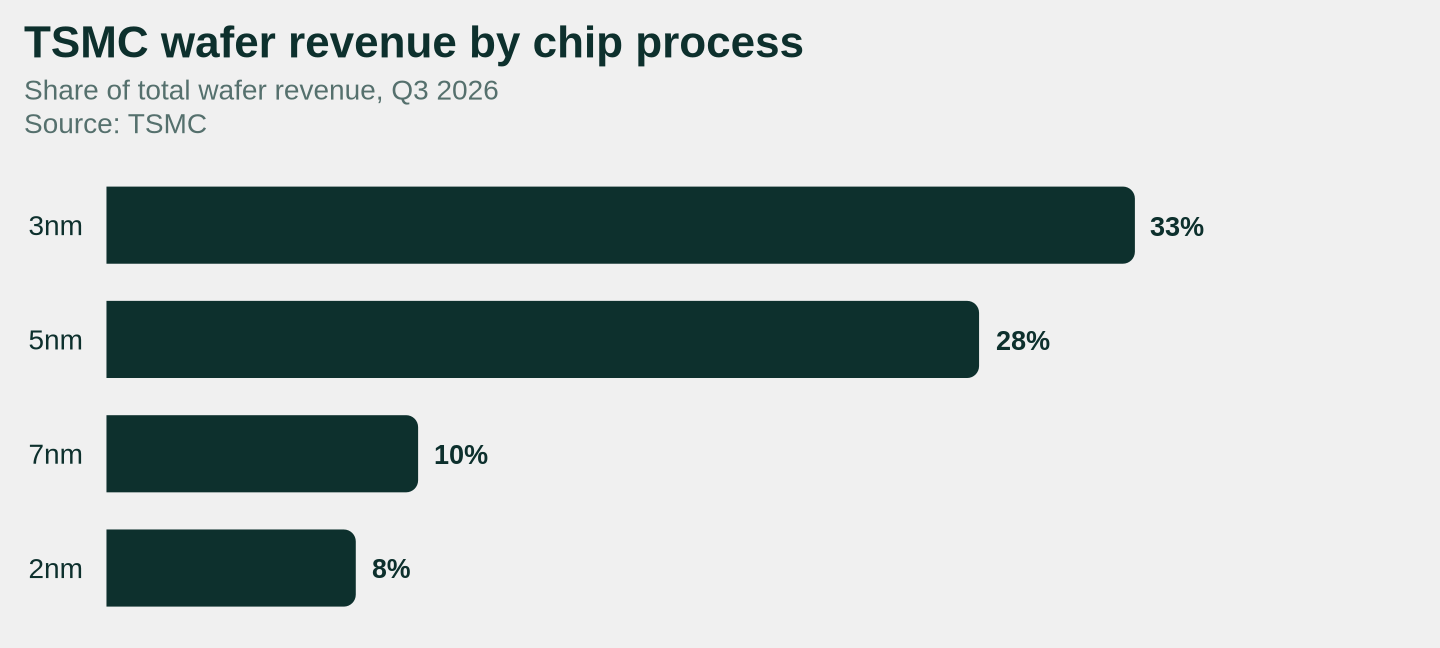
The other number people watch is the manufacturing generation, measured in nanometres. Smaller means newer. In the same quarter, 3-nanometre chips were 33% of wafer revenue, 5-nanometre 28%, 7-nanometre 10% and 2-nanometre 8%.
The latest numbers: results, monthly sales and spending plans
For the quarter ended September 30, 2026, TSMC reported consolidated revenue of NT$1.49 trillion and net income of NT$763 billion, in results released on October 15, 2026.

TSMC also publishes sales every month, which is unusual and gives a faster read than most large companies. On November 10, 2026, it reported October revenue of about NT$587 billion, up 59.7% on October 2025, with January to October revenue of NT$4.49 trillion, up 43.3%. That update is a sales figure, not a profit report.
Guidance comes with each quarterly release. For the fourth quarter of 2026, TSMC forecast revenue of US$52.3–54.3 billion. Gross margin is the revenue left after direct manufacturing costs. It forecast a gross margin of 65%–67% and an operating margin of 56.5%–58.5%. It said demand for leading-edge technologies, including its 2-nanometre ramp, was expected to stay strong.
Building those factories costs a lot. On the October 15, 2026 earnings call, TSMC repeated full-year 2026 capital spending guidance of US$60–64 billion and said investment in 2026 to 2028 was expected to be significantly higher than in the previous three years. On November 10, 2026, its board approved about US$40.9 billion in capital appropriations for capacity, fab construction, and 2027 research and other capital needs. That is an approved budget for planned investment, not money already spent.
The same board meeting approved investments capped at US$500 million each in Anthropic common shares at its listing price and in OpenAI preferred stock. Both were authorisations to invest, with no completion date given. For the expected price of those Anthropic shares, see our explainer on Anthropic's IPO range.
What moves the share price
Five things come up again and again: quarterly results, the guidance that comes with them, demand for advanced chips, the spending plans, and currency.
What matters is how results compare with what investors expected. A share can fall after strong reported earnings if investors already expected those numbers. It can also fall if the outlook, margins, demand or planned spending disappoint, as JPMorgan Chase explains, because investors reassess future earnings rather than simply rewarding the past quarter.
Currency works quietly in the background. TSMC reports in NT dollars, and its own annual report estimates that a 1% depreciation of the US dollar against the NT dollar would lower its operating margin by about 0.3 percentage points, based on 2025 results.
How to read the numbers on a quote page
| Measure | Figure (Nov 2026) | What it tells you |
|---|---|---|
| Closing price | US$398.73 | What one depositary share cost at the close on November 13, 2026 |
| Market value | US$2.07 trillion | What the market says the whole company is worth |
| Trailing price-to-earnings | 25.86 | The price compared with the past year's profit per share |
| Trailing earnings per share | US$15.42 | The profit attached to each share over the past year |
| 52-week range | US$266.82–487.47 | Where the price has traded over the past year |
Those figures come from CNBC's quote page for TSM on November 13, 2026. None of them answers the only question that matters to a buyer, which is whether today's price is fair. A price-to-earnings ratio of 25.86 is a comparison, not a verdict.
Risks
- Chip demand rises and falls. TSMC's 2025 annual report lists market cyclicality, fluctuating customer orders, downturns and overcapacity among its risks, and says they can pressure revenue, margins and earnings.
- Factories and equipment need substantial capital, and the same report flags execution risks: forecasting capacity, managing global expansion, finishing projects on time and reaching expected quality and yield.
- The report also names geopolitical and trade tensions, tariffs, sanctions and export controls as risks that can raise costs, disrupt supply chains or limit customer sales.
- Currency can work against the reported numbers, as the 0.3 percentage point margin sensitivity above shows.
- A strong business is not automatically a well-priced share, and the market reacts to guidance as much as to results.
This article is for information only and is not investment advice.
Frequently asked questions
Does TSMC pay a dividend?
Yes. CNBC listed a dividend yield of 1.02% for TSM on November 13, 2026. A yield is simply the payment measured against the current price, so it moves whenever the price moves. Dividends are decided by the company and are not guaranteed. Holders of a US depositary share receive them in dollars through the depositary bank. Fees and tax deducted before payment can apply. On November 10, 2026, TSMC approved a quarterly cash dividend of NT$9 per common share, up from NT$7.
Can I buy TSM from Europe?
TSM trades on the New York Stock Exchange. Access depends on the broker and the country where the account is held.
What does the 52-week range tell me?
It shows the lowest and highest prices over the past year. For TSM on November 13, 2026, that range was US$266.82 to US$487.47. It is a record of how wide the swings have been, not a floor, a ceiling or a forecast.
What did TSMC say about the employee data report in November 2026?
In a filing dated November 12, 2026, TSMC confirmed that some current and former employee data had appeared on an external website without authorisation. It said it had found no evidence that its systems were compromised, and that the data was unrelated to its operations or to customer data. The investigation was continuing.

Sources
- U.S. Securities and Exchange Commission: TSMC deposit agreement (2024)
- TSMC: Third Quarter 2026 Management Report (October 2026)
- U.S. Securities and Exchange Commission / TSMC: Third Quarter 2026 results (October 2026)
- TSMC: October 2026 revenue (November 2026)
- TSMC: Board resolutions (November 2026)
- JPMorgan Chase: Earnings season guide
- CNBC: TSM quote
- Focus Taiwan: TSMC raises quarterly cash dividend (November 2026)
Cover photo by Anne Nygård on Unsplash.

You might also like
Deepen your knowledge with more articles and inspiration.