On 13 November 2026, OpenAI introduced ChatGPT Wallet. It lets an automated assistant finish an online purchase after you review the merchant, items, total and card and approve with a Face ID or fingerprint check. The rollout started with US ChatGPT Pro subscribers aged 18 or older. It is not available in Europe yet.
Key takeaways
- OpenAI introduced ChatGPT Wallet on 13 November 2026 for purchases you approve yourself.
- Nothing is paid without your review and a biometric check such as Face ID.
- It is US ChatGPT Pro only at launch, so Europe waits.
What OpenAI launched on 13 November 2026
ChatGPT could already help you find things to buy. Now it can carry the order through to checkout, if you say yes each time.
A "dot" is OpenAI's name for an automated assistant that keeps working on a task. Wallet only works in conversations with a dot. It does not work in regular Chat, Work or standalone Codex threads, according to OpenAI's help page.
OpenAI names American Express, Mastercard and Visa as Wallet partners at launch. The rollout began on 13 November and OpenAI's 15 November update still described it as gradual rather than available to everyone eligible.
How a purchase actually works
The flow is short, and the control point is obvious.

- You choose what to buy and ask the dot to complete the purchase.
- You review the merchant, the items, the total, the selected card and any shipping or recurring-payment terms shown.
- You select Approve and complete biometric verification.
- The dot continues the checkout, and you check the merchant's confirmation to verify the order was placed.
Every purchase needs that approval and that biometric check, such as Face ID or Touch ID, so the dot cannot pay on its own.
What the payment token protects, and what it doesn't
After you approve, the payment network generates a substitute payment token with its own card number, security code and expiration date. The agent and the business are not given your actual card details.
OpenAI's Wallet privacy notice of 14 November 2026 explains who receives the data. The payment provider collects the full card number, expiry, security code, billing address and verification data. OpenAI receives a substitute payment credential and limited details instead of the full card number or security code. It also receives transaction, contact, device and security information. Merchants receive what they need to place and fulfil the order and may receive device, security and fraud data.
That protects your card number. It says nothing about whether the item is right, the merchant is reliable or the delivery terms suit you. Those are separate questions, and they stay yours.
Who can use it, and which cards work
| Item | Confirmed at launch (November 2026) |
|---|---|
| Who | ChatGPT Pro users aged 18 or older, resident in and using Wallet in the US |
| Also required | A US billing address for the card, an eligible US-issued card, an OpenAI account in good standing |
| Where it works | Conversations with a dot, not Chat, Work or standalone Codex threads |
| Cards supported | Eligible US-issued credit cards from American Express, Chase, Mastercard and Visa |
| Not supported | Debit cards |
| Chase detail | The card must belong to the primary cardholder, not an authorized user |
You also need to be legally able to contract and to own or be authorized to use the card.
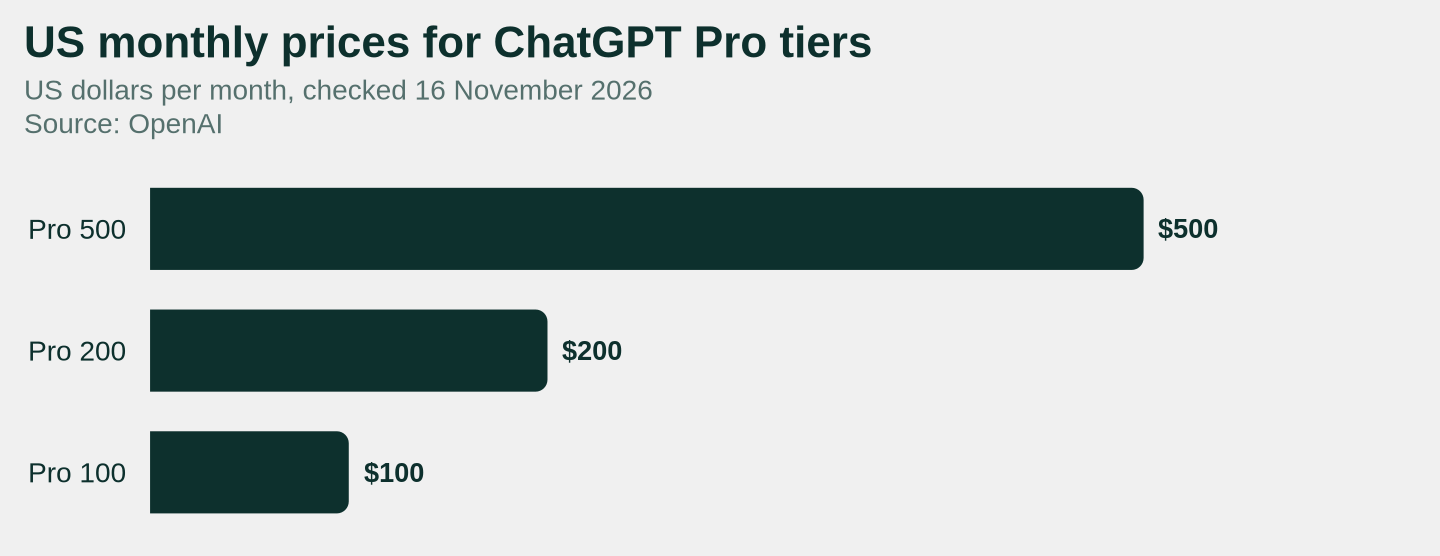
OpenAI's US pricing page listed Pro from $100 a month on 16 November 2026. The Wallet announcement and the pricing page do not list a separate Wallet transaction fee. On 29 September 2026, OpenAI announced a higher-priced ChatGPT Pro tier at $500 a month.
Can you use ChatGPT Wallet in Europe?
No. Three launch conditions block a European reader: you must reside in and use Wallet in the US, have a US billing address for your card, and hold an eligible US-issued card. A Pro subscription on top of that is still required.
Rewards, refunds and who you call when it goes wrong
OpenAI says issuer and payment-network rules continue to apply, including rewards and dispute rights, and that eligible users keep their existing card rewards and protections for eligible disputes with businesses.
The routing is clear in OpenAI's Wallet terms. The merchant handles order problems, cancellations, returns, refunds and product or delivery issues. The card issuer handles card charges, billing errors, disputed or unrecognized charges and chargebacks, subject to issuer and network rules. OpenAI may provide records or assistance and handles Wallet or account-access issues, but does not decide or fund merchant refunds or chargebacks unless legally required or separately promised.
What it changes for OpenAI and for merchants
The transaction now happens inside the product, not just the recommendation. OpenAI’s latest reported results were for Q3 2026: the Wall Street Journal reported about $10 billion in revenue alongside $10.9 billion in operating losses, from figures OpenAI shared with investors.
For more on those numbers, see our breakdown of OpenAI's Q3 2026 results.
For merchants, the practical work is product data an agent can read, pages that don't break at checkout, and support staff who understand an order placed with an agent's help. For everyone else, the open question is trust rather than technology.
OpenAI also says it expects users over time to be able to pre-authorize purchases within limits such as spending caps, categories or time periods, with additional safeguards. That is a stated expectation, not something you can switch on today.
Frequently asked questions
Can ChatGPT buy something without my approval?
No. Every Wallet purchase at launch requires you to approve it and complete biometric verification such as Face ID or Touch ID, so the dot cannot pay without that step. OpenAI describes fully delegated purchases with safeguards as a future possibility, not the current process.
Does the merchant see my card number?
No. After approval, the payment network generates a substitute payment token with its own card number, security code and expiration date. The agent and the business are not given your actual card details.
Does ChatGPT Wallet work with a debit card?
No. At launch, supported cards are eligible US-issued credit cards from American Express, Chase, Mastercard and Visa. Debit cards are not supported. An eligible Chase card must belong to the primary cardholder, not an authorized user.
Is Wallet available to every US Pro subscriber already?
Not necessarily. OpenAI announced Wallet on 13 November 2026 but described it as beginning a gradual rollout rather than being instantly available to every eligible subscriber. Its 15 November update still described the rollout as gradual.
Does using Wallet cost extra?
OpenAI's Wallet announcement and US pricing page did not list a separate Wallet transaction fee on 16 November 2026.

Sources
- OpenAI: Introducing ChatGPT Wallet (13 November 2026)
- OpenAI Help Center: Making purchases with ChatGPT Wallet
- OpenAI: ChatGPT Wallet Privacy Notice (14 November 2026)
- OpenAI: ChatGPT Wallet Terms (12 November 2026)
- OpenAI Help Center: ChatGPT release notes (29 September 2026)
- OpenAI: ChatGPT pricing (16 November 2026)
- The Wall Street Journal: OpenAI Continues to Suffer Heavy Losses as Revenue Rises to $10 Billion (10 November 2026)
Cover photo by Rolf van Root on Unsplash.

You might also like
Deepen your knowledge with more articles and inspiration.