On November 10, 2026, The Wall Street Journal and The Information reported that OpenAI told investors its third-quarter revenue was about $10 billion, nearly 50% above the second quarter, with an adjusted operating loss of $10.9 billion. For you, the useful part is how a company can sell that much and still lose more than it earns.
Key takeaways
- OpenAI's Q3 2026 revenue was about $10 billion, nearly 50% above Q2, according to press reports.
- The reported adjusted operating loss grew to $10.9 billion, from $10.1 billion in Q2.
- The reported loss was larger than revenue, even as the adjusted operating margin improved.
What the reports actually say
The news came out on November 10, 2026. Both The Wall Street Journal and The Information reported the same investor figures: revenue of about $10 billion for the quarter ended September 30, up nearly 50% from the previous quarter, and an adjusted operating loss of $10.9 billion, up from $10.1 billion. The reported adjusted operating margin improved to -109%, from -150% in the second quarter. It measures profit or loss against revenue.
One detail matters. The $10.9 billion loss is an adjusted operating loss, not a net loss, and the calculation left out $2.6 billion of stock-based pay for the quarter. Stock-based pay is the value of shares given to staff as part of their package.
| Reported figure (Q3 2026) | Amount |
|---|---|
| Revenue | About $10 billion |
| Change vs Q2 2026 | Nearly 50% higher |
| Adjusted operating loss | $10.9 billion |
| Q2 2026 adjusted operating loss | $10.1 billion |
| Stock-based pay excluded | $2.6 billion |
Why these are not normal quarterly results
OpenAI is a private company. In Q3 2026 it said its S-1 filing, the document a company submits before shares can trade, was confidential, and that it had not decided on timing. The Q3 figures were shared with investors and picked up by the press, so there is nothing comparable to a listed company's published quarterly report.
How OpenAI makes money
OpenAI's public pages show several ways it makes money.
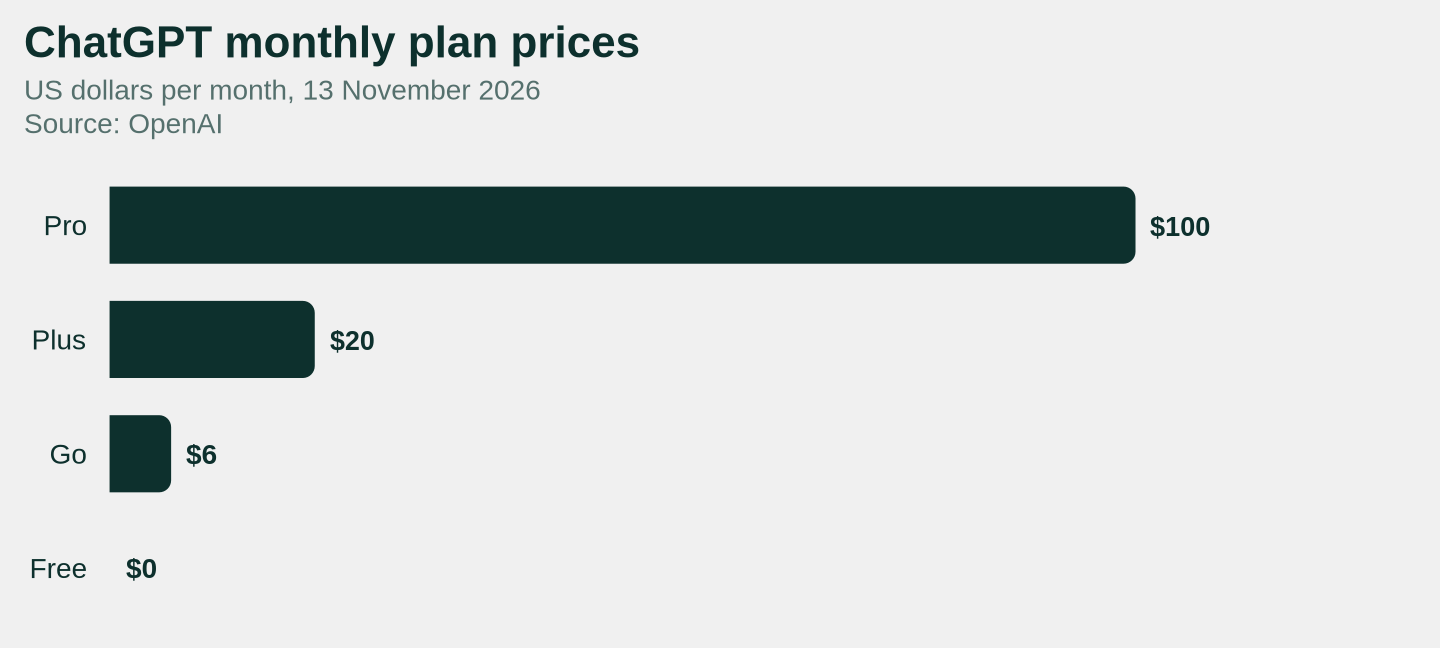
- Subscriptions and business customers. Customers pay to use ChatGPT and related tools.
- Developers and advertising. Companies pay to use OpenAI's models in software, and OpenAI sells advertising.
If you want a picture of what the paid chatbot plans actually include, see our overview of AI chatbot prices and free plans.
Why you see both $50 billion and $70 billion
Two different annualised numbers circulated in autumn 2026, and the gap confused a lot of readers.
On September 29, 2026, Axios first reported that OpenAI's annualised revenue run rate was nearing $70 billion. Then on October 8, 2026, Reuters reported that OpenAI had told investors its September annualised revenue was almost $50 billion.
CNBC reported that the earlier $68 billion figure included gross revenue from OpenAI's partners, to allow a comparison with Anthropic. Neither report quantified the partner pass-through.
So what is an annualised run rate? It takes a recent revenue pace, often one month, and stretches it across twelve months. It's a snapshot, not money already earned over a year. Gross revenue is the full amount when a company controls the product as the main provider. Net revenue is the fee it keeps when it only arranges a sale for someone else. A lower annualised figure, on its own, doesn't prove demand fell.
Why the losses grow with the revenue
Revenue rose nearly 50% in the quarter, and the adjusted operating loss still widened, from $10.1 billion to $10.9 billion.
What the reported margin shows is a direction. The adjusted operating margin improved from -150% to -109%. Losing less per dollar of revenue is not the same as losing less money in total, and in this quarter both things happened at once: a better margin, a bigger loss.
Meanwhile the company kept raising private capital. Bloomberg reported on November 6, 2026 that $11 billion of a new round had closed at a $1.25 trillion valuation, with the rest still expected in the coming weeks, and that OpenAI had delayed its plans to list. For more on that round, see our explainer on OpenAI's $1.25 trillion valuation.
OpenAI and Anthropic, side by side
| Company | Reported Q3 2026 revenue | Reported Q3 2026 operating loss |
|---|---|---|
| OpenAI | About $10 billion | $10.9 billion, adjusted |
| Anthropic | $17 billion | $567 million |
The Wall Street Journal reported both sets of figures. Same quarter, very different shapes: Anthropic reported more revenue and a far smaller operating loss. The OpenAI figure is adjusted, while the Anthropic one is described simply as an operating loss.
What comes next
Three things will tell you more than any single headline.
First, whether later figures are stated on a consistent basis, after the gross-versus-net confusion of October 2026. Second, how the loss moves against the margin: Q3 showed a better margin and a bigger loss at the same time. Third, the timing of a listing, which Bloomberg reported has been delayed and which OpenAI itself said it had not decided.
Frequently asked questions
How much money does OpenAI make? For the quarter ended September 30, 2026, press reports put revenue at about $10 billion, nearly 50% above the previous quarter. Earlier, on October 8, 2026, reports said OpenAI had told investors its September annualised revenue was almost $50 billion.
Is OpenAI profitable? Not on the reported figures. The adjusted operating loss for Q3 2026 was $10.9 billion, up from $10.1 billion in Q2. The adjusted operating margin improved from -150% to -109%. The $10.9 billion is an operating loss on an adjusted basis, not a net loss, and it excludes $2.6 billion of stock-based pay.
What is an annualised revenue run rate? It stretches a recent revenue pace, often a single month, across twelve months. It describes a current speed, not money already banked over a year. That's why a run rate and a quarterly revenue figure can't be compared directly.
Did OpenAI cut its prices? On July 30, 2026, OpenAI announced lower prices for developer access to its models: 80% less for GPT-5.6 Luna and 20% less for Terra, saying efficiency gains partly allowed the cuts. Separately, targeted enterprise discounts were reported on October 24, 2026, including more than 30% off for Replit, described as a bid to win customers from Anthropic. On September 22, 2026, Reuters reported that OpenAI launched GPT-6 Sol and Luna at API prices 50% below the earlier promotional prices.
Has OpenAI bought any companies recently? On November 4, 2026, OpenAI announced it would acquire Pierre Computer Company. At the time of the announcement the deal still depended on customary closing conditions and regulatory approvals, so it was planned rather than completed.

Sources
- The Wall Street Journal: OpenAI Continues to Suffer Heavy Losses as Revenue Rises to $10 Billion (10 November 2026)
- Reuters: OpenAI's annualized revenue $20 billion less than previously signaled, FT reports (8 October 2026)
- Bloomberg: OpenAI Completes $11 Billion Portion of Funding at $1.25 Trillion Value (6 November 2026)
- The Information: OpenAI Revenue Jumps to $10 Billion in Third Quarter (10 November 2026)
- OpenAI: OpenAI submits confidential S-1 (30 September 2026)
- OpenAI: Accelerating the next phase of AI (31 March 2026)
Cover photo by Levart_Photographer on Unsplash.

You might also like
Deepen your knowledge with more articles and inspiration.