On 6 November 2026, Reuters reported that OpenAI had closed an initial $11 billion of funding at a $1.25 trillion valuation, citing a source familiar with the matter rather than an OpenAI announcement. That $1.25 trillion is a private valuation, the price benchmark agreed in a funding deal, not a stock-market price. The rest of the round had not closed as of 9 November.
Key takeaways
- Reuters reported $11 billion closed at a $1.25 trillion valuation on 6 November 2026.
- The valuation is a negotiated price for new shares, not cash, revenue or profit.
- The rest of the round had not closed as of 9 November, and final terms remained pending.
What Reuters reported on 6 November 2026
Reuters wrote: "OpenAI has closed on new funding of $11 billion, the initial part of a round that values the company at $1.25 trillion."
Reuters also said two investors described the original target as up to $30 billion and the valuation first sought as $1.5 trillion.
| Item | Reported figure | Status (November 2026) |
|---|---|---|
| New capital closed | $11 billion | Reported initial close, 6 November |
| Original round target | Up to $30 billion | Described by two investors, not raised |
| Revised round target | About $20 billion | Reported 31 October |
| Valuation used | $1.25 trillion | Reported, basis not specified |
| Valuation first sought | $1.5 trillion | Described by two investors |
Who put money in
Reuters identified SoftBank and MGX as participants in the funding.
MGX describes itself as an Abu Dhabi and New York based investor focused on AI and advanced technologies.
Bloomberg reported that Coatue Management also took part in the 6 November first close, attributing this to people familiar with the matter.
What a $1.25 trillion private valuation actually means
Here is the part most headlines skip. A private-company valuation in a funding deal is the price benchmark the company and its investors agree on, to work out how much equity investors get for their money. It is not necessarily a price at which the whole company could be sold.

It is also none of these things. Cash held is money available at one point in time. Revenue is money earned over a period from sales. Profit is what is left after expenses. Public-market capitalisation is a listed share price multiplied by the number of shares. A private funding valuation is not the same as any of them.
One more detail matters. Reuters described $1.25 trillion as the valuation for the round, but did not say whether it was before or after the new money. Pre-money means the agreed value before the new investment. Post-money is after it, usually pre-money plus the investment. The difference changes how much of the company the new investors own, so it is worth not assuming either.
For a wider view of private AI valuations, see our ranking of AI companies in 2026.
Four numbers people keep mixing up
Four figures from this story travel together in headlines. They mean completely different things.
- $11 billion: the money reported as closed.
- Up to $30 billion: the original target for the wider round, described by two investors.
- About $20 billion: the revised target reported on 31 October.
- $1.25 trillion: the valuation used to price the deal.
Reuters was clear that up to $30 billion was the original target for the wider round, and that $11 billion had been raised so far, not $30 billion. Big rounds often arrive in stages. An initial close lets some investors in while talks with others continue.
What changed between October and November
On 31 October 2026, Reuters reported that OpenAI had cut the target for its funding round by $10 billion amid a technology-stock selloff. The revised target was reported at about $20 billion, with the valuation at $1.25 trillion. So by the time the first close was reported, the up-to-$30-billion figure was no longer the latest reported plan.

Reuters reported that the remaining portion could bring the round to as much as $20 billion in total in the coming weeks. TechCrunch, in an update on 9 November, said the larger raise had not yet closed and could reach about $20 billion. The first tranche is done. The rest is planned, not completed.
What the business looked like before this round
OpenAI told investors that revenue was $6.7 billion for the three months ended June 2026, up from $5.7 billion in the first quarter. The Wall Street Journal reported that losses deepened, without stating a loss amount.
OpenAI's own figures go further back. On 18 January 2026, the company said annualised revenue was $2 billion in 2023, $6 billion in 2024 and more than $20 billion in 2025.
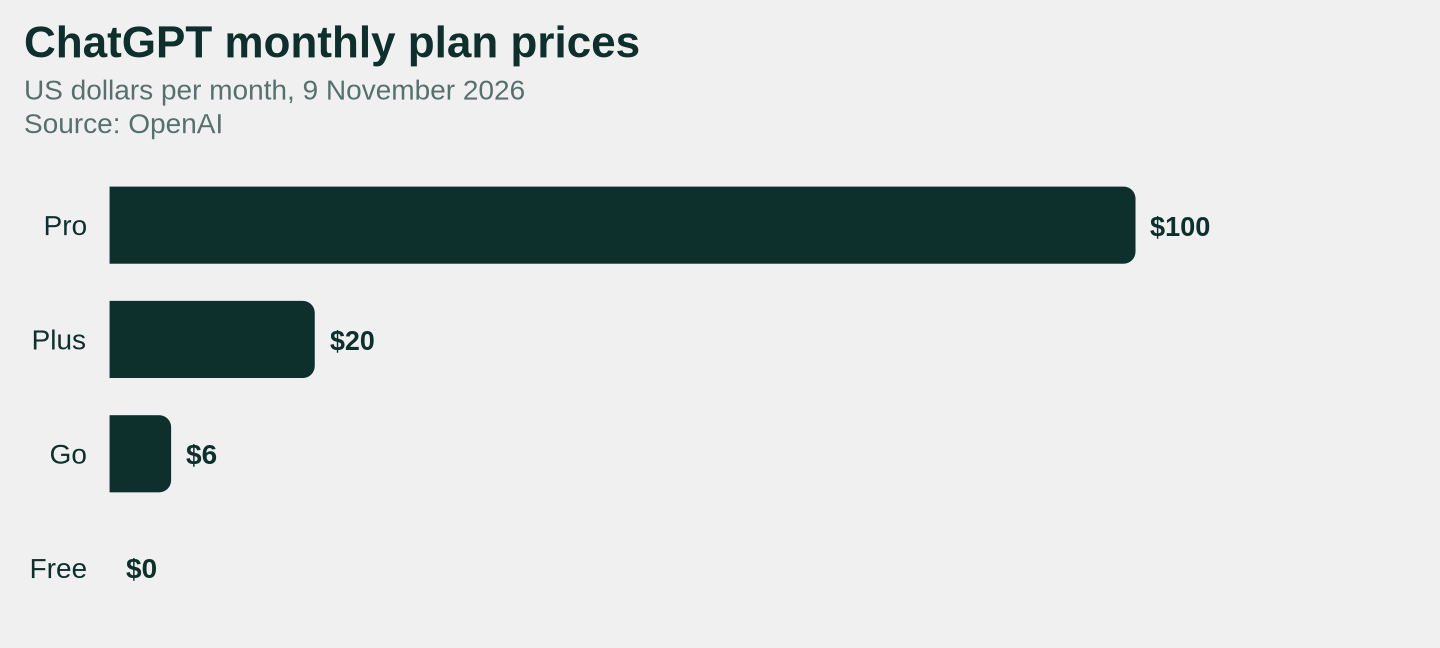
On the consumer side, the official US ChatGPT pricing page on 9 November 2026 showed Free at $0 a month, Go at $6, Plus at $20 and Pro starting at $100.
Separately, OpenAI announced on 4 November 2026 that it would acquire Pierre Computer Company. Its announcement said closing remained subject to customary conditions, including regulatory approvals, so that deal is agreed, not completed. On 8 June 2026, Reuters reported that OpenAI had confidentially filed for a US IPO, though it had not set a listing timeline.
Risks
- The round is not finished. The remaining financing and its final terms are still pending.
- The funding-round target was cut by $10 billion on 31 October, amid a technology-stock selloff.
- OpenAI's losses deepened in the quarter ended June 2026, and no loss figure was disclosed.
- A private valuation does not show cash, profit or who owns what.

This article is for information only and is not investment advice.
Frequently asked questions
Is $1.25 trillion the amount OpenAI raised?
No. The amount reported as closed was $11 billion. The $1.25 trillion is the valuation used to price the deal, meaning the agreed benchmark for how much equity investors receive for their money. Reuters described the $11 billion as the initial part of a round valuing the company at $1.25 trillion.
Is OpenAI's funding round finished?
Not as of 9 November 2026. TechCrunch's update that day said the larger raise had not yet closed and could reach about $20 billion. Bloomberg reported the remaining portion could bring the total to as much as $20 billion in the coming weeks.
Does a $1.25 trillion valuation mean OpenAI is profitable?
No. A funding valuation is a negotiated price for new shares. It says nothing directly about profit or cash. For the quarter ended June 2026, OpenAI told investors revenue was $6.7 billion, and The Wall Street Journal reported that losses deepened without giving a figure.
Who are the reported investors?
Reuters named SoftBank and MGX as participants. Bloomberg reported that Coatue Management also took part in the 6 November first close, citing people familiar with the matter. MGX describes itself as an Abu Dhabi and New York based investor focused on AI and advanced technologies.
What is the difference between pre-money and post-money?
Pre-money is the agreed value of the company before the new investment. Post-money is after it, usually pre-money plus the investment. The distinction matters because it changes the share of the company new investors end up with.

Sources
- Reuters: OpenAI gets $11 billion funding at $1.25 trillion valuation, source says (6 November 2026)
- Reuters: OpenAI cuts funding target by $10 billion, FT reports (31 October 2026)
- OpenAI: A business that scales with the value of intelligence (18 January 2026)
- Reuters: OpenAI files US IPO after Anthropic, AI giants head to public markets (8 June 2026)
- TechCrunch: OpenAI reportedly raises an additional $11 billion at a $1.25 trillion valuation (9 November 2026)
- Bloomberg: OpenAI completes $11 billion portion of funding at $1.25 trillion value (6 November 2026)
- MGX: Who we are
- U.S. Securities and Exchange Commission: Glossary
Cover photo by Brecht Corbeel on Unsplash.

You might also like
Deepen your knowledge with more articles and inspiration.