Revolut Business ranks first in Investing in the Web's comparison of five European business accounts and starts at €10 a month (November 2026). Four other accounts follow: Wise Business, bunq, Qonto and N26 Business. Which one fits you depends on where your company is registered and how money comes in and goes out.
Key takeaways
- Revolut Business ranks first in a comparison of five European business accounts.
- Transfers, currency conversion, cards and cash handling can all be charged on top of the plan.
- Money at an electronic-money provider is safeguarded rather than covered by the €100,000 EU deposit guarantee.
- Opening an account depends on compliance checks, so acceptance is never automatic.
The five accounts at a glance
This ranking follows the order of Investing in the Web's comparison of European business accounts, with the labels that comparison gives each account.
- Revolut Business, labelled "Best overall".
- Wise Business, labelled "Best for non-EU companies".
- bunq, labelled "Best free plan".
- Qonto, labelled "Best for admin tools".
- N26 Business, labelled "Best for freelancers".
The five business accounts
1. Revolut Business
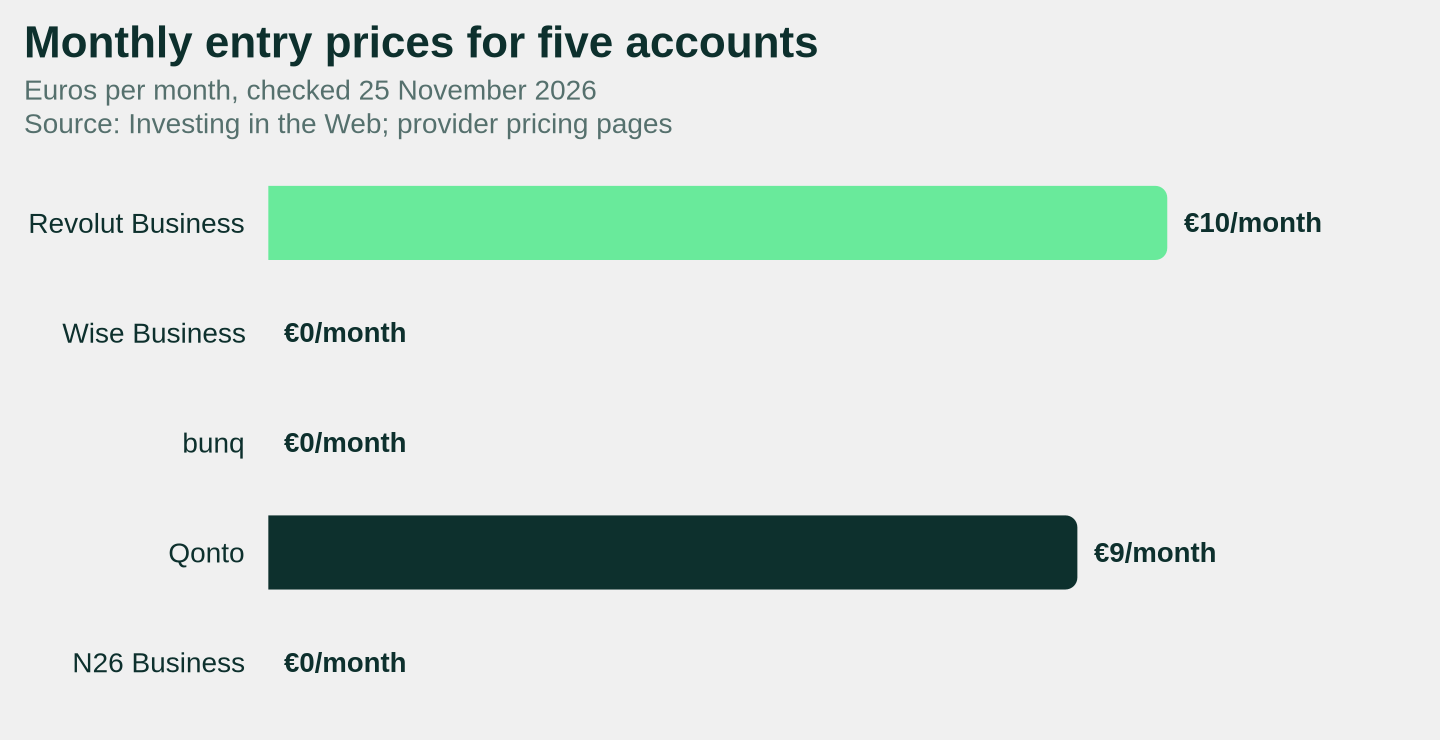
Revolut Business is the number one of the comparison, where it carries the label "Best overall". Its entry price is €10 a month, checked on November 25, 2026. That is the highest starting price of the five accounts listed here.
2. Wise Business
Wise Business appears second, labelled "Best for non-EU companies". There is no monthly entry price, but there is a one-off €60 setup fee, checked on November 25, 2026. The fee is paid once, so it does not come back every month.
3. bunq
bunq comes third in the comparison, labelled "Best free plan". On bunq's own business plans page, checked on November 25, 2026, the monthly prices are Free at €0, Core at €7.99, Pro at €13.99 and Elite at €23.99. So the free plan is the entry point of a four-step ladder.
4. Qonto
Qonto is fourth, labelled "Best for admin tools". Its Basic plan, checked on November 25, 2026, costs €9 a month excluding VAT on annual billing and includes 30 SEPA transfers or outgoing direct debits. SEPA is the system that moves euro payments between accounts across Europe. On 17 November 2026, Qonto received a credit-institution licence, allowing it to expand lending and savings services, with eligible deposits to be covered by France's deposit-guarantee scheme.
5. N26 Business
N26 Business closes the list, labelled "Best for freelancers". Its entry price is €0 a month, checked on November 25, 2026. As with the others, the price depends on your country and the plan you take.
What a business account really costs
The monthly plan is one line on the bill. Several other charges can sit next to it.
- Transfers and instant payments can have separate charges.
- Cards can have charges for issue, replacement, cash withdrawals and foreign-currency spending.
- Cash deposits and cash handling can have separate charges.
- International payments can include a transfer charge and a currency-conversion charge.
- Currency conversion can have a separate fee or a markup in the exchange rate.
Who can open one, and what the provider asks for
EU rules require customer due diligence, the checks a provider runs on a new customer. They do not guarantee every business an account, and a provider must not onboard a business if it cannot meet those checks or manage the risk.
Applicants are generally asked for identity and residential-address evidence for the owner or applicant, tax-residency details, and information on the business's activities, purpose, expected account use and source of funds. Providers can ask for more depending on risk and country. A company with several owners is commonly asked for its ownership and control structure, beneficial-owner details and verification, and identity and address evidence for the relevant owners, partners, directors and signatories.
A beneficial owner is the real person behind the company. On November 25, 2026, the current EU anti-money-laundering rule treats a holding of 25% plus one share, or an ownership interest above 25%, as an indication of beneficial ownership, and it also covers control by other means. Member States may set a lower threshold. The EU's new anti-money-laundering regulation sets the threshold at 25% or more and will apply from July 10, 2027.
Legal form, activity, countries of operation and the countries of the owners all feed into the decision. A complex or opaque ownership chain, or a higher-risk sector, can trigger more checks or make an account unacceptable.
Deposit guarantee or safeguarded money
Money in an account with a licensed bank is a claim against that bank and, if eligible, is protected by the bank's deposit-guarantee scheme. The standard EU limit is €100,000 per depositor per credit institution, with all that depositor's eligible accounts at the same institution added together, whatever their number, currency or location in the Union. Eligible deposits of ordinary companies are generally covered, though the scheme excludes some categories, such as deposits by financial institutions on their own behalf.
Money held by an electronic-money institution works differently. Those funds are safeguarded by the institution, but they are not bank deposits, and safeguarding is not deposit insurance. A payment institution must keep customer funds separate and, where required, in a separate bank account or in eligible low-risk assets, or cover them with qualifying insurance or a comparable guarantee. Electronic money sits outside the EU deposit-guarantee definition altogether, so it should not be described as a guaranteed, fixed-time repayment.
The verdict
Pick Revolut Business if you want the comparison's top-ranked account. Pick bunq if you need a free plan.
- Pick Wise Business if your company is registered outside the EU.
- Pick Qonto if you need admin tools.
- Pick N26 Business if you work as a freelancer.
Frequently asked questions
Can a non-resident open a business account in Europe?
There is no single EU test on director residency for opening a business account. Providers must verify the identity and authority of the people acting for the company, and they may apply their own country and documentation policies. Providers may compare ownership information with the national beneficial-ownership register. Banks are not allowed to rely on that register as their only check.
Does a euro transfer cost more because it crosses a border?
For euro payments inside the EU, a provider must charge the same for a cross-border payment as for the matching domestic one. A SEPA transfer is not necessarily free, but it should not cost more simply because it crosses a border. On those regulated payments, intermediary providers cannot charge the payer or payee or take fees out of the amount sent. Outside that rule, correspondent-bank charges can appear. Non-SEPA or foreign-currency payments can carry provider-specific sending and receiving fees.
What happens if my provider goes under?
If an e-money or payment provider becomes insolvent, safeguarded funds are meant to be insulated from claims by the provider's other creditors under the applicable national law. Customers recover through the safeguarding and insolvency process, not through an automatic deposit-guarantee payout. That is the practical difference with a bank deposit covered by a guarantee scheme.
Do freelancers need a separate business account?
It depends on legal form and country. In France, a micro-entrepreneur must have an account dedicated to the business once turnover passes €10,000 for two consecutive years, and that dedicated account can be a separate personal account rather than a business-branded one. Even where no law requires it, separating business and personal transactions makes bookkeeping and tax records simpler, and some personal accounts do not allow business use. An incorporated company is a distinct legal entity, so its banking is kept separate.
Will my clients accept a foreign IBAN?
A foreign IBAN is simply an account number whose country prefix differs from the country where the payer or payee expects a domestic account. Whether it works for euro payments depends on the account being reachable through the payment scheme, not on the prefix itself. Under EU rules, a payer or payee generally cannot require a reachable EU payment account to be in a particular Member State for a euro transfer or direct debit. The European Commission describes this practice as IBAN discrimination.

Sources
- Investing in the Web: Best business bank accounts in Europe
- bunq: Business plans
- Qonto: Pricing
- FinTech Futures: French fintech Qonto secures full banking licence
- EUR-Lex: Deposit guarantee schemes
- European Commission: IBAN discrimination
- European Banking Authority: Customer due diligence guidelines
Cover photo by Ibrahim Boran on Unsplash.

You might also like
Deepen your knowledge with more articles and inspiration.