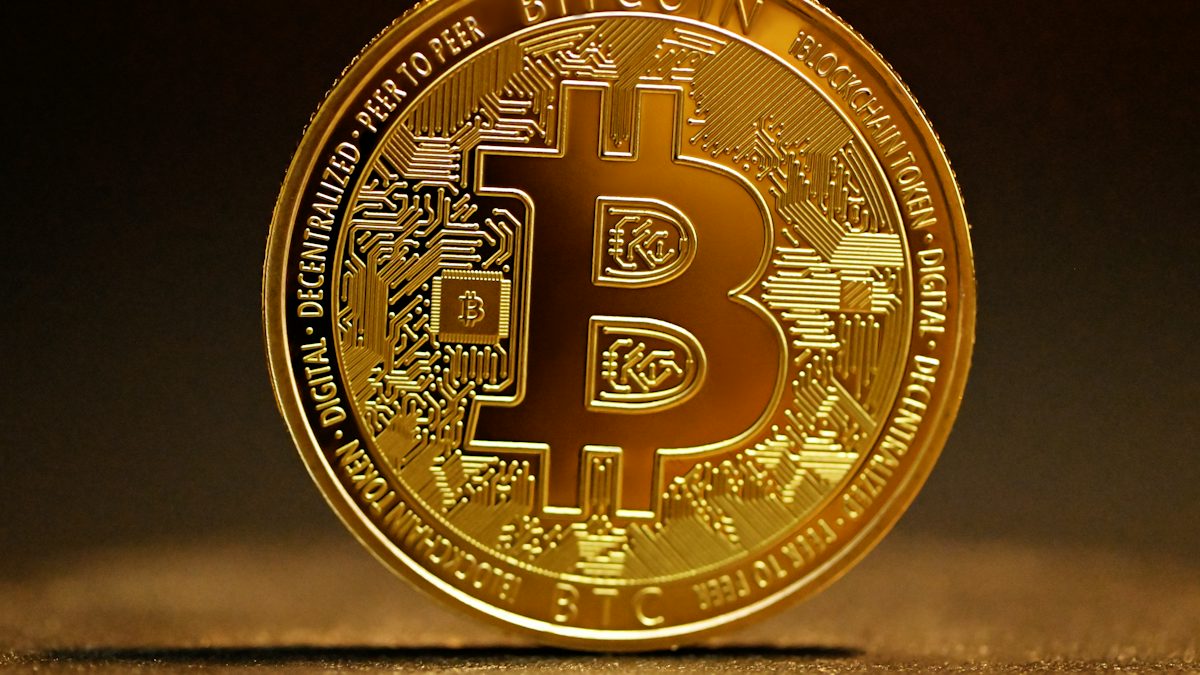
Bitcoin is two things at once: an open payment network run by many independent computers, and the digital money that moves on it. No company, bank or central authority controls it. Transactions are recorded in a shared public chain of blocks, and the price of a bitcoin can swing hard in both directions.
The idea was published on 31 October 2008, when someone using the name Satoshi Nakamoto posted a paper called "Bitcoin: A Peer-to-Peer Electronic Cash System" to a cryptography mailing list. The first block was produced on 3 January 2009. Understanding how the thing actually works matters more than any price headline, because the mistakes people make with it are usually permanent.
Key takeaways
- Bitcoin is a public network of independent computers plus the digital money that moves on it.
- Nobody runs it, so no support line can reverse a confirmed payment or reset a lost key.
- Issuance is capped just under 21 million bitcoin, but scarcity says nothing about demand or price.
What Bitcoin actually is, and what it is not
Bitcoin is not a company. It has no shares, no board, no revenue and no profit statement. That alone clears up a lot of confusion for anyone used to reading company results.
The white paper described electronic cash that lets people pay each other directly, without a financial institution in the middle. Transactions are announced publicly. The computers on the network agree on the history using proof of work. This means they use computing work to add records. There is no central mint. Security depends on honest computers controlling most of the computing power.
Three words get mixed up constantly.
| Term | What it means |
|---|---|
| Bitcoin | One specific payment network and the digital money on it |
| Cryptocurrency | The wider category of digital assets moved using cryptography |
| Blockchain | A shared linked ledger technology, used by many cryptocurrencies and beyond them |
Who created Bitcoin?
Satoshi Nakamoto is still an unverified pseudonym. In May 2024, the English High Court ruled that Craig Wright was not Satoshi, not Bitcoin's creator and not the white paper's author, but it did not name the real person.
How a Bitcoin payment works, step by step
A payment is a signed message that the network checks. A miner, a computer that adds blocks, can then put it in a block. Here are the six steps.
- The sender's wallet prepares a transaction using money received earlier that has not yet been spent.
- The sender signs it with a private key. This secret authorises a spend. The key itself is never revealed in the signature.
- The signed transaction is broadcast to the network.
- Other computers independently check it against the shared rules and pass it on.
- A miner may include it in a candidate block and perform proof of work.
- Once the block is accepted, the transaction has its first confirmation, and every later block adds another.
Two roles are easy to confuse. Full nodes check transactions and blocks against the shared rules and pass on valid ones. Miners choose transactions for a possible block and do the computing work needed to add it. The network accepts a block only if it follows the shared rules.
Timing is not guaranteed. The network aims for one block every ten minutes on average, so a transaction with a high enough fee usually gets its first confirmation in roughly ten minutes. When the network is busy, a low-fee transaction can wait much longer. There is no fixed fee either: it depends on demand for block space and the size of the transaction, and on what your wallet estimates.
Where new bitcoins come from
New bitcoin exist only as a reward to miners. Each winning block contains a special transaction that lets the miner claim the newly issued amount plus the fees from the transactions it included.

The amount of new bitcoin per block is written into the rules and falls over time. It started at 50 BTC, then dropped to 25 BTC in 2012, 12.5 BTC in 2016, 6.25 BTC in 2020 and 3.125 BTC in 2024. As of November 2026, the reward is 3.125 BTC per block. Four halvings have happened, the most recent at block 840,000 on 20 April 2024 UTC.
The rules halve the reward every 210,000 blocks. Because amounts are rounded to whole satoshis, the smallest unit, total issuance lands just under 21 million BTC. The reward is expected to reach zero around 2140, after which miners would be paid in transaction fees only.
Worth keeping in mind: a capped supply describes how new coins are issued. It says nothing about how many people will want them, or what they will pay.
Wallets, addresses and private keys
A wallet does not hold coins the way a physical wallet holds cash. It manages keys and gives you an address to receive payment. Your balance is recorded on the chain, not inside the address.
So there are two things to keep straight. The address is what you share to get paid. The private key is the secret that signs a spend, while the matching public key lets anyone on the network check the signature is valid. Knowing someone's address does not let you move their money.
That leads to the practical point. You can hold the keys yourself, which means full control and full responsibility. Or a platform can hold them for you, which is easier but makes you dependent on that platform. No legitimate support team ever asks for your recovery phrase, the list of words that restores a wallet. Anyone who asks is running a scam.
What people do with it
People send value across borders, hold it as a speculative asset, and in some places pay merchants who accept it. Acceptance for everyday purchases stays limited.
Large companies hold it too. On 16 November 2026, Strategy reported a completed purchase of 485 bitcoin at an average $68,887 each during 9–15 November, bringing its holdings to 850,849 bitcoin as of 15 November. The same day, Strive reported completed purchases of 251 bitcoin at an average of approximately $69,853 each during 7–13 November. On 14 November 2026, Bitcoin fell 5.3% to about $64,734, extending a sharp sell-off.
Risks
- The price moves sharply in both directions and you can lose what you put in.
- Lose your private key or recovery phrase and nobody can reset it for you.
- If a platform holds your bitcoin, you depend on that platform staying solvent and secure.
- A confirmed transfer is extremely hard to reverse, because redoing it means redoing the proof of work for that block and every later one while the honest network keeps adding more.
- Fraud is common: impersonation, phishing and promises of guaranteed returns. Legal and tax treatment also differs by country and can change.
This article is for information only and is not investment advice.
Frequently asked questions
Is Bitcoin real money?
It depends on the definition you use. The white paper describes it as electronic cash that moves directly between people without a financial institution. But it is not issued by a central bank, acceptance by merchants is limited, and the price moves too much for most everyday pricing.
Do I need to buy a whole bitcoin?
No. Amounts are counted in satoshis, the smallest unit the rules use, which is why issuance rounds to whole satoshis. You can hold a fraction. Minimum purchase amounts are set by whichever service you use, not by the network itself.
Is Bitcoin anonymous?
No, it is pseudonymous. Transactions are announced publicly and attached to addresses rather than names. Addresses can often be linked back to people through exchanges, payment records and analysis of the public chain. Treat the record as permanent and visible.
What does "confirmation" actually mean?
A transaction has one confirmation when it is included in a block, and each later block adds another and increases the work needed to replace that history. An unconfirmed broadcast is not a confirmation at all. How many confirmations are "enough" depends on the size and the situation.
Who controls Bitcoin?
Nobody, at the level of the network. Independent computers share and verify transactions under common rules, with no central authority in charge. In practice you still depend on other things: your wallet software, any platform holding your keys, and an internet connection.

Sources
- High Court of Justice of England and Wales: COPA v Wright judgment (2024)
- Blockstream Help Center: Why is the Bitcoin supply limited?
- U.S. Securities and Exchange Commission: Strategy filing (16 November 2026)
- Reuters: Bitcoin falls 5.3% amid sell-off (14 November 2026)
- Satoshi Nakamoto / Bitcoin.org: Bitcoin: A Peer-to-Peer Electronic Cash System (2008)
- Bitcoin Developer Documentation: Transactions
- Bitcoin Developer Documentation: Block Chain
- Bitcoin.org: Frequently Asked Questions
Cover photo by Kanchanara on Unsplash.

You might also like
Deepen your knowledge with more articles and inspiration.