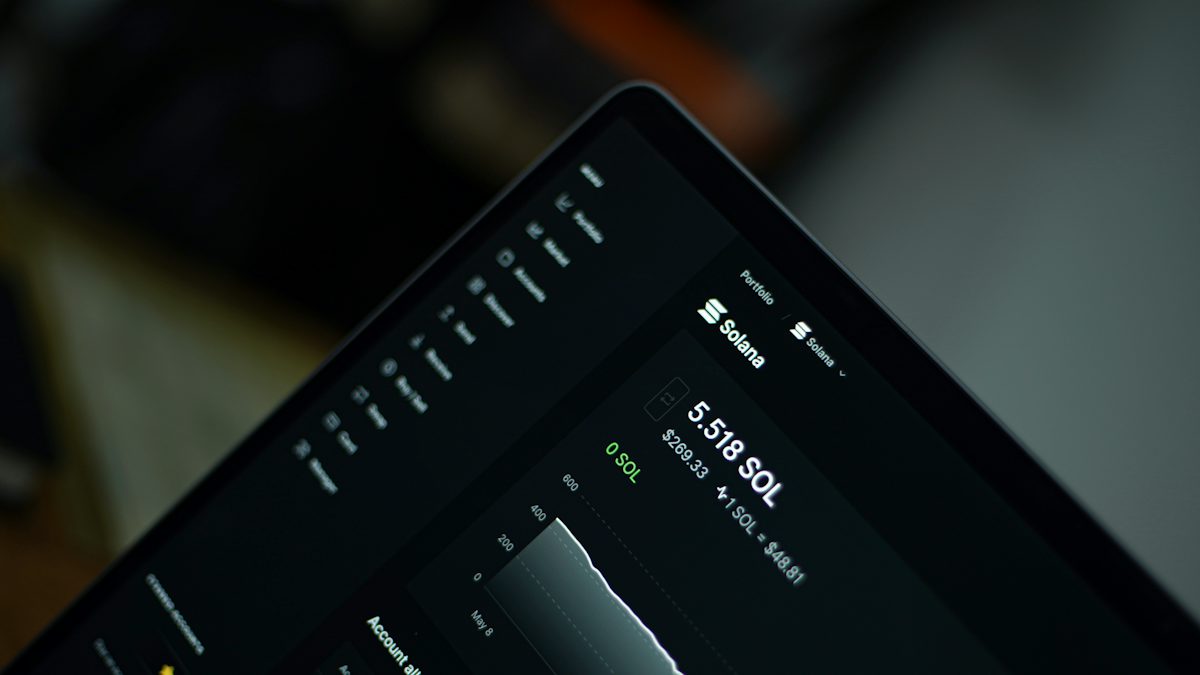
SOL traded at around $72.3246 on November 16, 2026, up 2.43% over 24 hours, on a price aggregated from 14 market sources. That number alone tells you very little. What it means depends on how many tokens exist, how big the whole market is, and how far the price has already travelled.
Key takeaways
- SOL traded at around $72.3246 on November 16, 2026, on a price built from 14 market sources.
- Market cap, the price times the tokens in circulation, compares size better than the price of one token.
- CoinGlass records $8.141 in December 2022 and $294.33 in January 2025, showing sharp moves.
Where the Solana price number comes from
There is no single official Solana price. Each exchange has its own list of buy and sell orders. This is called an order book. Trades can happen at different prices on different exchanges. Data providers collect prices from several exchanges. They remove unusual quotes and combine the rest.

That is why two browser tabs can show two slightly different prices, and why neither is wrong.
A 24-hour change is one day of market weather. It is not a trend, and it is not a signal about anything beyond that day.
What Solana is, and what the SOL token is for
Solana is a blockchain network, a shared record of transactions that apps are built on. SOL is the token used on it. On November 14, 2026, Solana's official fee documentation listed a base fee of 5,000 lamports per signature. That equals 0.000005 SOL. A lamport is simply the smallest unit of SOL.
Holding SOL is not the same as holding shares. A token on a network comes with no shareholder rights, no vote in a company and no claim on any company's profits.
For the step-by-step process on another large network, see our guide to buying Ethereum in Europe.
What moves the Solana price
A single day's move rarely has one confirmed cause, whatever the headlines say. Several things feed into the price at once.
- The wider crypto market. Large tokens often move together, for reasons that have nothing to do with Solana itself.
- Buyers and sellers on exchanges. The more orders sitting in the book, the larger the trade the market can absorb without the price jumping.
- Use of the network. The Solana Foundation's November 6, 2026 ecosystem roundup reported that the value of real-world assets recorded on Solana reached a record $5 billion during October 2026.
- Changes to the network itself. The Alpenglow upgrade went live on the main network on October 21, 2026. It replaced the previous system and targets around 150-millisecond finality. Finality is when a transaction becomes irreversible.
- Supply. Tokens entering circulation change how many are available to trade.
- General appetite for risky assets. Crypto sits at the risky end of what people buy.
Price, market cap and supply: how to read the numbers
| Number | Figure (November 2026) |
|---|---|
| SOL price | $72.3246 on November 16, 2026 |
| 24-hour change | +2.43% on November 16, 2026 |
| Market cap | About $43.0 billion on November 16, 2026 |
| Circulating supply | 591.5 million SOL, dated November 13, 2026 |
| Total supply | 637.5 million SOL, dated November 13, 2026 |
Market cap is the price multiplied by the tokens in circulation. It is the number to use when you want to compare the size of two cryptoassets, because the price of one token depends entirely on how many tokens exist. A token at $5 with a huge supply can be worth far more in total than a token at $500 with a tiny one.
Trading volume is a third thing again. It records how much changed hands over a period. High volume means activity, not quality, and says nothing about where the price goes next.
For the same set of numbers on Ethereum, see our explainer on the Ethereum price.
Solana price history, and how to read a chart
CoinGlass data starts on April 10, 2020, with a launch-period quote of $0.8320. It shows a 2021 high of $260.06 on November 6. It shows a 2022 low of $8.141 on December 29. It later recorded $294.33 on January 19, 2025. Its 2026 range so far is $60.415 on June 6 to $148.22 on January 14. On November 15, 2026, SOL fell to about $67.55 amid seven straight sessions of U.S. spot SOL ETF outflows.
CoinGecko lists SOL's all-time high as $293.31 on January 19, 2025. It lists its all-time low as $0.500801 on May 11, 2020.
That history matters for charts. The same price looks like a collapse on a one-year view and a rally on a one-month view. A chart shows what has already happened, and past performance does not predict future results.

Risks
- Cryptoassets are volatile. SOL has traded as low as $8.141 and as high as $294.33 on the dates above.
- You can lose the full amount you put in.
- Where the token is held matters. A platform can fail, and a lost private key cannot be recovered.
- Prices differ slightly between venues, and thin order books can make a large trade move the price.
- Rules for cryptoassets change, and that can affect what platforms and institutions are able to do.
This article is for information only and is not investment advice.
Frequently asked questions
Why do two websites show different SOL prices?
Because each exchange has its own order book, and the trades on it happen at slightly different prices. Data providers then average many of those venues, dropping quotes that look wrong, so each provider's methodology produces a slightly different headline number.
What is Solana's all-time high?
CoinGecko records $293.31 on January 19, 2025. CoinGlass puts the record on the same day at $294.33. A record is a historical fact, not a target.
Is market cap more useful than the price of one token?
For comparing assets, yes. Market cap is the price times the tokens in circulation, so it reflects the whole asset rather than the size of one unit. Fully diluted valuation estimates value using all possible tokens, so it can differ from market cap.
Does owning SOL give me a stake in anything built on Solana?
No. A token is not a shareholding. It carries no vote, no shareholder rights and no claim on the profits of any company or foundation working on the network.
What does a transaction on Solana cost?
The official documentation listed a base fee of 5,000 lamports per signature, equal to 0.000005 SOL, with optional priority fees for faster handling, as of November 14, 2026.

Sources
- Solana: Transaction fees documentation (14 November 2026)
- Solana Foundation: Solana ecosystem roundup: October 2026 (6 November 2026)
- CoinGlass: SOL historical data (2026)
- BigGo Finance: SOL price news (15 November 2026)
- CoinGecko: Solana price, market cap and supply (16 November 2026)
- Scrypt Price: SOL price (16 November 2026)

You might also like
Deepen your knowledge with more articles and inspiration.