SAP stock means shares in SAP SE, the German business software company based in Walldorf. The ordinary shares trade in euros on the Frankfurt Stock Exchange, Xetra and other German exchanges under the ticker SAP. A dollar receipt tracking the same shares trades on the New York Stock Exchange under the ticker SAP.
The most recent numbers come from the third quarter of 2026, published on October 21, 2026: revenue of €10.27 billion and cloud revenue of €6.67 billion.
Key takeaways
- SAP shares trade in euros in Germany and as a dollar receipt on the NYSE.
- Cloud revenue, money from internet-delivered services, reached €6.67 billion in the third quarter of 2026.
- SAP lists cloud migration, competition and cybersecurity among its main risks.
What SAP SE actually does
SAP sells integrated business software and cloud applications. These connect processes like finance, procurement, HR, supply chain and customer experience. The customers are large organisations, not consumers.

Christian Klein is the chief executive. The 2025 annual report records 111,397 employees by headcount at December 31, 2025, and 110,650 full-time equivalents. Full-year 2025 revenue under IFRS accounting rules was €36.8 billion.
Recent announcements show the kind of business SAP wins. On November 10, 2026, SAP said AstraZeneca plans to migrate its existing business software to SAP Cloud ERP Private. That is a plan, not a finished migration.
The share price and the numbers people look up
| Figure | Value | Date |
|---|---|---|
| Xetra close, in euros | €213.45 | November 13, 2026 |
| NYSE ADR close, in dollars | $234.90 | November 13, 2026 |
| 52-week range, NYSE ADR | $144.97–$255.90 | November 13, 2026 |
| P/E ratio, NYSE ADR | 28.72 | November 13, 2026 |
| Yield, NYSE ADR | 0.91% | November 13, 2026 |
The P/E ratio compares the share price with company profits. Dividend yield shows the annual dividend as a percentage of the share price.
Shareholders approved a dividend of €2.50 per share for the 2025 financial year at the annual meeting on May 5, 2026, with May 8 as the payment date. On November 10, 2026, SAP said it bought back 465,412 shares for about €95.4 million during November 2–6.
Factors that can move SAP stock
This section reviews cloud revenue, cloud backlog and guidance.
Cloud revenue is fees from software, platform and infrastructure delivered over the internet. For most subscriptions, SAP recognises the money evenly across the contract term, and usage-based contracts are recognised as customers consume them. So signing a big contract does not put the whole value into revenue straight away.
That is where backlog comes in. SAP's current cloud backlog is the cloud revenue already under contract that it expects to recognise over the next twelve months. At September 30, 2026, it stood at €24.1 billion, up 28% as reported. At constant currencies, which remove exchange-rate movements, growth was 26%. SAP describes that growth as an indicator of net cloud business added, counting new contracts and renewals minus lost ones.
For the third quarter of 2026, total revenue was €10.27 billion, up 13% as reported. The IFRS operating margin was 28.5% and the non-IFRS margin 29.5%. Free cash flow, cash left after operating and investment spending, was €1.72 billion for the quarter, up 36% year over year.
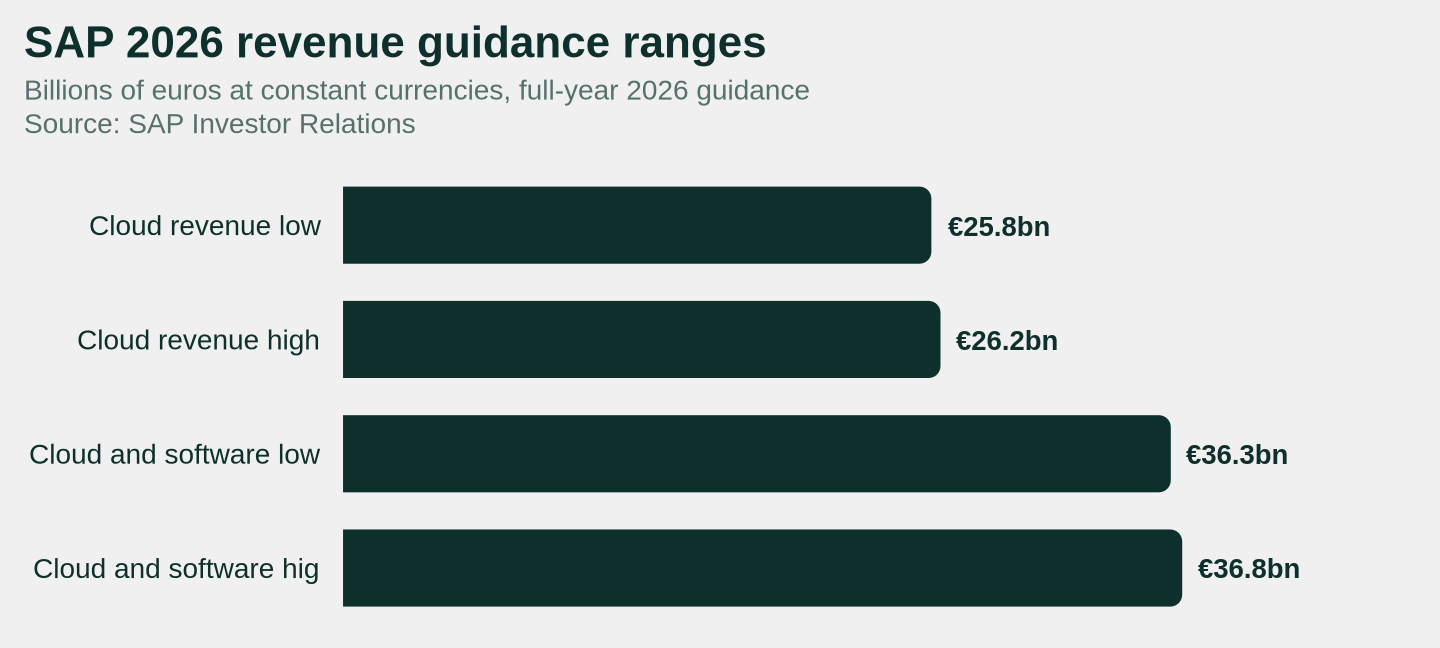
Guidance is management's own forecast for the year. In the October 21, 2026 update, SAP said it expects 2026 cloud revenue and cloud-and-software revenue toward the upper ends of their ranges of €25.8–26.2 billion and €36.3–36.8 billion, both at constant currencies. The ranges themselves did not change. SAP kept its 2026 non-IFRS operating-profit outlook at €11.8–12.2 billion at constant currencies and its free-cash-flow outlook at about €10 billion at actual exchange rates.
SAP also said it expects 2026 total-revenue growth at constant currencies to stay around 2025's 10.6%, and current-cloud-backlog growth to decelerate slightly from 2025's 25%.
AI announcements are a separate thing. On October 27, 2026, SAP announced AI tools for developers at its TechEd conference. That is a product announcement, not a financial result. The evidence of whether AI pays shows up later, in revenue and margins.
NYSE ADR or German shares: the difference
They represent the same SAP shares.
The German ordinary shares are SAP shares quoted in euros. The New York listing is an American depositary receipt. It is a certificate representing SAP ordinary shares and quoted in dollars.
The dollar value of the receipt and the converted dividend are both affected by moves in the euro-dollar exchange rate.
Trading hours differ too. The NYSE regular session runs 9:30 a.m. to 4:00 p.m. Eastern Time, while Xetra runs 9:00 a.m. to 5:30 p.m. Central European Time, so the two windows overlap only partly. Settlement is when payment and ownership are completed. As of November 16, 2026, the US market settles trades one business day after the trade, while EU securities including German ordinary shares settle in two. The EU's change to one day is scheduled for October 11, 2027 and is not yet in force.
Risks
- SAP's 2025 Integrated Report names global economic and political uncertainty as a likely, medium-level risk that could disrupt business and hurt financial results and cash flows. Its third-quarter 2026 outlook assumes a stable macroeconomic environment in the fourth quarter.
- The move to the cloud can be held back by reluctant customers, competing cloud offerings, pricing pressure and implementation problems, and the shift away from on-premise licences could temporarily hurt support revenue.
- SAP flags competition and innovation risks, including the possibility that it cannot keep pace with technology or execute its AI strategy. AI models or data may be flawed or biased, and deployments may cause legal, regulatory or reputational harm.
- SAP classifies cybersecurity as a likely, business-critical, high-level risk, including attacks on SAP or its partners. It also flags complex and conflicting regulation that may bring fines, compliance costs or restrictions on cloud and AI services.
- Anyone holding the dollar receipt from a euro base carries an exchange-rate effect on top of the share move.
This article is for information only and is not investment advice.
Frequently asked questions
Is SAP stock listed on the NYSE?
Yes. SAP's New York listing is an American depositary receipt. It trades under the ticker SAP in dollars. Deutsche Bank Trust Company Americas administers it. One receipt represents one ordinary share.
What is current cloud backlog?
It is contractually committed cloud revenue that SAP expects to recognise during the next twelve months. It is a subset of remaining performance obligations, and it excludes certain non-precommitted usage revenue and contracts that can be terminated without significant penalty. It is not money already earned.
Where does SAP's revenue come from?
In the third quarter of 2026, SAP reported €6.67 billion from cloud, €2.43 billion from software support, €1.02 billion from services and €147 million from software licences.
When does SAP report next?
SAP's financial calendar schedules the fourth-quarter and full-year 2026 results for January 28, 2027.
Why do the euro price and the dollar price differ?
Because they are quoted in different currencies, on exchanges whose main trading windows overlap only partly. On November 13, 2026, SAP closed at €213.45 on Xetra and its NYSE receipt at $234.90. The dollar value of the receipt is affected by EUR/USD exchange-rate changes.

Sources
- SAP: 2025 Annual Report on Form 20-F
- SAP News Center: SAP Expands Collaboration With AstraZeneca Through RISE With SAP and Business AI
- EQS News: SAP SE: Release of a capital market information
- SAP Investor Relations: Recent results
- ESMA: One year to go: T+1 settlement regulatory framework complete
- SAP Investor Relations: American Depositary Receipts
- MarketWatch: SAP SE ADR stock quote
- U.S. Securities and Exchange Commission: SAP risk information
Cover photo by Taylor Vick on Unsplash.

You might also like
Deepen your knowledge with more articles and inspiration.