OpenAI is a private company. As of November 4, 2026, it has no publicly traded shares and no official exchange ticker, so you can't buy it through a normal broker. The only routes are private-market deals. They are restricted and hard to resell. Listed companies connected to OpenAI are another route, but that is not the same as owning OpenAI.
One thing changed the conversation. On June 8, 2026, OpenAI said in its own words: "We recently submitted a confidential S-1." That's an early, private draft of a listing document handed to the US regulator. It's a preparation step, and OpenAI said timing was undecided.
Key takeaways
- OpenAI has no listed shares and no exchange ticker as of November 2026.
- A confidential draft filing was submitted in June 2026, with no date, price or ticker publicly confirmed.
- Private shares need OpenAI's written consent to transfer.
Is OpenAI publicly traded?
No. OpenAI is privately held, so no stock exchange quotes its shares and no broker account can hold them.
Some finance websites publish pages that look like stock pages, with a symbol-style label next to the OpenAI name. Those labels organise private-company data. Nothing trades behind them.
OpenAI warns that some products marketed around its name may breach its transfer rules. Buyers may not be treated as owners of the company.
What has actually been confirmed about an OpenAI listing
OpenAI's confidential S-1 announcement is dated June 8, 2026, and says the company had "recently submitted" the draft. A confidential draft lets a company prepare quietly. It sets no price, no date and no obligation to list.

| Status | What it says |
|---|---|
| Confirmed by OpenAI | A confidential S-1 was submitted, timing undecided |
| Reported by media | Sam Altman said OpenAI would not list in 2026; CFO Sarah Friar reportedly told employees the company "will be a public company in 2027", possibly sooner |
| Not known | Listing date, exchange, ticker, offer price, any share allocation |
On October 30, 2026, updated November 4, the New York Post reported that one Wall Street CEO expected a listing in the first quarter of 2027, while an OpenAI representative said the company had not set a timetable.
For how another private AI company's listing path looks on paper, see our explainer on the Anthropic IPO filing.
Why there is no OpenAI share price, only valuations
Big OpenAI numbers come from two places: funding rounds and private trades between existing shareholders. Neither is a live market quote.
The last official one is clear. OpenAI announced on March 31, 2026, that it closed a funding round with $122 billion in committed capital at an $852 billion post-money valuation. A post-money valuation is the company value after the funding round. Since then, Reuters reported on October 19, 2026, that OpenAI was seeking investor commitments at a valuation of more than $1.4 trillion. On October 31, 2026, Reuters reported, citing the Financial Times, that the target had been cut by $10 billion and the desired valuation reduced to a reported $1.25 trillion. CNBC reported the same day that OpenAI was seeking up to $20 billion in a round that had not closed.
That is why two websites can show two different OpenAI "prices" on the same day. A funding-round valuation is a financing benchmark, often based on the price of preferred shares in that round. A secondary-market trade price is what one buyer and one seller actually agreed, and it can differ by share class or fund structure. A bid is a buyer's offer. An ask is a seller's offer. Neither is a completed trade. A platform estimate such as Forge Price or NPM Price is not a price you are guaranteed to get.
Three routes people use to get exposure
| Route | What you actually own | Main trade-off |
|---|---|---|
| Private shares via a marketplace | An interest in OpenAI equity, if approved | Company consent required, high minimums, no sell button |
| Listed companies linked to OpenAI | Shares in that company | Their whole business drives the price, not OpenAI |
| Broad AI funds or baskets | A spread of listed AI companies | Liquid, but no OpenAI ownership |
Private shares. Eligible institutional or accredited-entity investors can pursue OpenAI shares through Nasdaq Private Market, which lists OpenAI and says seller transactions require company approval. A listing there does not guarantee an available or approved purchase.
Listed companies. Microsoft's SEC filing reported an approximate 24% as-converted interest in OpenAI as of September 30, 2026. As-converted means treating securities that can convert into shares as shares. The filing also reported $12.0 billion funded of $13.0 billion in total investment commitments. Under the April 27, 2026 amendment, Microsoft remains OpenAI's primary cloud partner. Its licence to OpenAI models runs through 2032 and is non-exclusive. OpenAI may serve all its products through any cloud provider. Buying Microsoft gives you Microsoft. For what else drives that share price, see our explainer on Microsoft stock.
Neither the second nor the third route gives you any ownership in OpenAI.
What moves OpenAI's valuation
Revenue is the first force. OpenAI stated $2 billion per month on March 31, 2026. Reuters reported on October 8, 2026, citing a person familiar with the matter, that OpenAI told investors its September annualised revenue was almost $50 billion, a run-rate estimate rather than reported full-year revenue, superseding an earlier indication approaching $70 billion.
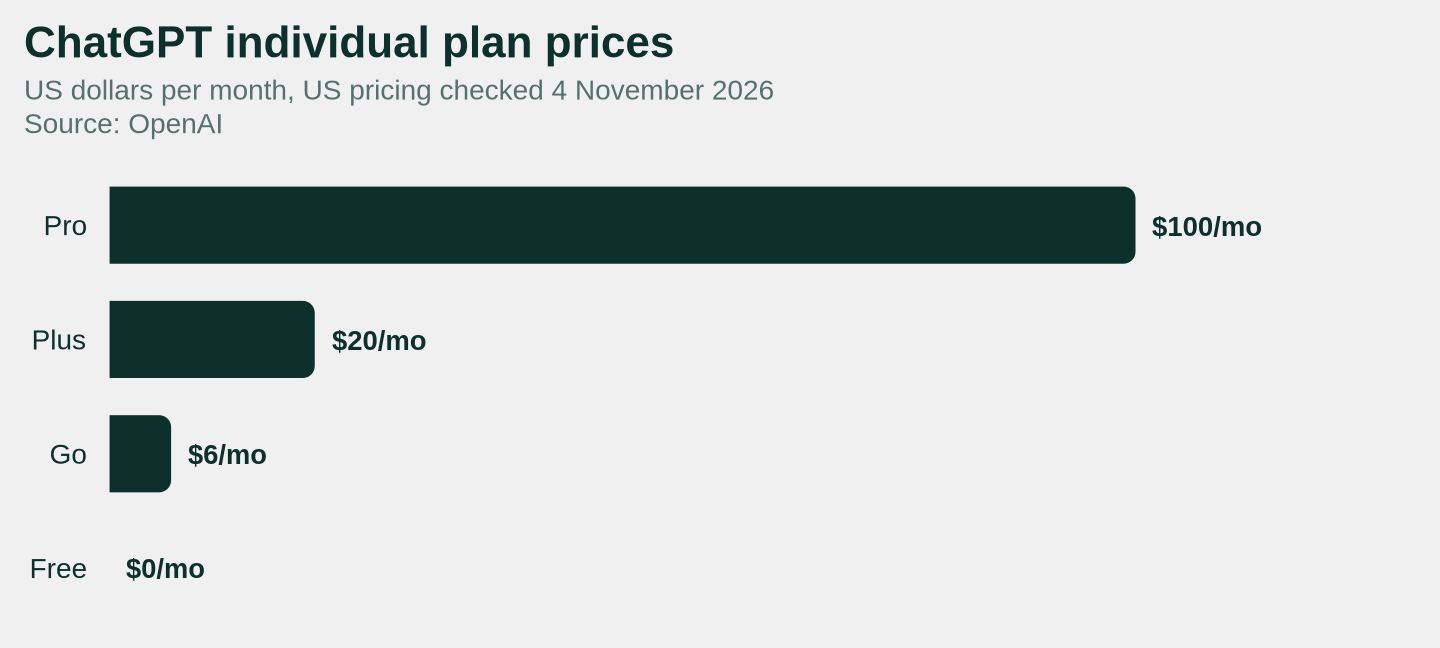
Scale is the second. OpenAI said on October 7, 2026, that more than 1.2 billion people use ChatGPT each week. Paid plans sit behind that: in the US in November 2026, ChatGPT costs $0 for Free, $6 for Go, $20 for Plus and from $100 a month for Pro. On September 29, 2026, OpenAI introduced ChatGPT Pro 500, a $500-a-month plan.
Commercial deals matter too. OpenAI announced an expanded Oracle partnership on October 27, 2026, bringing Oracle business applications into ChatGPT. It announced an expanded ServiceNow partnership on October 28, 2026, covering enterprise workflows. OpenAI's revenue-share payments to Microsoft continue through 2030. The companies did not disclose a total cap.
Risks
- Total loss. Private companies can fail, and there is no market floor under the shares.
- No liquidity. Money can stay locked for years, and a listing is not guaranteed.
- Transfer blocks. OpenAI requires written consent before any direct or indirect transfer, and says an attempted transfer that bypasses consent is void.
- Unauthorised products. OpenAI warns that some products marketed around its name may not make the buyer an owner.
- Legal restrictions. US securities laws can restrict private resales. OpenAI warns that unlawful transfers may be cancelled.

This article is for information only and is not investment advice.
Frequently asked questions
Does OpenAI have a stock ticker? No. There is no exchange ticker, because the company is not listed as of November 4, 2026. Symbol-style labels on finance sites are internal references for private-company data pages, not exchange symbols, and nothing trades behind them.
Can someone in Europe buy OpenAI shares? Not through a normal broker. Access depends on the specific offering and on eligibility: Nasdaq Private Market lists OpenAI for eligible institutional or accredited-entity investors, and says seller transactions require company approval. A listing on that platform does not mean shares are available to buy.
Why can a sale be blocked after it is agreed? A right of first refusal can let a company or its designee buy the shares on the proposed terms before an outside resale. Separately, Nasdaq Private Market says its OpenAI sellers must obtain company approval, and OpenAI's own policy makes a transfer without prior written consent void.
How many people pay for ChatGPT? In its February 27, 2026 update, OpenAI reported more than 50 million consumer subscribers and more than 9 million paying business users, alongside more than 900 million weekly active users.
Is buying Microsoft stock the same as owning OpenAI? No. Microsoft reported an approximate 24% as-converted interest in OpenAI as of September 30, 2026, but you would own Microsoft shares. Microsoft's price reflects its whole business, including cloud, software and everything else it sells.

Sources
- OpenAI: OpenAI submits confidential S-1 (8 June 2026)
- New York Post: Here’s when top Wall Street executives expect OpenAI will launch its blockbuster IPO (30 October 2026)
- OpenAI: Accelerating the next phase of AI (31 March 2026)
- Reuters: OpenAI cuts funding target by $10 billion, FT reports (31 October 2026)
- Nasdaq Private Market: OpenAI company page
- U.S. Securities and Exchange Commission: Microsoft Form 10-Q (30 September 2026)
- OpenAI: GPT-6 for everyone (7 October 2026)
- OpenAI: Unauthorized OpenAI equity transactions (16 July 2025)
Cover photo by Milad Fakurian on Unsplash.

You might also like
Deepen your knowledge with more articles and inspiration.