Open banking lets you give an app you choose permission to see selected bank account data, or to start a payment from your account. You approve what is shared, and you can withdraw account-information consent later.
One thing is moving right now. On 29 October 2026 the Council adopted its first-reading positions on PSD3 and the Payment Services Regulation, the planned successors to today's rulebook, but the package is not finished. Until it is, the current rules still decide what an app can ask of your bank.
Key takeaways
- Open banking means you let an authorised provider see chosen account data or start a payment.
- Seeing data and moving money are two different permissions, and you can withdraw data consent.
- PSD2 still applies on 26 November 2026, with PSD3 awaiting Parliament's second reading.
What open banking is, in plain words
Three parties are involved: you, your bank, and the app you want to use. The app asks your bank for specific information, or asks to place a payment order. Your bank only does it because you said yes.
The connection runs through an interface your bank provides, often called an API. It's an agreed, secure channel between two systems. Under the current PSD2 framework, the interface lets an identified provider request only the account information you approved or start a payment. The bank then checks that it is really you over a secure connection.
Open banking is not a type of bank. It's not your data becoming public. And it's not handing over your bank login: the rules protect your security credentials from access by other parties, so the provider doesn't need your bank password.
The two permissions: seeing data and moving money
These are two different permissions. An account-information service brings your account data together for you. A payment-initiation service places a payment order at your request. Seeing data does not let a provider start a payment.

The providers have different legal requirements. A firm offering only account information must register with the regulator in its home country and hold insurance or similar financial protection. A payment-initiation provider must be authorised as a payment institution, a regulated payment provider, and meet a similar insurance or guarantee requirement.
Two words are worth separating. Authentication is your bank checking that it is really you. This usually uses a security check called strong customer authentication. Payment authorisation is your permission to make a payment. You may give that permission through the payment-initiation provider.
How a connection works, step by step
A typical journey under the current rules runs like this.
- You choose a service, such as a budgeting app, an accounting tool or a checkout that pays directly from your bank account.
- You select your bank and the relevant account.
- You give the provider permission for the account access or the payment you want.
- The provider starts your bank's authentication flow, often by sending you to the bank's site or app.
- Your bank verifies that it's you.
- A secure interface returns the permitted data, or processes the payment order.
You can withdraw account-information consent later, and the provider must then stop accessing the data. One detail: the rules don't prescribe a single screen-by-screen design, so the exact wording you see varies by bank and app.
For payments specifically, the payer must consent, and the bank must apply strong customer authentication for electronic payment initiation, subject to the applicable exemptions. The current rules allow that consent to be given through the payment initiation provider, without requiring a second separate consent at the bank.
What people actually use it for
Account aggregation is one use. An authorised account-information provider may access information from the online-accessible payment accounts you designate and their associated transactions: account details, balances and transaction history. It may not access sensitive payment data, and it doesn't get blanket access to every kind of financial account you hold.
That matters if you're a freelancer or run a small company. Instead of exporting statements, you can let an accounting tool or a lender look at the incoming and outgoing payments on the accounts you chose. The permission is limited to what you designated.
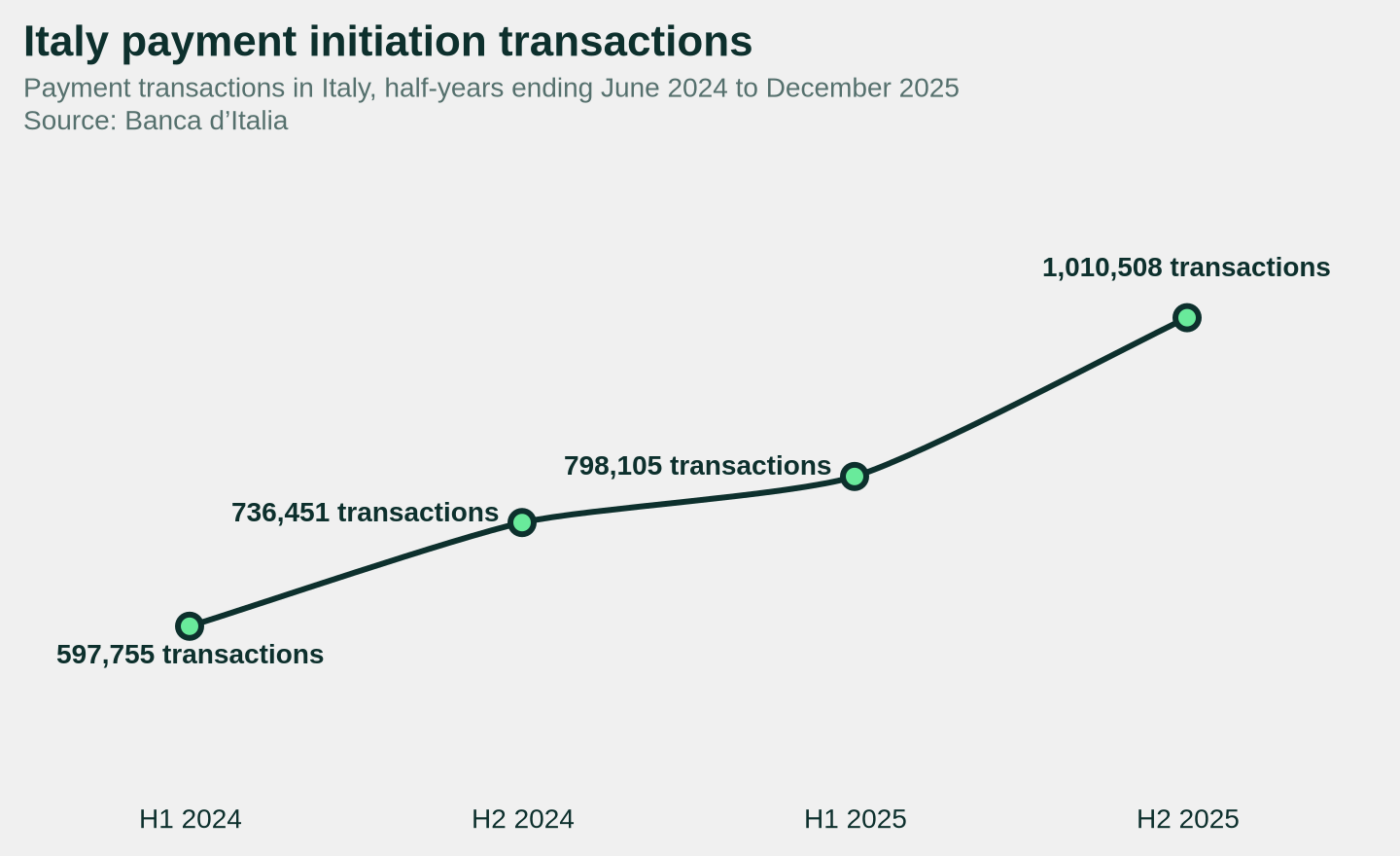
Then there are payments straight from a bank account, with no card. Volumes are measurable. In Italy, Banca d'Italia reported 1,010,508 payment transactions initiated by payment initiation providers in the second half of 2025, the latest half-year in a table published on 19 May 2026. The earlier half-years in the same table show 597,755 transactions in the first half of 2024, 736,451 in the second half of 2024, and 798,105 in the first half of 2025.
If you're comparing where your business banking sits, see our guide to business bank accounts in Europe.
Is it safe, and what are you actually sharing?
Open banking doesn't remove risk. It changes how access is requested, approved and withdrawn.
The protections are real. An account-information provider needs your explicit consent. It may access only the accounts and transactions you chose. It must not request sensitive payment data. It may use or keep data only to provide the service you asked for. EU privacy law, known as GDPR, requires data to be used only for stated purposes, limited to what is necessary and kept secure. It also gives you a right to withdraw consent where consent is the basis for processing. A provider offering only account information must also hold professional indemnity insurance or a comparable guarantee covering liability for unauthorised or fraudulent access to payment-account information.
If a payment is initiated without your authorisation through a payment initiation provider, the bank that holds your account must refund you, and the provider must compensate the bank if it's liable.
The European Banking Authority names several risks. You may grant wider access than you need. Phishing and other tricks can steal your bank login details. A provider or its systems can suffer a breach. Information can be misused. A connection you have forgotten about may keep allowing access until you withdraw consent. Data can also become out of date. GDPR requires personal data to be accurate and kept up to date where necessary.
One practical limit worth knowing. A dashboard inside your bank to review and revoke third-party permissions is not universally required: the EBA said the framework was silent on revocation through the bank and recommended adding that option. Your bank can separately deny a provider access for objectively justified and evidenced unauthorised or fraudulent access.
The European rules, and what comes next
PSD2 is why an app can ask to link your account at all. It gives you the right to use account-information services for online-accessible payment accounts, requires providers to have your explicit consent and limit access to the accounts you designate, and requires banks to communicate securely with those providers without discriminating against data requests except for objective reasons.

On 26 November 2026, PSD2 remains in force and is the current EU directive governing payment services. PSD3 and the Payment Services Regulation have not replaced it. The Council adopted its first-reading positions on 29 October 2026, and the Parliament procedure was listed as awaiting second reading, with a plenary date indicated for 14 December 2026. On 3 November 2026 the European Commission said it supported and could accept the Council's positions. Parliament's ECON Committee published draft second-reading recommendations for both texts on 20 November 2026, and as of the Parliament's procedure update on 24 November 2026, formal adoption remained pending. Under the Council's 29 October proposal, banks would have to offer a free dashboard to manage and withdraw recurring consents, avoid unjustified access obstacles, and in some cases reimburse victims of payment-provider impersonation fraud.
Frequently asked questions
Does an app get access to all my bank accounts?
No. Access is limited to the online-accessible payment accounts you designate and their associated transactions. The provider may see account details, balances and transaction history for those accounts, but not sensitive payment data, and it doesn't get blanket access to every financial account you hold.
Can an app take money from my account?
Not on its own. A payment initiation provider places a payment order at your request, and the payer must consent to the payment. The bank applies strong customer authentication for electronic payment initiation, subject to the applicable exemptions. If an unauthorised payment is initiated through a payment initiation provider, your bank must refund you.
Can I cancel access later?
Yes for account information. You can withdraw consent from the provider, and once withdrawn the provider must stop accessing the data. Under the EBA's reading of PSD2, your bank cannot itself revoke your consent. A bank-side dashboard to manage permissions is not a universally required route, though the EBA recommended adding one.
Who is allowed to ask for this access?
Only registered or authorised providers. A firm offering only account information registers with its home-state authority and must hold professional indemnity insurance or a comparable guarantee. A payment initiation provider must be authorised as a payment institution and meet a similar requirement.

Sources
- Banca d’Italia: Payment system statistics (19 May 2026)
- EUR-Lex: Directive (EU) 2015/2366 on payment services (PSD2)
- European Banking Authority: Response to the call for advice on the review of PSD2 (2022)
- Council of the European Union: PSD3 and Payment Services Regulation first-reading position (29 October 2026)
- European Parliament Legislative Observatory: Payment services procedure 2023/0209(COD) (24 November 2026)
- EUR-Lex: Delegated Regulation on strong customer authentication and secure communication
Cover photo by CardMapr.nl on Unsplash.

You might also like
Deepen your knowledge with more articles and inspiration.