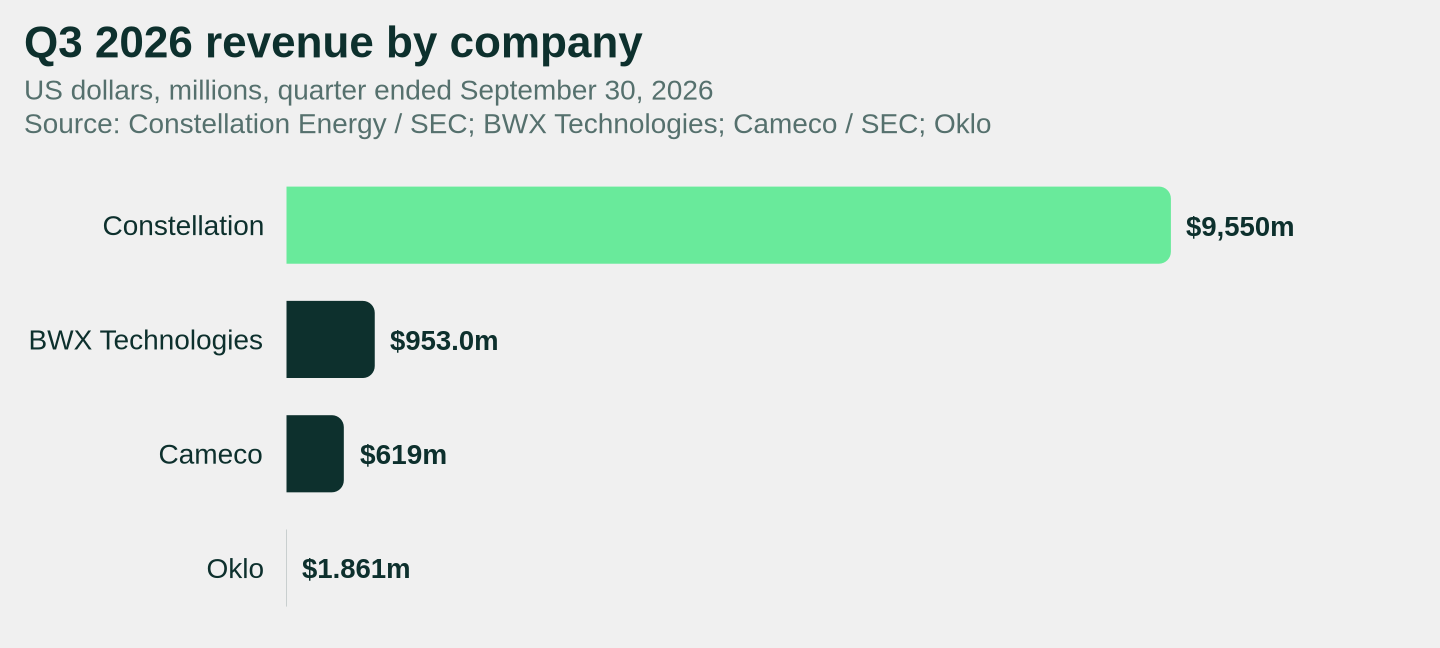
Ranked by revenue in the quarter ended September 30, 2026, Constellation Energy comes first with $9.550 billion, ahead of BWX Technologies, Cameco and Oklo. These four are not the same business. One sells electricity from reactors it already runs, one makes reactor equipment, one mines uranium, and one is still developing a reactor.
Key takeaways
- Constellation Energy leads this ranking with $9.550 billion of revenue in the quarter ended September 30, 2026.
- The four companies do different jobs: generating power, supplying reactor equipment, mining uranium, developing small reactors.
- Oklo reported $1.861 million of revenue in that same quarter.
- Watch contracts and permits: a US construction permit does not allow a reactor to operate.
- Power prices, outages, licensing delays and issuing new shares are the main risks in this group.
The ranking at a glance
The measure is simple: revenue reported for the quarter ended September 30, 2026. Only companies with a stated figure for that quarter are ranked here.
| Rank | Company (ticker) | Q3 2026 revenue (quarter ended Sep 30, 2026) | Market value (Nov 10, 2026) | What it does |
|---|---|---|---|---|
| 1 | Constellation Energy (CEG) | $9,550 million | $94.09 billion | Operates nuclear stations and sells electricity |
| 2 | BWX Technologies (BWXT) | $953.0 million | $11.60 billion | Reactor technology, components and services |
| 3 | Cameco (CCJ) | $619 million | $31.72 billion | Uranium mining and production |
| 4 | Oklo (OKLO) | $1.861 million | about $4.89 billion | Develops advanced reactors |
The three largest figures were reported on November 9, November 2 and October 30, 2026 respectively.
The four companies ranked by revenue for the quarter ended September 30, 2026
1. Constellation Energy: $9,550 million
Constellation reported $9.550 billion of revenue and $1.835 billion of net income attributable to common shareholders for the quarter. At the end of 2025, it ran a fleet of 14 nuclear stations with 25 units in service. Its own filings name power-price volatility and reactor outages as material operating considerations.
2. BWX Technologies: $953.0 million
BWX Technologies reported revenue of $953.0 million and net income of $102.0 million on November 2, 2026. The same release said its reactor technology had been selected for the US Army's Janus Program and a Prodigy Clean Energy project. At the end of 2025, it had $7.3 billion of funded and unfunded work still to complete.
3. Cameco: $619 million
Cameco reported revenue of $619 million and net earnings of $43 million for the quarter. Its McArthur River mine and Key Lake mill returned to full production on May 27, 2026 after a supply-route disruption, with the 2026 production outlook unchanged. Cameco said its 2025 uranium revenue rose 7%, mainly because the average realised price in Canadian dollars rose 9%, partly offset by 2% lower sales volumes.
For the wider list of listed uranium companies, see our guide to uranium stocks.
4. Oklo: $1.861 million
Oklo reported revenue of $1.861 million and a net loss of $41.746 million for the quarter. On November 6, 2026, it announced a manufacturing agreement with U.S. Forged Rings to reserve planned capacity for future components, with initial deliveries targeted for 2030. Project-stage developers generally carry more execution and financing risk than established utilities, because they depend on licensing, funding, customer contracts and construction. On September 11, 2026, Oklo launched a stock-sale programme of up to $1 billion, and later reported $2.254 billion in net proceeds from common-stock sales in the first nine months of 2026.
What you are actually buying: three kinds of nuclear company
Utilities and power producers. A nuclear utility owns or operates plants and often sells under regulator-approved rates. An independent power producer mainly sells wholesale, so its income moves with energy, capacity and service prices. A power purchase agreement sets the price, quantity and delivery period. It can make revenue more predictable without removing market or performance risk.
Reactor builders and suppliers. They sell designs, engineering, equipment, construction or services, plus fuel-cycle products. Their results depend on contracted work rather than the market price of uranium, as BWX Technologies' $7.3 billion of work still to complete at the end of 2025 shows.
Small reactor developers. They design and license smaller reactors and chase customers, financing and eventual projects, rather than operating plants today. The gap is not always "no revenue": NuScale reported engineering and licensing revenue for 2025, and on November 5, 2026 it announced a Doosan Enerbility contract to manufacture the upper reactor coolant system of its module. Its own risk factors list construction and manufacturing delays, regulatory and permit delays, difficulty securing binding contracts and financing, and dilution if new shares are issued.
The road from design to electricity. A developer must first mature the design, then obtain the US regulator's approvals: a construction permit and later an operating licence, or a combined licence with operation conditional on required tests and inspections. Then it needs credible customers, usually through a contract to buy future output. It also needs a funding plan that can support the project. Before fuel loading, it needs a qualified fuel supply and the fabrication, transport and storage arrangements that go with it. Finally it must build, test, obtain authorisation to operate and secure grid interconnection, which involves studies, grid upgrades and an interconnection agreement.
What could change the picture
- The International Energy Agency forecasts global electricity demand to grow by an average 3.6% a year over 2026–2030, with nuclear contributing to data-centre demand and substantial uncertainty in the outlook.
- Demand turns commercial when contracts are signed. Constellation announced a 20-year Amazon agreement on September 30, 2026 supporting a planned 190-MW Calvert Cliffs uprate, and a 20-year Google agreement on October 6 for about 890 MW of planned uprates.
- On October 27, 2026, the US Department of Energy announced a conditional loan commitment of up to $5 billion for Constellation uprates and modernisation expected to add nearly 1.1 gigawatts, still contingent on technical, legal, environmental and financial conditions.
- Permits are not plants. On November 9, 2026, the NRC issued a construction permit for a proposed four-reactor Xe-100 facility in Texas, which does not authorise operation, and Dow said it had not made a final decision to proceed.
- The OECD Nuclear Energy Agency estimates financing costs can account for two-thirds of nuclear electricity costs when the rate paid to fund a project is 9%, against less than one-third at 3%.
- Supply chains and people are constraints too, with long lead times, obsolete equipment, suppliers leaving the market and workforce retirement.
Funds that hold nuclear companies
A fund spreads money across several of these businesses instead of one. VanEck's NLR follows an index covering uranium miners, nuclear power producers, reactor and facility construction and engineering, and nuclear-industry equipment and services. As of November 9, 2026, its holdings included Constellation and Public Service Enterprise Group alongside Cameco, uranium explorers and miners, BWX Technologies, the enrichment firm Centrus and small reactor companies. Global X's URA describes a narrower focus around uranium mining, exploration, uranium investments and related technologies, so the two are not interchangeable.
To understand how these funds work, read our explainer on ETFs versus index funds.
Risks
- Outages can cut generation and raise replacement-power costs, and wholesale electricity and fuel prices move earnings in both directions.
- Developers face construction and manufacturing delays, regulatory and customer-permit delays, financing gaps and dilution when new shares are issued.
- Licensing delays can push up construction and financing costs, which is why the IEA stresses timely reviews.
- Some advanced designs need high-assay low-enriched uranium. This fuel is enriched above 5% and below 20% uranium-235. Near-term supply and processing capacity are limited.
- Share prices in this sector are volatile and sentiment shifts quickly.
This article is for information only and is not investment advice.
Frequently asked questions
Are uranium stocks the same as nuclear energy stocks?
No. Miners are most directly exposed to uranium-market conditions, which is why Cameco's 2025 uranium revenue rose 7% mainly on a 9% higher average realised price in Canadian dollars. Reactor builders and equipment suppliers depend instead on winning, funding and executing projects and on their order books. Utilities depend on electricity prices, output and outages.
What does a euro-based investor need to know about US-listed shares?
Exchange-rate moves can change the euro value of an investment, and even dollar-denominated shares of foreign issuers can be affected by the currencies their companies earn in. US-source dividends paid to a nonresident are generally subject to 30% US withholding unless a tax treaty allows less, which a valid Form W-8BEN can be used to claim. Dividends from a foreign corporation are generally not subject to that withholding, even with a US listing. Tax in your own country may apply as well, and the treatment varies by EU country.
Can an old reactor simply keep running, or restart?
Not automatically. Licence renewal requires a safety case covering ageing effects and showing they will be managed during the extended operating period. A restart needs regulatory approval and readiness work, including restoring the plant's operational licensing basis and returning components to a condition that supports safe operation, sometimes with repairs or upgrades. Constellation says its Crane restart, covered by a 20-year Microsoft power purchase agreement, could happen as early as 2027, subject to approvals and permits.
Which advanced reactors need high-assay low-enriched uranium?
Several designs use or propose it. TerraPower's Natrium uses fuel enriched up to 19.75% uranium-235, and X-energy's Xe-100 uses fuel enriched to 15.5%. Supply stays tight because several steps are needed to make usable fuel, and capacity is limited.
What recent deal is pending at Constellation?
On November 9, 2026, alongside its quarterly results, Constellation said it had agreed to acquire the 609-megawatt Rhode Island State Energy Center for $715 million. The acquisition remained pending regulatory approvals and other closing conditions, so it is agreed rather than completed.

Sources
- Constellation Energy / SEC: Q3 2026 results (November 2026)
- BWX Technologies: Q3 2026 results (November 2026)
- Cameco: McArthur River/Key Lake operation resumes production (May 2026)
- International Energy Agency: Electricity 2026: Executive summary (October 2026)
- U.S. Department of Energy: $5 billion loan commitment for nuclear power (October 2026)
- U.S. Nuclear Regulatory Commission: Construction permit issued for Xe-100 facility (November 2026)
- Internal Revenue Service: Withholding on US-source income paid to nonresident aliens
Cover photo by Nicolas HIPPERT on Unsplash.

You might also like
Deepen your knowledge with more articles and inspiration.