Uranium stocks are shares in listed companies. These companies can mine uranium, develop future mines or process and enrich nuclear fuel. The listed names are Cameco, Kazatomprom, Uranium Energy Corp, Energy Fuels, Centrus Energy and NexGen Energy. They do very different jobs, and their shares do not all move with the uranium price.
One point sets the tone for the whole list. On 30 October 2026, Cameco reported net earnings of C$43 million for the quarter ended 30 September, while NexGen had not yet produced a single pound of uranium for sale. Same sector, completely different businesses.
Key takeaways
- A uranium stock can be a producer, a mine developer or a fuel processor.
- Cameco ranks first here: it produces, refines, converts and owns 49% of Westinghouse.
- NexGen is not yet producing uranium.
What counts as a uranium stock
Nuclear fuel goes through several steps before it reaches a reactor. The International Atomic Energy Agency describes the usual front end of the fuel cycle. Companies mine ore and mill it into uranium concentrate. They convert it to UF6, or uranium hexafluoride, before enriching it where needed. They then make fuel pellets, rods and assemblies for reactors. Some reactor types run on natural uranium and skip the enrichment step.
Mining itself comes in two flavours. Conventional mining digs the rock out, by open pit or underground, and sends it to a mill. In-situ recovery, usually shortened to ISR, circulates a solution through wells to dissolve the uranium underground, then pumps the liquid back up.
Why the interest? The International Energy Agency forecasts average global electricity demand growth of 3.6% a year over 2026–2030, and describes nuclear as a source that can reduce dependence on imported fuels. Electricity demand from data centres is part of that story. For the companies driving it, see our ranking of the biggest AI companies in 2026.
Uranium stocks in 2026, ranked
The ranking below uses one measure: how established the commercial operations are, then how much of the nuclear fuel chain the company covers. Recent share performance plays no part.

| Company | Ticker | Listed | Role | Producing in 2026? |
|---|---|---|---|---|
| Cameco | CCO (TSX), CCJ (NYSE) | Canada, US | Mining, refining, conversion | Yes |
| Kazatomprom | KAP (AIX, LSE GDRs) | Kazakhstan, UK | ISR mining | Yes |
| Uranium Energy Corp | UEC (NYSE American) | US | ISR mining | Yes |
| Energy Fuels | UUUU, EFR, EF2 | US, Canada, Australia | Conventional mining | Yes |
| Centrus Energy | LEU (NYSE) | US | Enrichment | No mining |
| NexGen Energy | NXE, NXG | Canada, US, Australia | Mine under construction | No |
1. Cameco
Cameco spans uranium production, refining and conversion, and owns 49% of Westinghouse, a company that makes reactor technology. Its Saskatchewan operations include the Cigar Lake and McArthur River mines with the Key Lake mill, and it holds 40% of the Inkai joint venture in Kazakhstan, where Kazatomprom holds 60%. On 30 October 2026 it narrowed 2026 uranium production guidance to 19.5–20.5 million pounds from Cameco's share of production, with a longer planned maintenance shutdown underway at the Key Lake mill. Its contracts cover average annual deliveries of more than 28 million pounds of uranium oxide, written as U3O8, over 2026–2030.
2. Kazatomprom
Kazatomprom says its attributable production represented about 20% of global primary uranium production in 2025, all of it mined by ISR in Kazakhstan. It reiterated 2026 production guidance of 27,500–29,000 tonnes of uranium on a 100% basis and 14,500–15,500 tonnes attributable to Kazatomprom. The state held 75% as of 30 June 2026, split between the Samruk-Kazyna fund and the Ministry of Finance, leaving 25% available for public trading. Logistics is the live risk. In August 2026, Fitch Ratings reported that more than half of Kazatomprom's shipments to Western customers use the Russian port of St Petersburg, and identified possible sanctions as a risk rather than a current restriction.
3. Uranium Energy Corp
UEC produces through ISR operations in Wyoming and Texas. For the fiscal year ended 31 July 2026 it reported 229,294 pounds of production: 211,942 pounds at Christensen Ranch in Wyoming and 17,352 pounds from Burke Hollow in Texas, where production began in April 2026. On 5 November 2026 it announced long-term agreements with two US nuclear utilities for 1.1 million pounds of U3O8 in total, priced at prevailing spot prices. Its fiscal-2026 filing records 21,177,233 shares issued through market share-sale programs in 2024 and 2025, for $292.61 million gross proceeds.
4. Energy Fuels
Energy Fuels produces conventional uranium ore in Arizona and Utah, and its Nichols Ranch ISR project is restart-ready. On 4 November 2026 it reported Q3 2026 total revenue of US$29.180 million and a net loss of US$52.206 million for the quarter ended 30 September. It sold 0.32 million pounds of U3O8 in that quarter. The same release said the ASM acquisition was completed in August, while the VAC acquisition remained pending, with closing expected in Q1 2027.
5. Centrus Energy
Centrus trades as LEU on the New York Stock Exchange and runs uranium-enrichment activities in Ohio, with centrifuge manufacturing in Tennessee. It does not mine uranium. That matters for how you read it: enriched fuel is a processed product, so Centrus sits on a different step of the chain from every other name in this list. On 19 October 2026, Centrus announced its approximately US$116 million acquisition of Westerman Holdings, a centrifuge-component supplier.
6. NexGen Energy
NexGen trades as NXE in Canadian dollars on the Toronto exchange and in US dollars on the NYSE, plus NXG in Australian dollars. It is not yet producing, because its conventional underground Rook I mine in Saskatchewan is under construction. On 5 November 2026 it announced a Q3 2026 conference call scheduled for 10 November.
Why uranium shares and the uranium price move apart
A producer rarely sells at the current market price. Cameco has contracts to deliver more than 28 million pounds of U3O8 a year on average over 2026–2030, with commitments above that average in 2026–2028 and below it in 2029–2030.
Some contracts do follow the market. UEC's two November 2026 utility agreements are priced at prevailing spot prices, with annual 100,000-pound deliveries from 2027–2032 under one contract and 2028–2032 under the other.
Developers have no uranium revenue to compare with any price at all. And enrichment companies like Centrus sell a processed product, not raw ore.
Risks
- Uranium is a cyclical commodity and the listed sector is small, so share moves can be sharp.
- Project risk is real: Cameco flagged a longer planned maintenance shutdown at the Key Lake mill in its October 2026 report.
- Funding and dilution: UEC issued 21,177,233 shares through its 2024 and 2025 at-the-market programs for $292.61 million gross.
- Country and route risk: Kazakhstan accounted for about 39% of global uranium production in 2025, and Fitch flagged sanctions as a possible risk to Kazatomprom's export routes.
- Currency: these shares are quoted in Canadian dollars, US dollars, Australian dollars or tenge, so the euro or krona rate affects what you get back.

This article is for information only and is not investment advice.
Frequently asked questions
Is Cameco the world's largest uranium producer?
No. Cameco is reasonably described as the largest Western producer: it reported 21.0 million pounds of attributable production in 2025. Kazatomprom identifies itself as the global leader, and Cameco's own materials describe it more cautiously as one of the largest global providers.
What does Cameco do besides mining?
It refines and converts uranium. Its investor presentation gives approximately 32 million kgU of UF6 conversion production for 2026, described as 85% of Western capacity. Westinghouse is owned 49% by Cameco and 51% by Brookfield.
How much uranium do these companies actually sell?
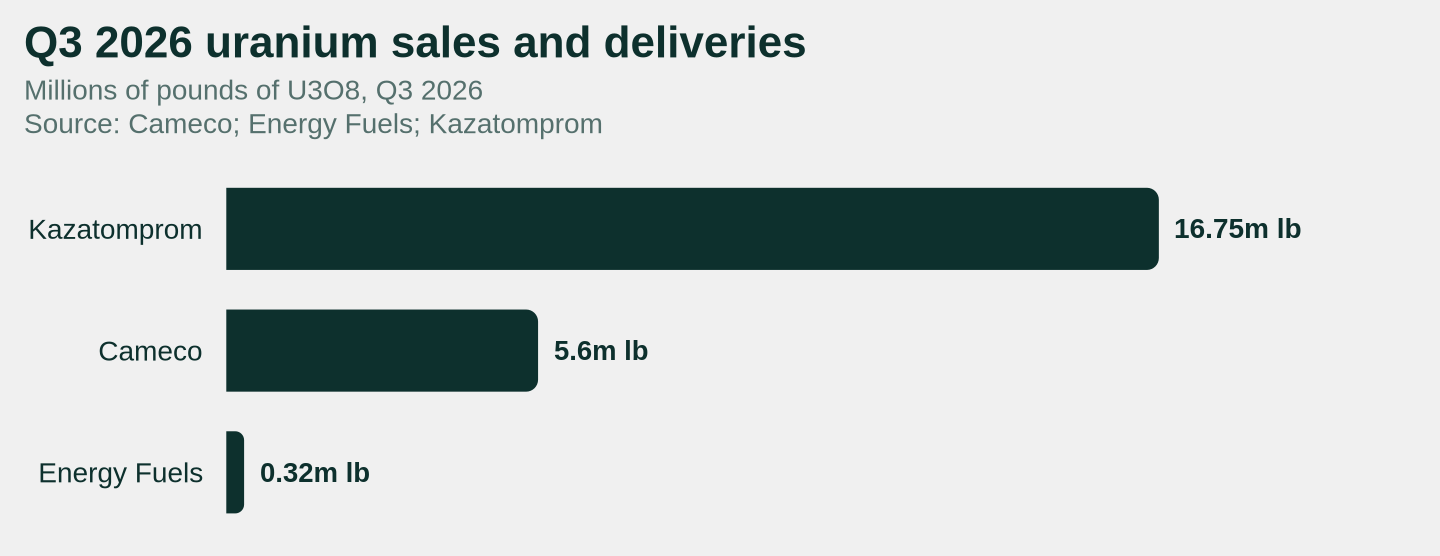
In Q3 2026, Cameco delivered 5.6 million pounds of U3O8 and Energy Fuels sold 0.32 million pounds. Kazatomprom reported provisional group sales of 16.75 million pounds, covering the company and its consolidated subsidiaries.
Where can I see how a sector fund compares with a broad index?
A themed fund removes single-company risk but keeps full sector risk, which a broad index fund spreads differently. For the mechanics of broad index investing in Europe, read our guide to investing in the S&P 500.
When is the next round of results?
Cameco planned its annual and fourth-quarter results for 12 February 2027. NexGen scheduled its Q3 2026 conference call for 10 November 2026.

Sources
- International Atomic Energy Agency: What is the nuclear fuel cycle? (2026)
- International Energy Agency: Electricity 2026: Executive summary (2026)
- Cameco: 2026 third-quarter reports (2026)
- Kazatomprom: Q3 2026 operating results (2026)
- U.S. Securities and Exchange Commission: Uranium Energy Corp annual report for fiscal 2026 (2026)
- Energy Fuels: Energy Fuels announces Q3 2026 results (2026)
- U.S. Securities and Exchange Commission: Centrus Energy acquisition of Westerman Holdings (2026)
- NexGen Energy: NexGen receives final federal approval for the Rook I uranium project
Cover photo by Abdul Basit on Unsplash.

You might also like
Deepen your knowledge with more articles and inspiration.