An ETF describes how you buy a fund: on a stock exchange, during market hours, at a market price that can differ from the fund's underlying value. An index fund describes what the fund tries to do: match an index's return before fees. Many funds are both.
On October 30, 2026, State Street launched SPYMX, a mutual-fund share class of its SPYM S&P 500 ETF that invests in the same underlying pool of assets.
Key takeaways
- An ETF is a way of trading a fund, while an index fund is what the fund tracks.
- ETFs can trade during market hours, while index mutual funds price once a day.
- Platform fees, spreads and currency charges add to the annual fund fee.
What an ETF is, and what an index fund is
An ETF is a fund that trades on a stock exchange. Retail investors trade its shares on an exchange at market prices.
An index fund seeks approximately to match a selected index's return before fees. An index mutual fund is simply the mutual-fund form of that.
So the two words answer different questions. The US Securities and Exchange Commission updated its ETF investor bulletin on October 27, 2026, explaining that ETFs can be index-based or actively managed. The ETF label does not guarantee broad diversification either: a fund may hold relatively few investments, or even track one stock.
For a worked example of buying one index, see our guide to investing in the S&P 500.
Key differences at a glance
| ETF | Index mutual fund | |
|---|---|---|
| How you buy it | Through a broker on an exchange, during market hours | At the fund's value, calculated once a day |
| Price you get | Changing bid and ask prices, which can differ from the fund's underlying value | The next value calculated after your order arrives |
| If you order when markets are shut | The order is generally queued for the next opening | Priced at the next calculation |
| Minimum | Set by the platform, from €10 on Interactive Brokers Ireland's recurring plans | Set by the fund manager, though Saxo says most are waived for its clients |
| Fractional units | Available on some platforms, not all | Not an issue, you buy an amount |

Availability of each fund and each feature depends on your broker. Tax treatment varies by country and personal situation, and is not covered here.
Fees: the annual charge is only part of it
Examples of annual fees on broad index funds include: State Street reported the SPYM S&P 500 ETF's annual gross expense ratio as 0.02% on November 6, 2026. Its SPYMX mutual-fund share class showed 0.02% gross and 0.01% net on November 5, 2026. BlackRock's iShares Core S&P 500 ETF had a 0.03% annual expense ratio in its current prospectus, on a page updated November 3, 2026.
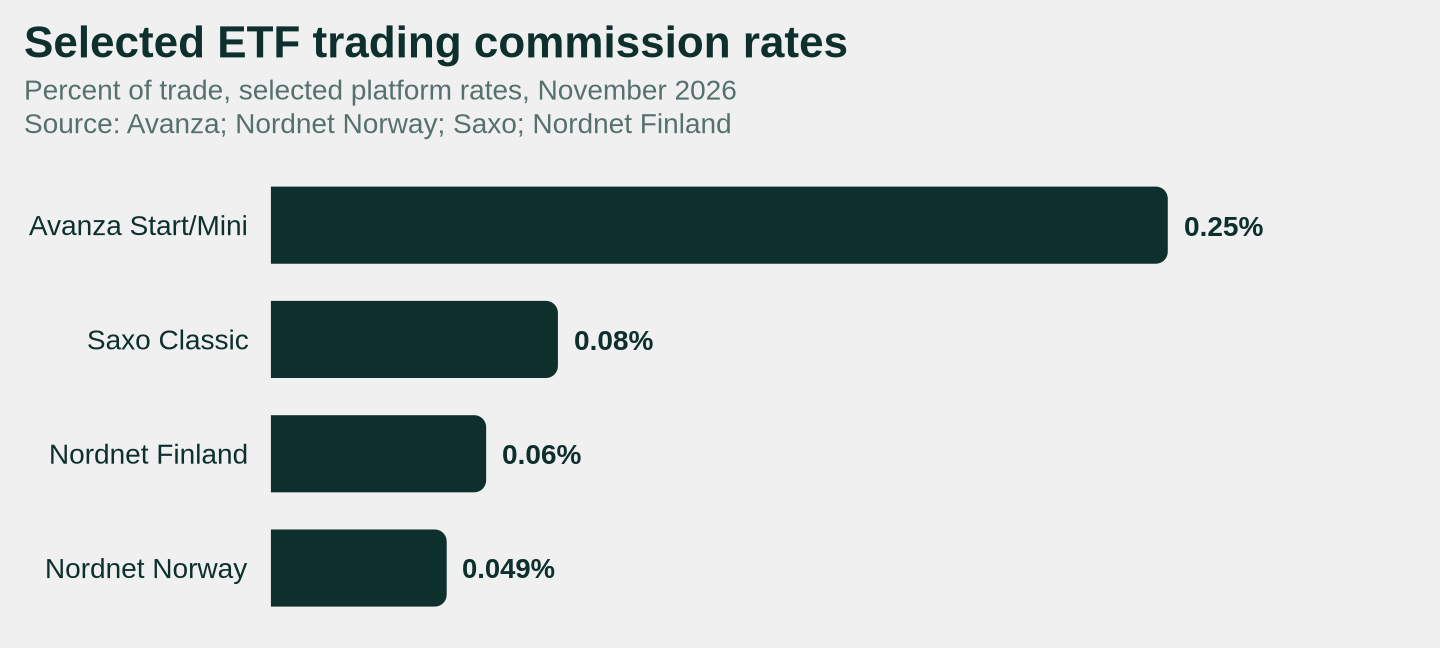
Then come the platform costs, which are often larger than the fund fee:
The SEC's guidance is to compare the same exposure over your expected holding period, counting the ongoing expense ratio, broker commission, platform or custody fee, the ETF's bid-ask spread and any currency charges, rather than expense ratios alone. The bid-ask spread is the gap between the buying price and the selling price, and you pay it every time you trade.
Trading and liquidity: intraday price versus daily value
An ETF's market price is what buyers and sellers agree on during the day. Its net asset value is the per-share value of fund assets minus liabilities, generally calculated daily. Supply and demand can leave the market price temporarily above that value or below it.
Large financial firms can trade large blocks of ETF shares directly with the fund. This can narrow the gap, but it does not ensure it disappears.
With an index mutual fund, your purchase or sale is priced at the next value calculated after the order is received, so you don't know the exact price when you place it. With an ETF, a market order placed while the exchange is shut is generally queued for the next opening and executes at the price then available, which may differ from the last quote.
Trading volume alone does not show how easily you can trade. The bid-ask spread, available buy and sell orders, and the liquidity of the fund's holdings also matter.
Three mix-ups worth clearing up
- "They're opposites." They're not. An ETF can track an index or be actively managed.
- "Every ETF is diversified." No. The ETF label does not guarantee broad diversification, and a fund may hold relatively few investments. For an example of concentrated exposure, see our ranking of quantum computing stocks.
- "Only mutual funds can be automated." Interactive Brokers Ireland offers commission-free recurring plans in eligible ETFs using fractional shares.

Verdict: it depends on what you want
There is no single winner: it depends on what you want. A difference is timing and the way you pay. An ETF trades on an exchange during market hours at a changing market price. An index mutual fund is bought at a value calculated once a day, known only after the calculation.

ETFs: suit people who need to trade during market hours.
Index mutual funds: suit people who accept a price calculated once a day.
Risks
- Funds can lose value, including broad index funds. Past performance does not predict future results.
- An ETF's market price can sit above or below the value of its holdings.
- Wide bid-ask spreads and thin market depth make an ETF more expensive to trade.
- In November 2026, Nordnet Norway charged 0.25% per currency conversion, which can add up with frequent buying.
- An index fund only seeks to approximately match its index's return before fees.

This article is for information only and is not investment advice.
Frequently asked questions
Is an ETF an index fund? It can be. An index fund is defined as a mutual fund, ETF or unit investment trust that seeks approximately to match an index's return before fees. But ETFs can also be actively managed, so the label alone doesn't tell you.
Which has the lower annual fee? Neither category wins automatically. State Street's SPYM ETF and its SPYMX mutual-fund share class both showed a 0.02% gross expense ratio in early November 2026, and they invest in the same underlying pool.
Can I invest a fixed amount every month in an ETF? On some platforms, yes. Interactive Brokers Ireland offers commission-free recurring plans in eligible ETFs and uses fractional shares. Saxo AutoInvest buys whole units only.
What happens if I place an ETF order at night? An ordinary market order sent while the exchange is closed is generally queued for the next opening and executes at the price available then. Handling depends on your broker, the order type and the trading sessions on offer.
Do fund minimums block small investors? Fund minimums are set by the manager and differ by fund. Saxo's fund-trading guidance says most of those minimums are waived for its clients.

Sources
- U.S. Securities and Exchange Commission, Investor.gov: Exchange-Traded Funds: A Guide for Investors (27 October 2026)
- State Street Investment Management: SPDR Portfolio S&P 500 ETF (SPYM) (6 November 2026)
- Interactive Brokers Ireland: Commission-Free Recurring Investments in ETFs
- U.S. Securities and Exchange Commission, Investor.gov: Index Fund glossary (15 October 2026)
- State Street Investment Management: State Street S&P 500 Index Fund Institutional Shares (SPYMX) (5 November 2026)
- BlackRock: iShares Core S&P 500 ETF (IVV) (3 November 2026)
Cover photo by David Vives on Unsplash.

You might also like
Deepen your knowledge with more articles and inspiration.