N26 is a real bank, not only an app: N26 Bank SE holds a full German banking licence, and eligible deposits are protected up to €100,000. Whether it's worth paying for depends on how much cash you withdraw and how often you spend outside the euro. The free plan handles everyday payments, and the paid plans mostly buy free cash withdrawals, travel cover and a different card.
Key takeaways
- N26 Bank SE holds a full German banking licence, and eligible deposits are covered up to €100,000.
- In November 2026, plans run from free to €16.90 a month and include withdrawal benefits and travel cover on some tiers.
- That protection covers bank failure, not account reviews or outages, so a backup card helps.
Is N26 a real bank?
Yes. N26 says it holds a full German banking licence granted on 18 July 2016 by the European Central Bank. BaFin is Germany's financial regulator and supervises N26 in Germany. As of November 2026, N26 holds a BaFin-issued banking licence and is jointly supervised by the Deutsche Bundesbank, Germany's central bank. The ECB's supervisory list with a 1 September 2026 cut-off names N26 BANK SE as a credit institution, in other words a licensed bank.

The business behind the app is no longer tiny. For 2025, N26 reported group revenue of €501.6 million and net income of €1.6 million, using its own management-reporting framework. Preliminary first-quarter 2026 figures were revenue of €130.0 million and net income of €9.8 million.
What the €100,000 protection really covers
Eligible deposits in N26 accounts are covered by the Compensation Scheme of German Private Banks, up to €100,000 per depositor per bank, with balances across your accounts added together. The scheme excludes deposits owned by banks, financial-service firms, insurers or public bodies, and it does not cover investments such as securities and cryptocurrencies.
Here's the part people miss. German deposit protection pays out only after BaFin determines a compensation event, meaning the bank cannot repay deposits. It does not guarantee uninterrupted access to your account, and it does not resolve ordinary account reviews, payment disputes, outages or service interruptions. Every regulated bank runs identity checks and checks to prevent money laundering. A check can pause payments or lead to a request for documents. That is a separate question from whether your money is safe if the bank fails.
N26 plans and prices in November 2026
Four plans, all priced in euros on N26's EU plan page.
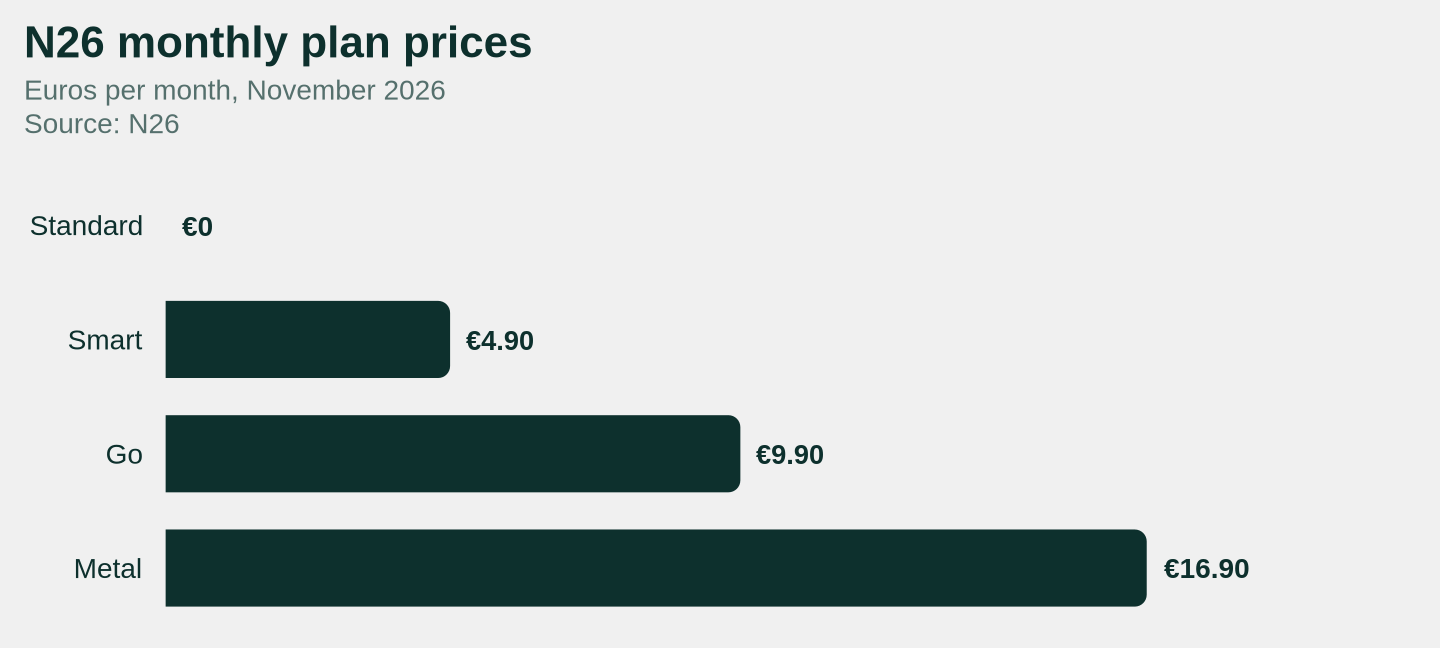
Spaces are sub-accounts inside the app, useful for putting tax money or rent aside. The same four names and monthly prices apply in Germany. N26 lists exclusions for claims tied to pre-existing medical conditions, certain epidemic or pandemic events, war and intentional damage. Financial limits, deductibles and benefit-specific conditions also apply.
Cash, cards and spending abroad
Free cash withdrawals depend on the country where you opened the account, not on where you stand. For Germany, France and the rest of Europe, the monthly euro-ATM quotas are 2 for Standard, 3 for Smart, 5 for Go and 8 for Metal. In Italy, Standard gets 3 and the three paid plans get unlimited withdrawals. In Austria and Spain, all tiers get unlimited withdrawals.

Once the quota is used, each further euro ATM withdrawal costs €2 in November 2026 until the quota resets on the first of the next month. Non-euro withdrawals sit outside that quota. In November 2026, Standard and Smart pay a 1.7% extra charge, while Go and Metal pay no N26 extra charge. ATM operators can add their own charge that N26 cannot reject or reverse, and the machine should show it before you confirm.
Card payments in another currency use Mastercard's exchange rate. N26 says it adds no extra fee for paying in another currency. The rate moves, so the final amount charged can differ from the one you saw. Standard card limits are €1,000 per day and €2,500 per week in most EU countries, with weekly limits of €1,050 in France and €2,000 in Italy.
In November 2026, a Standard physical card costs €10. The first physical card is included on Smart, Go and Metal. In November 2026, a Standard customer's first virtual card is free but needs a one-time minimum balance of €10 to activate. Up to five extra virtual cards cost €2.59 each. Standard delivery takes up to 15 working days. In November 2026, express delivery takes 3 to 4 working days and costs €25 on a first card.
Where N26 works, and where it doesn't
N26's account-opening support list names 21 eligible countries, including Denmark, Finland, Norway and Sweden, and residents must also meet N26's account requirements. Eligibility follows where you live, not your nationality.

Cash deposits are the weak spot of a bank with no branches. N26 lists its CASH26 cash service only for accounts with German, Austrian, Spanish or Italian terms and conditions. In Switzerland, local franc withdrawals count as foreign-currency withdrawals. In November 2026, they have a 1.7% fee and fall outside the free monthly quota.
Who N26 fits, and who needs something else
It fits people who bank from their phone, move around Europe and want to see every payment the moment it happens. Smart adds a physical card and up to 10 Spaces, while Go has no N26 markup on non-euro withdrawals.
Think twice if you handle a lot of cash, since CASH26 is limited to accounts under German, Austrian, Spanish or Italian terms. Think twice too if a single account would hold your salary, your rent and your tax reserve with nothing behind it. Deposit protection answers bank failure, not a blocked payment on a Friday afternoon.
Frequently asked questions
Can N26 be your main account? For app-first daily banking, yes. The practical limits are cash and ceilings, not features. Standard card limits run to €1,000 per day and €2,500 per week in most EU countries, with €1,050 weekly in France and €2,000 weekly in Italy. A second account and a backup card elsewhere cover the days when an app-only bank is not enough.
What does a lost or expiring card cost? In November 2026, reordering a lost, broken or stolen card costs €10 with standard delivery on Standard, Smart and Go. It costs €45 with standard delivery on Metal, with faster options priced higher. Replacing a card that is expiring or has expired is free on Smart, Go and Metal, while Standard customers opened after the applicable 2021 cutoff dates pay the price of a new card.
Does N26 still work in the United States? No. All US N26 accounts were closed on 18 January 2022. Today the account-opening list covers 21 European countries, and you need to be resident in one of them.
Is N26 launching anything new? On 12 November 2026, N26 announced a German private retirement account with Franklin Templeton, planned to launch in the app on 1 January 2027. Pre-registration was open, and the product had not yet launched on the announcement date. The company said Standard portfolios opened by June 2027 would get a permanent service-fee exemption, openings from July 2027 would carry a 0.10% annual fee, and self-directed trades were planned at €0.90 per order. On 8 October 2026, N26 expanded its Flexible Cash Fund to all tiers in 10 European markets, with a variable target return of up to 2.57% a year and no N26 service fee until 1 January 2027.

Sources
- N26: N26 delivers over €500m revenue and €350m gross profit in 2025, hitting first full year of net profitability (2026)
- Compensation Scheme of German Private Banks: FAQs
- N26: N26 plans in Germany
- N26 Support: How often can I withdraw cash for free?
- N26 Support: Is N26 closing all US accounts?
- N26: N26 to launch fully digital private retirement account in Germany with Franklin Templeton (12 November 2026)
- European Central Bank: List of supervised entities (September 2026)
Cover photo by Nico Indii on Unsplash.

You might also like
Deepen your knowledge with more articles and inspiration.