Nvidia earnings: a $115.8 billion quarter, and the board's position on a Huang return
On 17 November 2026, Nvidia reported $115.8 billion in quarterly revenue and $65.287 billion in net income, while its board said it did not intend to reinstate Jensen Huang as chief executive. The company also guided to $130.0 billion, plus or minus 3%, for the quarter under way. And the board chair said the board did not intend to reinstate Jensen Huang as chief executive.
Key takeaways
- Nvidia reported $115.8 billion in revenue for the quarter ended 25 October 2026.
- The company guided to $130.0 billion for the current quarter.
- Revenue was concentrated among a small number of direct customers.
What Nvidia reported for the three months to October
The results cover Nvidia's fiscal third quarter of 2027, which ended on 25 October 2026. The company published them on 17 November.
| Figure (quarter ended 25 Oct 2026) | Reported | Change year over year |
|---|---|---|
| Revenue | $115.8 billion | +103% |
| Net income (GAAP) | $65.3 billion | +105% |
| Diluted earnings per share (non-GAAP) | $2.68 | +111% |
| Data Center revenue | $107.6 billion | +110% |
| Gross margin (GAAP) | 74.8% | +1.4 points |
Two words appear next to most of these numbers. GAAP means the figure follows standard accounting rules. Non-GAAP is the company's own adjusted version, which leaves out some specified items such as acquisition-related costs and legal settlements. Nvidia says the adjusted numbers are supplemental and not a substitute for the standard ones. One change worth knowing: from fiscal 2027, its non-GAAP measures no longer leave out stock-based pay.
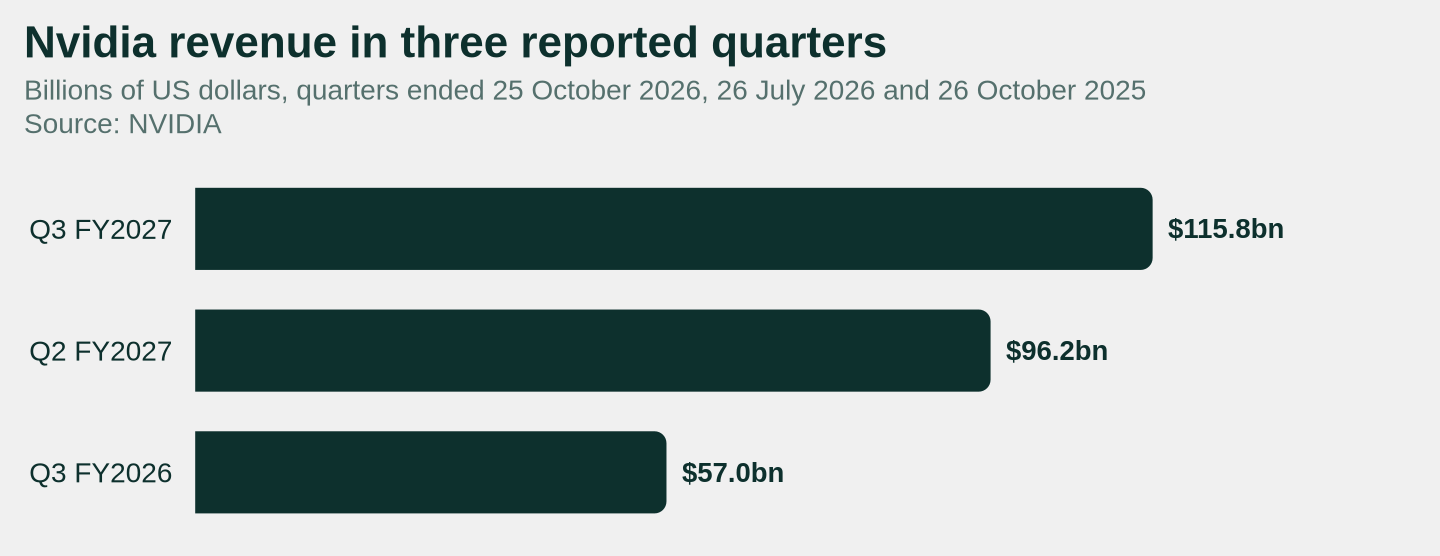
For context on the pace, revenue was $57.0 billion in the quarter ended 26 October 2025 and $96.2 billion in the quarter ended 26 July 2026.
What the numbers say about AI chip demand
Data Center brought in $107.6 billion, up 110% year over year and 21% quarter over quarter. It is not a separate reporting segment. It is part of Nvidia's Compute & Networking segment and includes data-centre products and services. So it is more than chips.
Who is buying? Hyperscale revenue was $60.1 billion. The rest, $47.5 billion, came from AI clouds, industrial and enterprise customers, up 195% year over year. Management also said sovereign AI revenue more than tripled. On the call, management described compute demand as coming from a "diverse and expansive" range of end customers, from hyperscalers and frontier labs to enterprises and governments.
Two details sit behind the growth. Data Center growth reflected continued Blackwell Ultra growth plus $2.4 billion of Hopper shipments to China, and the company said those China shipments had stopped. Nvidia also said production had ramped and that Vera Rubin NVL72 systems had begun shipping. Management called the move from Grace Blackwell to Vera Rubin exceptionally smooth, with production shipments starting in August and Rubin systems arriving at major hyperscalers three months later.
For a view of how one of those buyers is doing, see our breakdown of CoreWeave's quarter.
Why the $130 billion outlook matters
Guidance is the company's forecast for the quarter it is in now, not money already earned. Nvidia guided to $130.0 billion, plus or minus 3%. That quarter includes an extra week, and the forecast assumes no Data Center compute revenue from China.
Reuters reported on 17 November that the LSEG analyst average for that quarter was $125.25 billion.
One number in the outlook points the other way. Nvidia forecast gross margins of 71% to 72% for the quarter, both on a standard and an adjusted basis. That is below the 74.8% standard gross margin it just reported. Operating expenses are forecast at about $11.0 billion on a standard basis and $10.7 billion adjusted.
What changed after Jensen Huang's exit, and what did not
Nvidia announced on 12 November that Jensen Huang had resigned with immediate effect, and that finance chief Colette Kress would serve as interim chief executive while the board looks for a permanent successor. The resignation and Kress's interim appointment were documented in a Form 8-K filed with the SEC that same day.
Kress led the 17 November earnings call. On that call, board chair Harvey C. Jones said the board did not intend to reinstate Huang as chief executive. That is the board's stated position, not a completed decision about a return. As of the latest company announcement, Kress remained interim chief executive and the search for a permanent successor was continuing.
We covered the resignation itself and the share reaction in our article on Jensen Huang's exit.
The board made one other move on 17 November. It established a standing National Security and Export Control Oversight Committee, chaired by director Suzanne Nora Johnson, to oversee national-security policies and compliance with export control and global trade rules.
The share price and the size of the company
Nvidia's regular-session closing price was $155.46 on 17 November 2026. Its market value, the total worth of all its shares, was about $3.75 trillion at that close. On 17 November 2026, Reuters reported that Nvidia shares rose about 2% in late trading after the results.
Share prices move after earnings when the numbers or the forecast differ from what buyers and sellers already assumed. The quarter that just closed is partly known in advance. The forecast, the margin outlook and what management says on the call are new information, and that is usually where the reaction comes from.
Frequently asked questions
What period do these results actually cover?
Nvidia's financial year does not match the calendar. The company calls this period fiscal third quarter 2027, running from 27 July to 25 October 2026. Its 17 November release states only the 25 October end date. So when you see "Q3", it is the three months to late October.
Was there a full quarterly filing to read alongside the release?
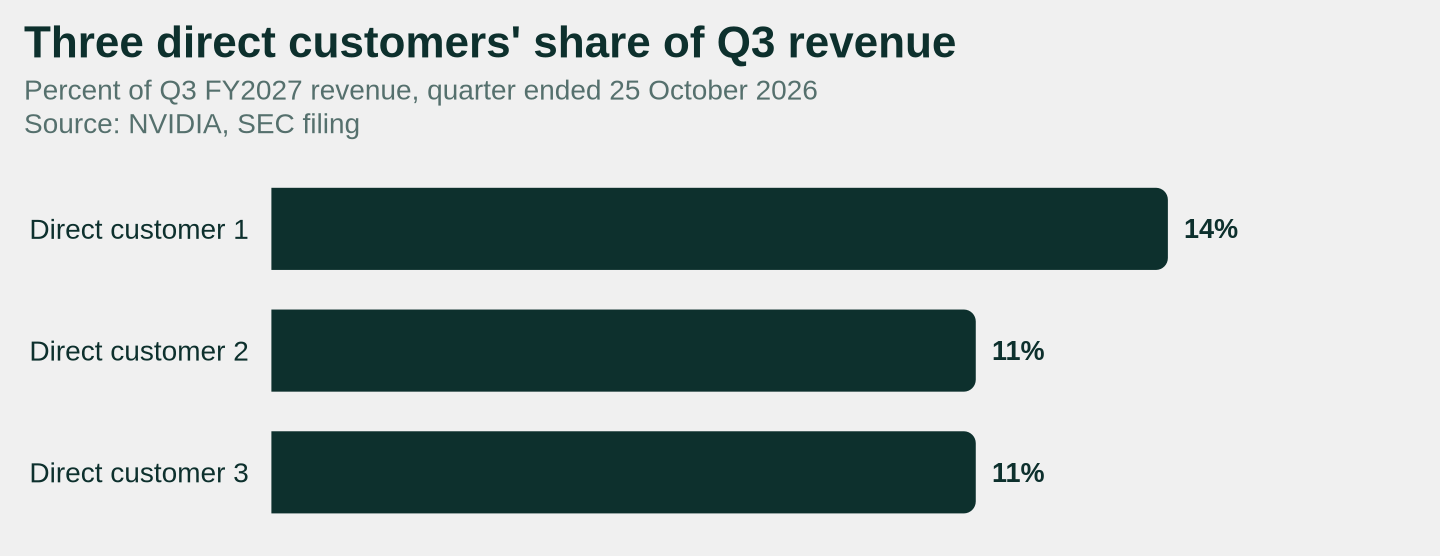
Not immediately. By 18 November, the SEC filing list still showed the second-quarter 10-Q as Nvidia's latest quarterly report, not a third-quarter one. The company did publish supplemental financial information and CFO commentary on 17 November, which is where the customer concentration and segment detail come from.
What is the difference between the $65.3 billion profit and the $2.68 per share?
They measure different things. Net income under standard accounting rules was $65.287 billion for the quarter ended 25 October 2026. The $2.68 is adjusted diluted earnings per share, a per-share figure. Compare net income with net income, and per-share with per-share: standard diluted earnings per share was $2.70 against $2.68 adjusted.
How fast has revenue grown across recent quarters?
Revenue was $57.0 billion in the quarter ended 26 October 2025, $96.2 billion in the quarter ended 26 July 2026, and $115.8 billion in the quarter ended 25 October 2026. The latest quarter was up 20% on the previous one.
Why did the board create an export control committee?
On 17 November, Nvidia's board set up a standing National Security and Export Control Oversight Committee, chaired by director Suzanne Nora Johnson. Its job is oversight of national-security policies and compliance with export-control and global-trade rules. Those rules decide which products can be sold into which markets.

Sources
- NVIDIA: NVIDIA Announces Financial Results for Third Quarter Fiscal 2027 (17 November 2026)
- Reuters: Nvidia forecasts quarterly revenue above estimates in first report since Huang's exit (17 November 2026)
- U.S. Securities and Exchange Commission: NVIDIA Form 8-K (12 November 2026)
- The New York Times: Nvidia earnings and stock price live updates (17 November 2026)
- Stock Analysis: NVIDIA Market Cap
- Reuters: Nvidia earnings beat estimates as attention turns to call (17 November 2026)
Cover photo by Christian Wiediger on Unsplash.

You might also like
Deepen your knowledge with more articles and inspiration.