Crypto exchanges in Europe differ in their authorised legal entity, euro transfers and total trading costs. Under the EU's crypto rulebook, a provider must normally hold an authorisation before it offers crypto services in the Union. The rest is about euro transfers, fees and who holds your coins.
Key takeaways
- In the EU, a crypto exchange usually needs an authorisation before it can serve you.
- Check euro deposits and withdrawals, and add every cost: the headline trading fee is rarely the full bill.
- Authorisation does not protect you from price falls, and crypto on an exchange is not a bank deposit.
Getting euros in and out
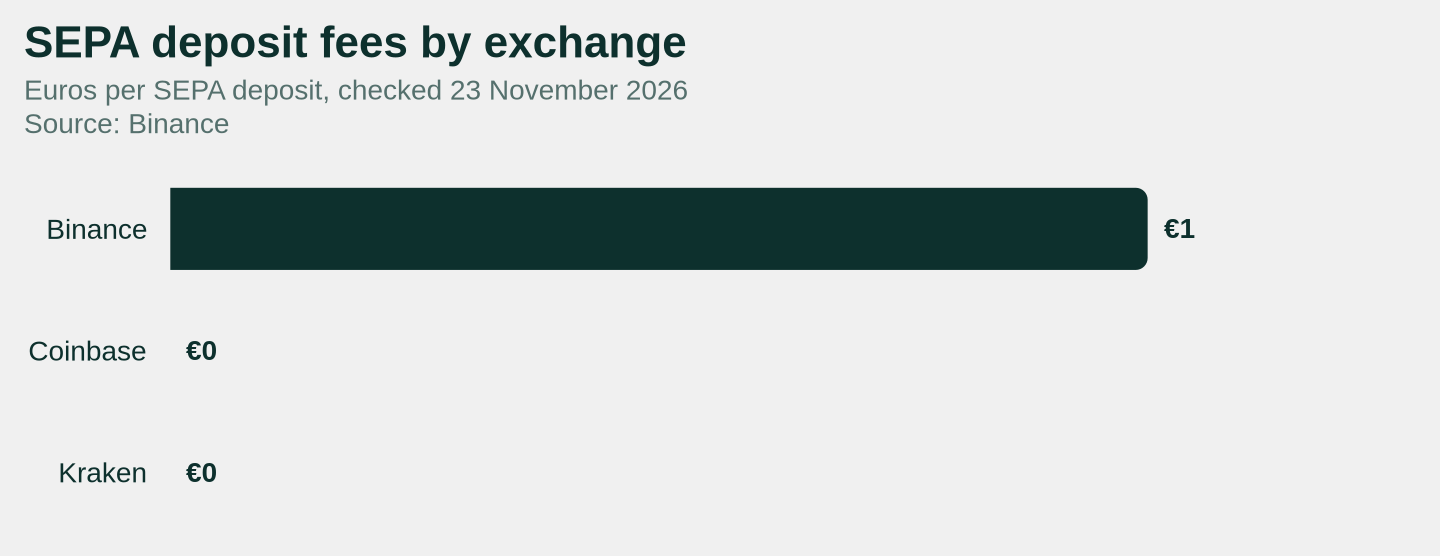
Most European buyers fund an account by bank transfer. A standard SEPA transfer moves euros between payment accounts in the SEPA area. Exchange guidance gives examples of ordinary deposits taking one to three business days. Timing depends on the banks and on the exchange's processing.
SEPA Instant is the faster version. It runs around the clock. The European Payments Council says it is designed to make funds available within ten seconds. That said, an exchange's own checks or processing can still affect when a deposit or withdrawal is credited.
Delays happen for ordinary reasons: wrong payment details, a missing reference, standard bank processing, or compliance checks, including an extra review of where the money came from.
What you actually pay
The number on the fee page is one part of the cost. On an order book, a maker fee applies when your order waits to be matched. A taker fee applies when your order matches an existing order. The bid-ask spread is the gap between the current buy and sell prices. It varies by market and order.
Then come the costs around the trade. A deposit fee is charged for adding money. A card charge can apply when you fund or buy by card. A network fee pays for moving crypto between crypto accounts. A cash withdrawal fee is charged for sending money back out. Each of these depends on the method and the currency, and any of them can be zero.
One point matters more than the rest. A one-click "instant buy" screen can cost more than the same purchase on the order book, because the quoted price may include a spread plus a separate trading or payment-method fee. An order-book trade charges its stated maker or taker fee, and still carries execution costs from the market itself. Same platform, same amount, different total.
Where the fees go
Exchanges live mainly on trading. In its SEC filing, Coinbase reported $590 million in transaction revenue for the third quarter of 2026, the three months ended September 30, 2026. It reported $570 million in subscription and services revenue over the same three months.
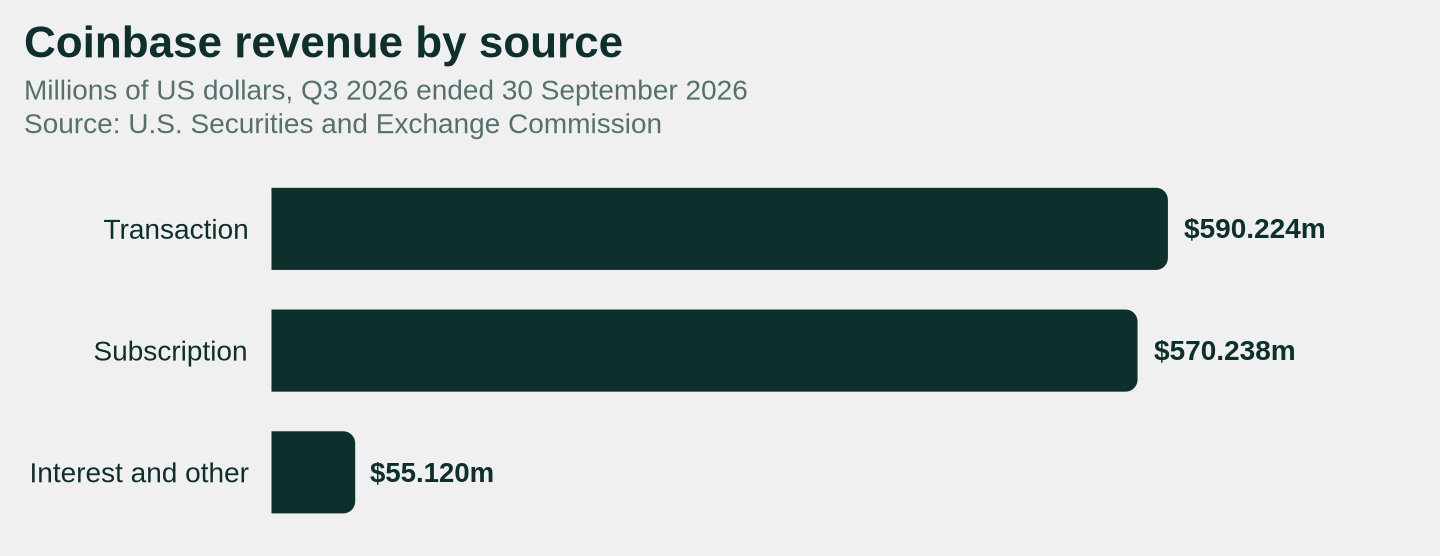
That split tells you something as a customer. The price you pay per trade is worth a careful look before you open an account.
For the asset side of the question, see our plain guide to how Bitcoin works.
MiCA: what "regulated in Europe" means
MiCA is the EU's rulebook for crypto services. Under it, a provider generally has to be authorised by its home EU Member State before offering crypto services in the Union. Some financial firms can offer services after a separate notification process. To get authorisation, a firm must describe its planned services and financial safeguards. It must also explain how it is run, whether its managers are suitable and how it manages risks. The authorisation then names exactly which services are permitted.
Two limits are easy to miss. The authorisation attaches to a specific legal entity and to the services listed in it, not automatically to every company using the same brand. And it brings duties for custody, such as safeguarding and keeping client assets separate, but it is not a guarantee against price losses and not a deposit guarantee. MiCA itself excludes deposits from its scope and requires warnings that crypto-assets are not covered by EU deposit-guarantee schemes.
ESMA, the EU markets watchdog, publishes an official MiCA register. Each entry names the provider, its competent authority, its home Member State, the services it is authorised for and the countries it intends to serve. ESMA says the register is updated weekly and its latest version was dated 18 November 2026.
Exchange custody or your own wallet
With exchange custody, the provider safeguards or controls your crypto, or the keys that give access to it, on your behalf. With a self-custody wallet, you hold the private keys yourself and you are responsible for keeping them safe.

Neither option removes risk. It moves it. With self-custody, you do not depend on an exchange to control your keys. Losing those keys can permanently cut off access to the assets. Exchange custody means depending on that provider's security and on its ability to give the assets back.
Stablecoins sit in this same custody question. For how those tokens work, read our explainer on stablecoins and their risks.
Risks
- Crypto prices can fall, and an EU authorisation does not protect you from that.
- If a custodian fails, client assets must be separate from the provider's own assets under applicable law. ESMA says there is no compensation scheme if it cannot return the assets.
- Exchanges have suffered hacks and severe operational problems, which can cause losses or cut off access to your coins, according to EU supervisory authorities.
- With self-custody, losing your keys can mean losing the assets for good.
This article is for information only and is not investment advice.
Frequently asked questions
Do I have to declare crypto to my tax office?
It depends on national tax rules; DAC8 does not itself determine whether you must declare crypto. Under DAC8, which applies from 1 January 2026, reporting crypto-asset service providers collect transaction information on reportable EU-resident users for 2026 and report it to national tax authorities, with the first exchange between EU tax authorities due by 30 September 2027. DAC8 standardises reporting. It does not set national tax rules. Taxable events, treatment and rates stay national.
Is the same exchange available everywhere in Europe?
Not necessarily. A cross-border notification under MiCA names the Member States and services a provider intends to offer, but account eligibility, available assets and products, and payment methods can still vary with where you live. Payment access can also depend on the country and on the payment provider, and some regions cannot use card funding at all. On 7 November 2026, CoinDesk reported that Binance told some EU customers their accounts will close on 31 December 2026 and a monthly fee of 0.025% of their crypto balance or 10 USDC, whichever is higher, starts on 29 November 2026.
Why would a euro transfer be rejected?
Common reasons: the bank account holder's legal name does not match the exchange account, the money comes from a third-party account, the exchange does not support your country or your bank, or account verification and limits are not satisfied.
Are all crypto products covered by MiCA?
No. MiCA excludes crypto-assets that are unique and non-fungible, and assets that qualify as financial instruments or deposits. Products that do fall inside its scope stay subject to MiCA's own rules and restrictions.
How do I know the authorisation belongs to the company serving me?
The register identifies the legal entity and its permitted services. The exchange's terms or customer contract names the entity serving the customer. MiCA protections attach to the authorised EU entity, not to other companies sharing the brand.

Sources
- European Payments Council: SEPA Instant Credit Transfer
- U.S. Securities and Exchange Commission: Coinbase Q3 2026 Form 10-Q (30 September 2026)
- European Union: Regulation (EU) 2023/1114 on markets in crypto-assets
- European Securities and Markets Authority: Markets in Crypto-Assets Regulation (MiCA) (18 November 2026)
- European Commission: DAC8
- CoinDesk: Binance users in some European countries told to pull crypto before fees kick in, with accounts closing by year-end (7 November 2026)

You might also like
Deepen your knowledge with more articles and inspiration.