
A stablecoin is a privately issued blockchain token built to hold its value against a reference asset such as a dollar, euro or gold. The issuer can support that aim by holding reserves and redeeming tokens. Other designs use crypto collateral or adjust supply. Prices can still drift away from the target, especially under stress.
Key takeaways
- A stablecoin is a token built to track a dollar, euro or gold, and it is not a bank deposit.
- Tokens backed by cash, by crypto, by gold or by a mechanism do not carry the same risks.
- A key risk is a slip from the target price, when selling rises and exits get delayed.
What is a stablecoin?
Most crypto moves in price all day. A stablecoin is the part that is meant to stand still, because it references something outside crypto, such as an official currency or a metal.
The market for these tokens is large. On 20 November 2026, RWA.xyz put the total stablecoin market capitalisation at $273.87 billion, a circulating market value estimate rather than an issuer's reported revenue or profit.
Three things it is not: money in a bank account, government money, or a guaranteed value.
How the peg works, and why it can slip
For a typical fiat-backed stablecoin, new tokens are created when the issuer receives funds, and redemption destroys tokens and pays out the reference currency, as the Bank for International Settlements described in May 2026. Fiat means ordinary state-issued money.
Once a token trades on an exchange, its price is set by buyers and sellers. When that price drifts from the target, traders may buy or sell to profit from the gap, which helps pull the price back. How well this works depends on transparency, reserve quality and market access, the BIS said in May 2026.
The market price, the issuer's promise and the assets in reserve are three separate things. Direct redemption may be limited by fees, minimum amounts or eligibility rules. Holders without direct access have to sell on the market at whatever price is on offer. A token can trade below its target even when its backing assets are sound, because the peg also depends on market liquidity and on the ability to sell reserve assets. If confidence falls far enough, selling and redemptions intensify, and a broad run can force rapid reserve sales.
The four main types
| Type | What backs it | How the peg is meant to hold | Main risk |
|---|---|---|---|
| Fiat-backed | Funds held by an issuer, commonly cash or financial assets that mature soon | Issuance against funds and redemption at par, subject to the contract | Redemption can be limited by the contract. |
| Crypto-backed | Crypto collateral worth more than the tokens issued | The system may automatically sell collateral when its value falls | Fast falls in collateral value can weaken backing. |
| Commodity-backed | A commodity such as gold | Custody and legal ownership of the metal are meant to make the value track the commodity | Custody and legal ownership matter. |
| Algorithmic or synthetic | Algorithmic designs use rules rather than tangible reserves. Synthetic or hybrid designs can combine fiat assets, crypto collateral and contracts linked to asset prices | Changes in supply or trading with paired tokens | These mechanisms can fail under stress. |
These four are not equally comparable in risk. TerraUSD is the clearest example: it targeted one US dollar through swaps with the LUNA token rather than actual dollar backing, according to the SEC's amended complaint. It depegged in May 2022 and did not recover, and the complaint reported that UST and LUNA were essentially worthless by the end of May, with more than $40 billion in combined market value wiped out. Terraform's Chapter 11 liquidation plan was approved by the bankruptcy court on 20 September 2024.
USDT, USDC and EURC: prices, size and reserve reports
| Token | Price (20 Nov 2026) | Market capitalisation (20 Nov 2026) |
|---|---|---|
| USDT | $0.9990 | $174.08 billion |
| USDC | $0.9996 | $67.43 billion |
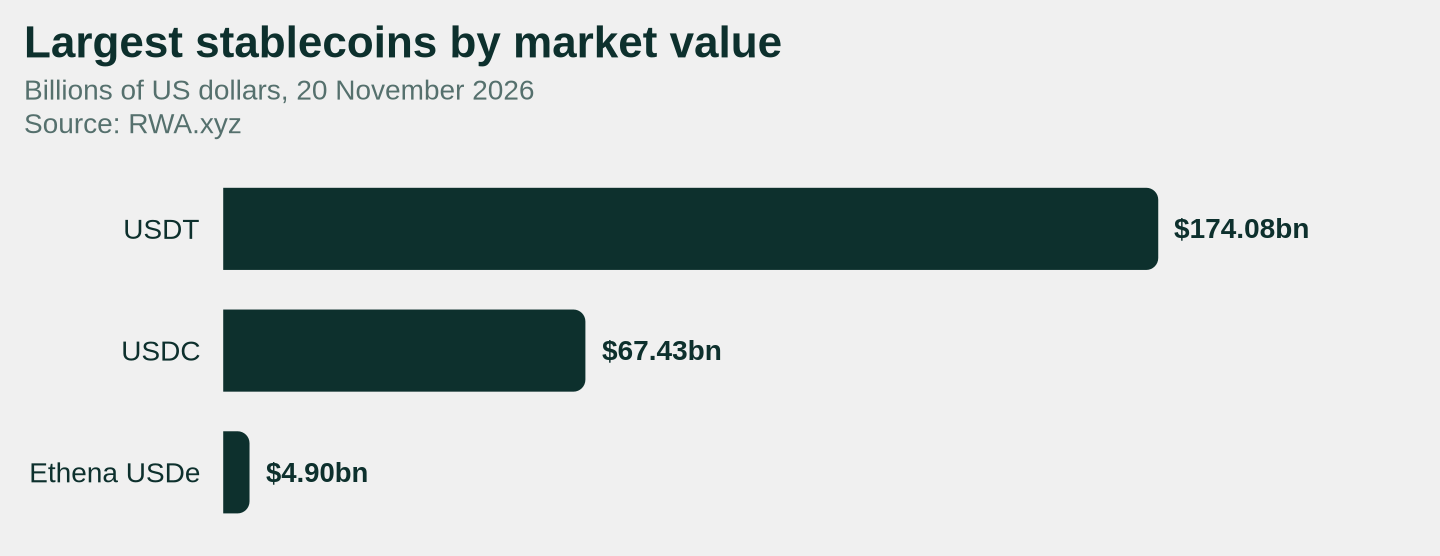
RWA.xyz also listed EURC at $1.0963 on that date, and these are observed market prices, not guaranteed redemption prices. Smaller tokens sit far below the leaders: Ethena USDe had a market capitalisation of $4.90 billion on the same date.
The two issuers report very differently. On 30 October 2026, Tether published a BDO-prepared attestation on its 30 September reserves. It put reserve assets at $191.5 billion and the excess of assets over liabilities at about $7.95 billion. It also reported $1.5 billion in Q3 2026 net operating profit. Circle Internet Group reported its Q3 2026 results on 4 November 2026: $865 million in total revenue and reserve income and $226 million in net income from continuing operations.
Know the difference between the reports. A reserve attestation checks the issuer's statement about its reserves and tokens in circulation on a stated date. The SEC says a reserve report is different from a financial statement audit. An audit examines the issuer's financial statements as a whole.
What the European rules say
MiCA, the EU's crypto rulebook, does not treat "stablecoin" as one thing. An e-money token references one official currency, while an asset-referenced token references another value or right, or a combination. E-money token issuers must be authorised credit or electronic money institutions, issue at par when they receive funds, and redeem at any time at par. Asset-referenced token issuers generally need EU authorisation or credit institution status, must keep a segregated reserve, and must redeem on request at market value or deliver the referenced assets. Both sets of rules have applied since 30 June 2024.

Enforcement is tightening. In an opinion of 8 October 2026, ESMA said authorised crypto businesses serving clients should not provide services that maintain or facilitate EU clients' access to tokens that do not meet MiCA conditions. Existing exposure must be addressed by 8 January 2027. Only time-limited sell-only, conversion, transfer or withdrawal services may be allowed to protect existing clients. The EBA has also finalised redemption-plan guidelines for issuers and supervisors, covering plan content, review timing and implementation triggers. On 8 October 2026, ESMA's opinion meant EU-authorised firms had to wind down normal services for USDT, which lacks MiCA authorisation, by 8 January 2027.
Frequently asked questions
What happens if a stablecoin loses its peg?
The token trades away from its target. Holders without direct issuer redemption have to sell on secondary markets, where supply and demand set the price and limited liquidity can widen the discount. Redemption minimums, operational lags, banking-hour limits or issuer stress can delay exits and leave holders unable to obtain the value they expected.
How are funds backing e-money tokens held under MiCA?
At least 30% of safeguarded funds must sit in separate credit-institution accounts. The rest must be in secure, low-risk, highly liquid assets in the referenced currency.
Are stablecoins the same as money in a bank account?
No. A stablecoin is a privately issued blockchain token intended to hold value against a reference asset. Under MiCA, an e-money token issuer must be an authorised credit or electronic money institution and must redeem at par at any time, with the funds received safeguarded.
Are the rules different in the United States?
Yes, and they are still arriving. On 21 October 2026, the OCC announced a final rule implementing the GENIUS Act for payment stablecoin issuers and certain custody activities under its jurisdiction. The rule is finalised but takes effect on 18 January 2027, and the OCC said it would separately announce when issuer applications would begin.

Sources
- Bank for International Settlements: The impact of stablecoins on the international monetary and financial system (May 2026)
- RWA.xyz: Stablecoins (20 November 2026)
- Tether: Tether generates $1.5 billion in Q3 net operating profit as reserve buffer doubles to almost $8 billion (30 October 2026)
- Circle Internet Group / U.S. SEC: Q3 2026 earnings release (4 November 2026)
- EUR-Lex: Regulation (EU) 2023/1114 on markets in crypto-assets
- ESMA: Opinion on services relating to non-MiCA-compliant tokens (8 October 2026)
- U.S. Securities and Exchange Commission: Amended complaint against Terraform Labs and Do Hyeong Kwon (3 April 2023)
- Office of the Comptroller of the Currency: OCC issues final rule implementing the GENIUS Act (21 October 2026)
Cover photo by Shutter Speed on Unsplash.

You might also like
Deepen your knowledge with more articles and inspiration.