On 18 November 2026, Google announced Gemini 4 Neon, a model for complex software engineering, knowledge work and science workflows. In November 2026, it costs $3 per million tokens you send and $15 per million tokens it writes back. It reads up to about a million tokens at once. If you pay for the Gemini app or build with Google's tools, this is the new middle option between the fast model and the heavy one.
Key takeaways
- Google announced Gemini 4 Neon on 18 November 2026 and began rolling it out the same day.
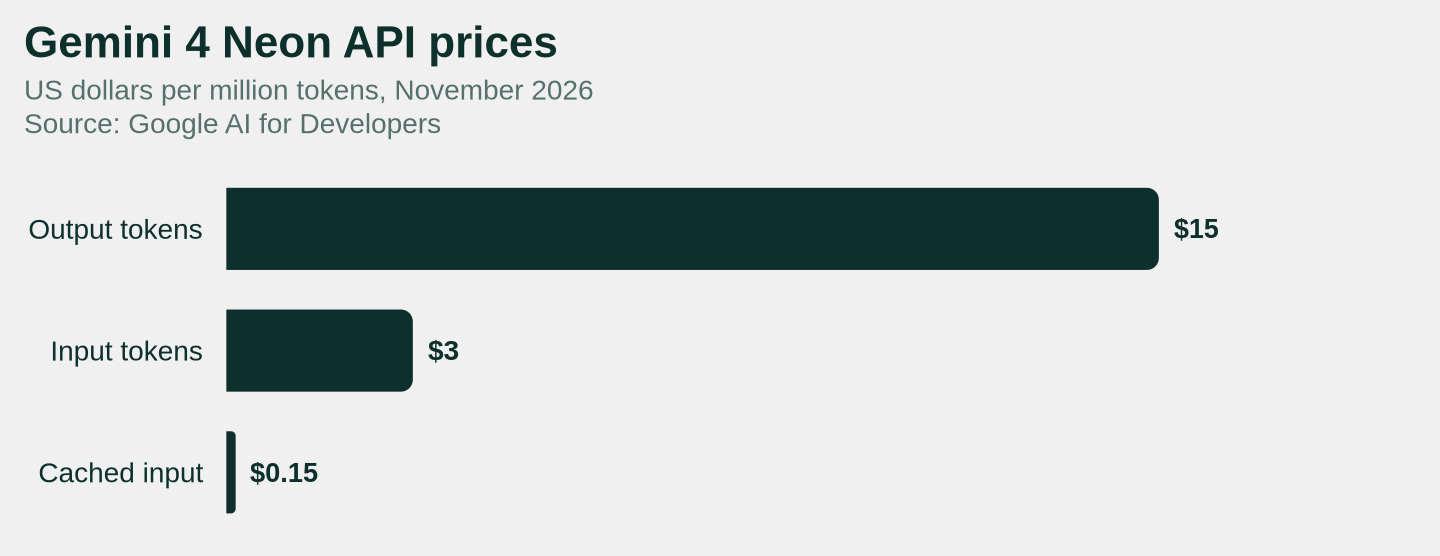
- Using Google's developer interface costs $3 per million input tokens and $15 per million output tokens in November 2026.
- Availability still depends on your plan, your product and your organisation's settings.
What Gemini 4 Neon is, in plain words
Gemini 4 Neon is Google's new AI model, announced on 18 November 2026 and described by Google as built for complex software engineering, knowledge work and science workflows. It sits in the middle of the Gemini 4 family.
Google says Neon handles repository-level coding work, such as debugging and reorganising code across many files at once. It also says Neon supports long-running, tool-heavy agent workflows. An agent workflow is when the model works through a job in several steps. It can plan the job and use tools instead of giving one answer.
For everyday work, Google says Neon can bring together spreadsheets, PDFs, charts, audio and video inside its context window for analytical, enterprise and scientific tasks. In the Gemini app, Google says it can help with writing, research and multi-step jobs such as reviewing bills or receipts.
What it costs and how big its memory is
Here are the published numbers. A token is a small chunk of text, roughly a word or part of one. Input tokens are what you send, output tokens are what the model writes back.
| Item | Figure (Nov 2026) |
|---|---|
| Input | $3 per million tokens |
| Cached input | $0.15 per million tokens |
| Output (including thinking tokens) | $15 per million tokens |
| Context window | 1,048,576 tokens |
| Synchronous response | up to 65,536 tokens |
Your bill is the input tokens at the input rate, plus the output tokens at the output rate. Google's official pricing page listed those same standard paid-tier rates on 20 November 2026, with no free tier for this model.
Caching can lower input costs when you repeat content. Google says implicit caching is on by default for Neon and needs at least 4,096 input tokens. When Google reuses cached input, it gives a 95% discount on the input price. You cannot set up caching yourself for Neon.
What a million-token context window means
The context window is how much the model can hold in one go. Google documents 1,048,576 tokens, and defines it as unified: the input you send, the model's own thinking and the output all draw on that same total. Responses sent back in one call can reach 65,536 tokens. Longer output can use the remaining context capacity. A big window means the model can consider more at once. It does not guarantee it remembers every detail correctly, so important answers still need a human check.
LOW, MEDIUM, HIGH and XHIGH thinking levels
Neon has four thinking levels. They set how much effort it spends before answering. Google says LOW uses the fewest tokens and has the shortest wait. MEDIUM uses fewer tokens and responds faster. HIGH balances reasoning and speed. XHIGH uses the most tokens for deeper reasoning and takes longer. HIGH is the default. The setting changes how many tokens you use and how long you wait. It does not change the per-token rate. Thinking tokens are billed at the $15-per-million output rate in November 2026.
Where you can use it, and what changes if you already use Gemini
Google said the rollout started on 18 November. At launch, Google said Neon was rolling out through its paid developer interface, called an API, its Gemini app and its business products.
Using Neon through the app is different from using it through the developer interface. Availability can depend on the product and an organisation's settings.
Neon, Hydrogen and Carbon: how Google splits them
Google positions Neon between two other models. Hydrogen is for fast everyday execution, Carbon is for the hardest long-horizon projects, and Neon is meant to balance depth and efficiency for complex work.
In practice, that gives you a simple way to read the range. Hydrogen suits simple jobs you repeat often, where speed matters most. Neon is Google's answer for complex coding, long documents and multi-step tasks. Carbon is where Google points the hardest, longest projects. On 10 November 2026, Google said Carbon’s introductory API prices would rise from $2 and $10 to $4 and $20 per million input and output tokens on 1 December 2026.
What the launch says about Google's position
Our reading is that the middle of the range is where the money is. A model priced at $3 and $15 per million tokens in November 2026 is aimed at work people do all day, not only at the rare hard problem.

Distribution is the other half of the story. The same model was rolling out through a consumer app, a developer API, a coding environment, an agent builder and a business product as the rollout began. Google is trying to make one model useful to several different customers at once.
For context on the business behind it, Alphabet reported revenue of $127.577 billion for the third quarter of 2026, the quarter ended 30 September, with Google Cloud at $30.709 billion. Alphabet announced those results on 28 October. For the wider picture on how AI spending is landing in company accounts, see our explainer on CoreWeave's latest earnings.
What to watch next: whether the middle tier picks up real production work, whether access widens beyond paid plans, and whether the price holds.
Frequently asked questions
Is Gemini 4 Neon available right now?
Google announced it on 18 November 2026 and described the rollout as starting that day, not as complete across every listed service. The November 18 Gemini API release note marked Neon generally available on the paid tier. The broader rollout was described as ongoing. So whether you can use it today depends on which product you open, your plan and your organisation's settings.
Can Neon read PDFs, images, audio and video?
Yes. Google lists Neon's inputs as text, images, audio, video and PDFs, with text output. Supported document formats include plain text, PDF, Word DOC, DOCX and DOTX, PowerPoint PPT and PPTX, Excel XLS and XLSX, and OpenDocument ODT, ODP and ODS. Listed image formats are PNG, JPEG and WebP. Audio covers formats including MP3, WAV and FLAC, and video covers formats including MOV, MP4 and WEBM.
Does a higher thinking level cost more per token?
No. Google says the thinking level changes token consumption and latency, not the per-token rate. The bill still moves, because XHIGH produces more thinking tokens, and those are billed at the $15-per-million output rate. If you want cheaper and faster answers for simple jobs, LOW uses the fewest tokens with the lowest latency.
How do I get the cached input price?
Implicit caching is on by default for Gemini 4 Neon and needs at least 4,096 input tokens. Cache hits get a 95% discount on the input price, which is the $0.15-per-million rate in November 2026. In Gemini 4 multi-turn chats, Google caches the full previous request only when the next request adds at least 2,050 tokens, otherwise the last 2,050 are billed at the standard input rate. Explicit caching is unsupported.

Sources
- Google: Introducing Gemini 4 Neon (18 Nov 2026)
- Google: Gemini 4 Carbon now available (10 Nov 2026)
- U.S. Securities and Exchange Commission / Alphabet: Alphabet announces third quarter 2026 results (28 Oct 2026)
- Google AI Studio: Gemini API changelog (18 Nov 2026)
- Google AI Studio: Gemini API pricing (20 Nov 2026)
- Google AI for Developers: What's new in Gemini 4 Neon (20 Nov 2026)

You might also like
Deepen your knowledge with more articles and inspiration.