Spotify Technology S.A.'s SPOT shares trade on the New York Stock Exchange, and their price moves mainly when expectations for revenue, profit, users and outlook change. The price moves every trading day, so a quote page will always be fresher than an article. What follows is the part that doesn't change every minute: how the company earns money, which numbers investors watch, and the risks.
The most recent numbers come from the third quarter of 2026. On October 22, 2026, Spotify reported revenue of €4,969 million and operating income of €672 million for the three months ended September 30, 2026. That report is the reference point for most of what moves the share price right now.
Key takeaways
- Spotify began trading as SPOT in 2018 through a direct listing, which lets existing shareholders sell shares.
- Paid subscriptions brought in 90.3% of revenue in the third quarter of 2026.
- Music licensing costs, advertising swings and currency moves are the company's own stated risks.
What Spotify stock is, in plain words
A ticker is the short code used to find a company's shares in a broker app or a chart. For Spotify, that code is SPOT, and the shares change hands on the New York Stock Exchange. Buying one share makes you a part-owner of the company. It gives you nothing inside the app.

Spotify began trading on April 3, 2018 through a direct listing. In a direct listing, existing shareholders can sell their shares. The NYSE set a $132-per-share reference price to start trading, Reuters reported. Spotify sold no new shares. Existing shareholders' shares were registered for resale, according to a filing with the SEC.
For how the usual route works instead, see our guide to how an IPO works.
The share price and the numbers around it
The latest reported closing price was $609.12 on November 11, 2026. On November 12, 2026, CNBC listed a market capitalisation of $125.19 billion, a 52-week range of $405.00–$668.50 and a trailing price-to-earnings ratio of 33.66.

A few of those words need unpacking. Market capitalisation is the price of all the shares added together. The price-to-earnings ratio compares that value with recent profits. The 52-week range is the highest and lowest price over the past year. It gives context, but does not measure what the business is worth.
CNBC also listed Spotify's next earnings date as February 8, 2027, marked as an estimate. A trailing ratio uses recent reported profit. On October 22, 2026, Spotify said it had repurchased $1.1 billion of shares year to date through October 21, including purchases after quarter-end, in an SEC filing.
How Spotify makes money
Two lines, and they are very different in size. In the third quarter of 2026, Premium revenue was €4.487 billion, or 90.3% of the total, while advertising-supported revenue was €482 million, or 9.7%. Total revenue was €4.969 billion.
Behind those euros sit two user numbers. At the end of September 2026, Spotify reported 306 million Premium subscribers and 788 million monthly active users. The gap matters: most listeners don't pay, and only the paying ones generate subscription revenue.
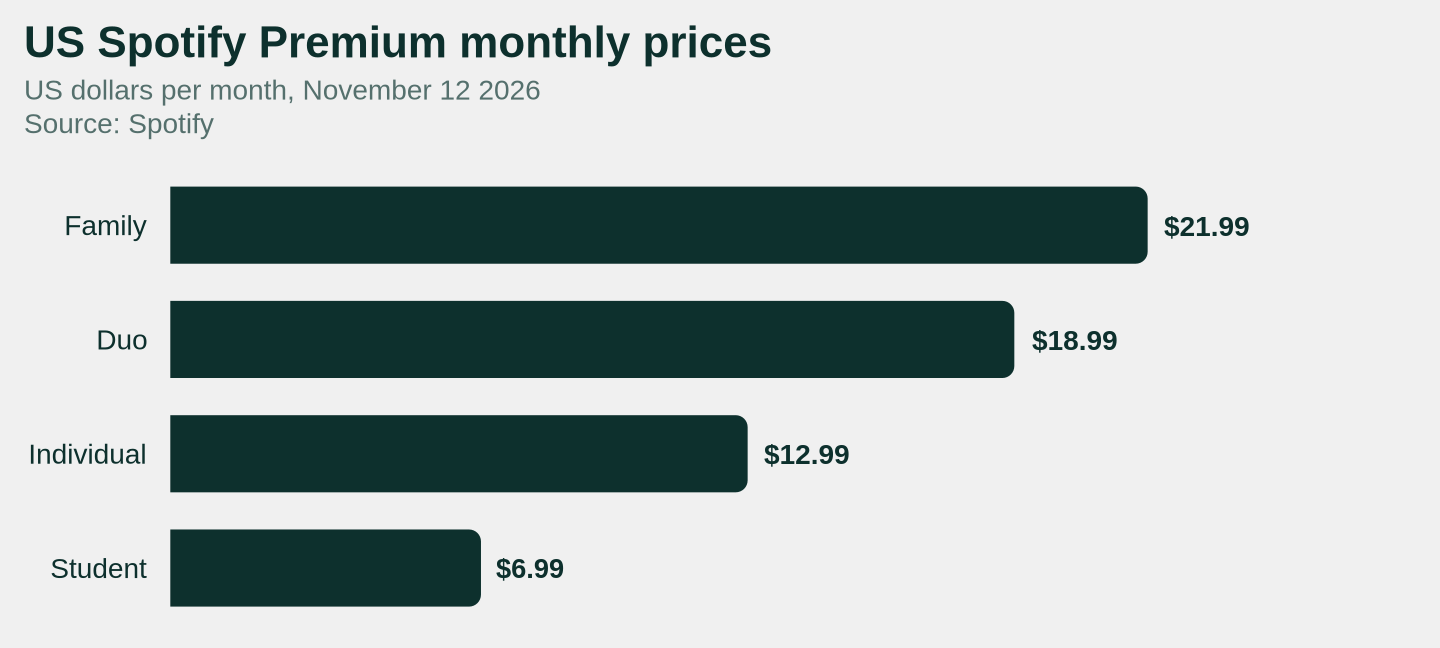
In the US, Spotify's Premium prices in November 2026 were $12.99 a month for Individual, $6.99 for Student, $18.99 for Duo and $21.99 for Family, with eligible new Individual and Student subscribers offered one month for $0.
Then come the costs. Most streamed content is licensed from others. Gross margin is what remains after Spotify pays those costs. Spotify's gross margin was 33.0% in the third quarter of 2026, up 136 basis points year over year. A basis point is one hundredth of a percentage point.
What moves the share price
Share prices move when expectations change, not when a company is simply doing well or badly. Here's what the expectations hang on.

- Revenue growth. Total revenue was €4,272 million in the third quarter of 2025, €4,777 million in the second quarter of 2026 and €4,969 million in the third quarter of 2026.
- The company's own outlook. On October 22, 2026, Spotify gave fourth-quarter estimates of €5.2 billion revenue and €820 million operating income. Those were outlook, not reported results.
- Users and subscribers versus the outlook. The same October 22 update guided to 818 million monthly active users and 316 million Premium subscribers for the fourth quarter.
- Margin direction. The fourth-quarter outlook put gross margin at 33.8%.
- Advertising conditions. Spotify says advertising revenue is affected by the wider economy and is typically seasonally higher in the fourth quarter and lower in the first, according to its annual report.
- Competition. Spotify names Apple, Alphabet, Amazon, Meta and ByteDance as competitors for users, listening time and advertisers.
Product news is a different category. Spotify said on October 20, 2026 that creator Memberships were rolling out in 34 markets. On November 10, 2026, it announced an agreement with Scholastic and made its kids' and family audiobook catalog available to Premium subscribers in the US, UK, Canada, Australia, New Zealand and Ireland. On October 22, 2026, the company said its audiobook service was planned to expand from 22 markets to more than 180 by year-end, and its Partner Program to more than 35 additional markets that fall. Those are planned expansions, not completed rollouts.
How to read the valuation numbers
A share price on its own says nothing about whether a company is cheap. A €600 share is not more expensive than a €60 one. What matters is the size tag next to the profits.
At the November 11, 2026 close, Yahoo Finance showed a market capitalisation of approximately $125.19 billion and a trailing price-to-earnings ratio of 37.12. Note that CNBC listed a trailing P/E of 33.66 on November 12, 2026.
Price-to-sales compares the company's market value with its revenue rather than its profit. It's often used for companies where profits are small or recent.
Risks
- One company, one sector. The SEC says investing heavily in any individual stock can create significant investment risk and recommends spreading money across different investments.
- Music rights set the cost floor. Spotify depends on third-party licences for most streamed content and warns that higher royalty rates, unfavourable renewals or lost licences could materially harm results. Its four major label groups accounted for about 72% of label-delivered audio streams in 2025.
- Advertising is cyclical. It moves with the wider economy and with the seasons.
- Currency works against the reported numbers sometimes. Much revenue is earned in local currencies while royalties are paid mainly in US dollars and euros, and that gap can hurt reported revenue and margins.
- Rules keep changing. Spotify flags complex and shifting laws on privacy, content, intellectual property, advertising, competition and AI that may raise costs or require business changes.
If you'd rather hold many companies at once than one, our explainer on ETFs versus index funds covers how those work.
This article is for information only and is not investment advice.
Frequently asked questions
Does owning Spotify shares give me anything in the app?
No. A share is part-ownership of Spotify Technology S.A., the listed company. It isn't a Premium account, a discount or any claim on the music catalogue. Those rights belong to labels and other rights holders, and Spotify licenses them.
Why did the direct listing matter?
Because no new money was raised on day one. Spotify sold no new shares and there was no set public offer price, just existing shares registered for resale on the exchange. The NYSE set a $132 reference price to start trading on April 3, 2018.
Why do monthly active users and Premium subscribers differ so much?
They measure different things. Monthly active users count everyone who listens, paying or not: 788 million at the end of September 2026. Premium subscribers count only paying accounts: 306 million on that date. Subscriptions produced 90.3% of revenue in that quarter.
What is gross margin and why do investors watch it?
It's what's left of revenue after the direct costs of delivering the service, mainly music rights. Spotify reported 33.0% for the third quarter of 2026 and guided to 33.8% for the fourth. It shows whether revenue growth is actually turning into money the company keeps.
Can people in Europe buy Spotify shares?
Spotify trades in the US on the New York Stock Exchange, so the shares trade in dollars.

Sources
- Reuters: Spotify shares jump in record-setting direct listing (2018-04-03)
- U.S. Securities and Exchange Commission: Spotify Technology S.A. direct listing no-action letter (2018-03-23)
- U.S. Securities and Exchange Commission: Spotify Technology S.A. Form 6-K (2026-10-22)
- U.S. Securities and Exchange Commission: Spotify Technology S.A. 2025 annual report (2026-02-10)
- Yahoo Finance: Spotify Technology S.A. (SPOT) stock quote
- U.S. Securities and Exchange Commission: Ten things to consider before you make investing decisions
Cover photo by Alexander Shatov on Unsplash.

You might also like
Deepen your knowledge with more articles and inspiration.