IonQ builds trapped-ion quantum computers and sells machines, paid access to them, services and, since its SkyWater acquisition, semiconductor manufacturing. Its shares move on revenue, guidance, contracted backlog, funding and acquisition news. The company is deeply loss-making at the operating level.
On 5 November 2026, IonQ reported Q3 2026 revenue of $173.8 million, up 336% year over year, and raised its expected 2026 revenue to $505 million–$515 million. That quarter also showed a $433.075 million operating loss. Those two numbers, side by side, explain most of what you need to know about this share.
Key takeaways
- IonQ reported $173.8 million of Q3 2026 revenue and a $433.075 million operating loss.
- A non-cash accounting gain from revaluing warrants drove Q3's $563.957 million net income.
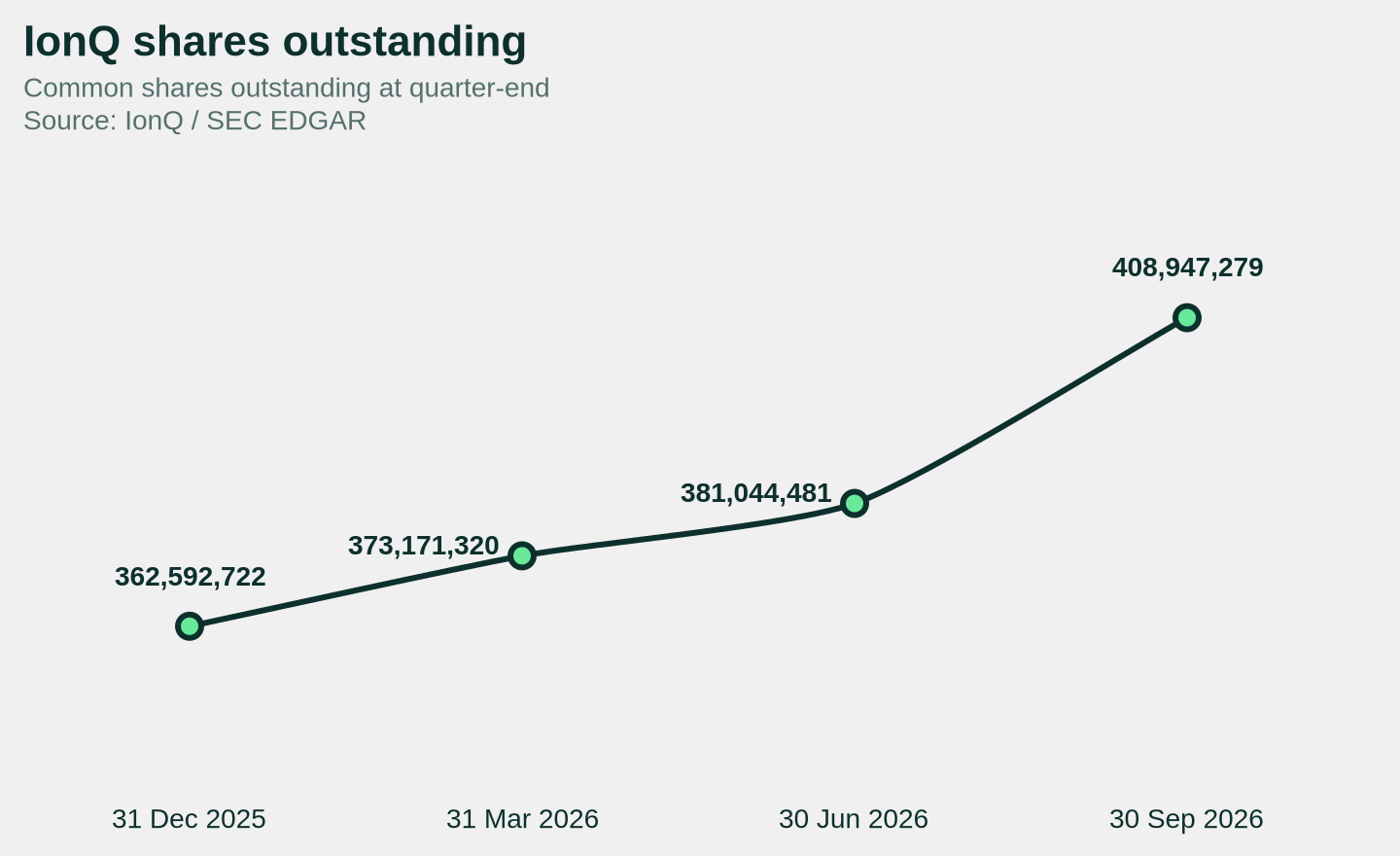
- Share count rose about 12.8% over four quarter-ends.
What IonQ sells today
IonQ makes quantum computers using trapped ions, which are charged atoms held in place and controlled with lasers.

Its latest quarterly filing with the US regulator describes the IonQ Platform as quantum hardware sales with maintenance and support, quantum computing sold as a service, algorithm consulting, satellite imagery and data, and integrated computing, networking, sensing and security work. Since buying SkyWater, IonQ also reports a second business: foundry services. This means semiconductor manufacturing and related development and packaging work. Those are its two reported operating segments.
Customers include government agencies and large enterprises, and the filing says receivables come mainly from US-located customers, including the US government. On 7 October 2026, IonQ said it had reached the final stage of DARPA's Quantum Benchmarking Initiative under an agreement worth up to $300 million.
One detail matters for how the money arrives. When IonQ sells access through a cloud platform, the cloud provider is the customer, not the end user, and IonQ books what it charges the provider. In November 2026, Microsoft's Azure Quantum pricing page listed IonQ access at a minimum of $97.50 per Aria 1 execution. It listed $168.195 per Forte 1 or Forte Enterprise 1 execution with error mitigation on. It also listed a subscription at $25,000 per month, plus Azure infrastructure costs. Those are Azure prices, not all IonQ contracts.
What actually moves IonQ's share price
Three things show up again and again: company news, funding news and the mood of the whole quantum and chip sector.
| Driver | Recent example |
|---|---|
| Technical milestones | Shares rose more than 10% before the bell on 23 September 2026 after an announcement about a tool to correct quantum-computing errors in real time, CNBC reported. |
| Acquisitions paid in shares | Shares fell more than 9% on 12 October 2026 after the Elisity deal, paid entirely in shares, of up to $1.3 billion, CNBC reported. |
| Sector sentiment | Shares fell 10.5% on 5 November 2026 in a post-election sell-off in chip and AI stocks, then reversed higher after hours on the Q3 results, Yahoo Finance reported. |
That last line is the one most readers underestimate. The stock dropped double digits on a day when the company itself published record revenue and a raised outlook.
For the wider picture of who else is listed in this field, see our overview of quantum computing stocks.
How to read IonQ's results
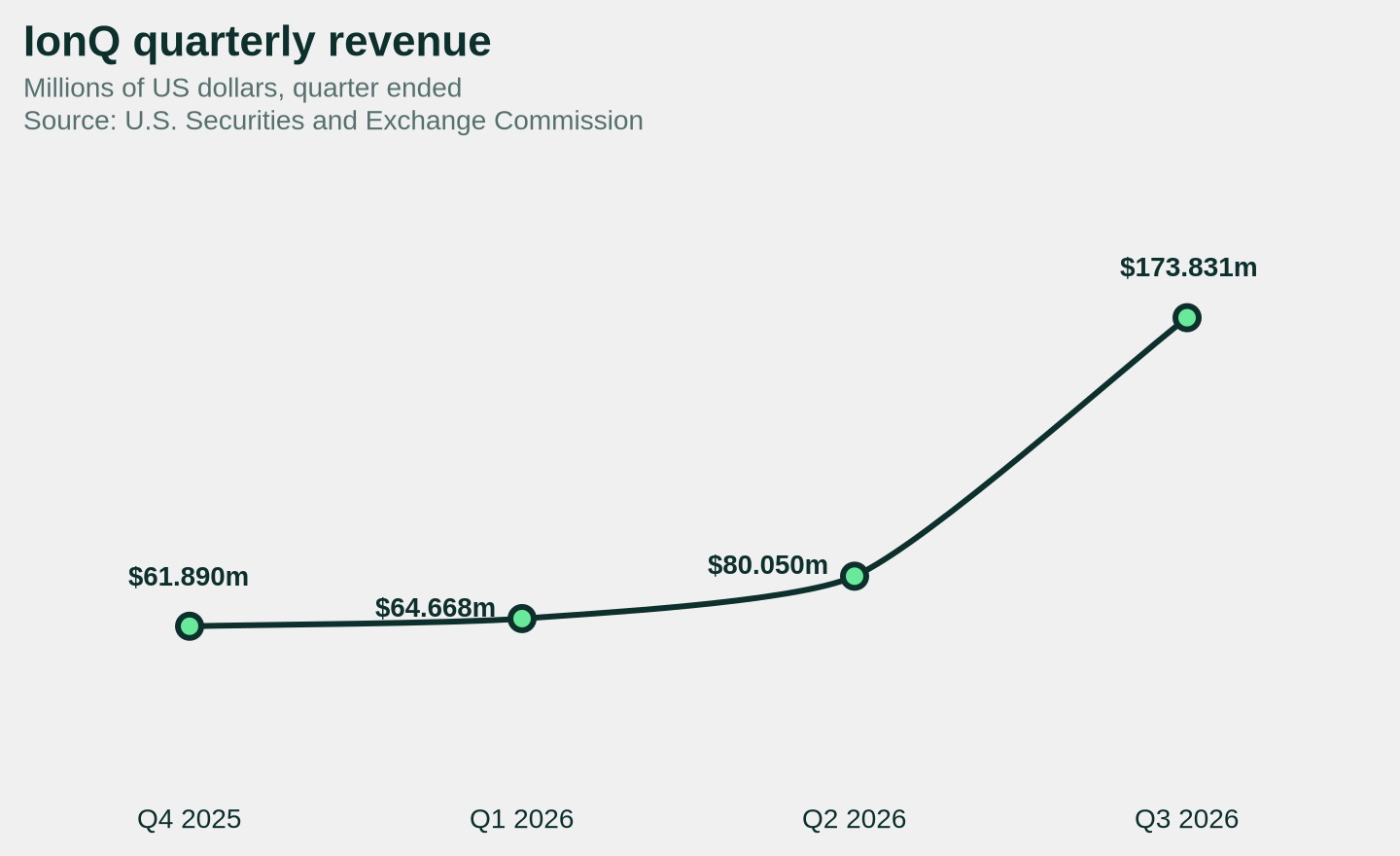
Revenue has climbed each quarter: $61.890 million in Q4 2025, $64.668 million in Q1 2026, $80.050 million in Q2 2026 and $173.831 million in Q3 2026. The Q3 jump is not all organic. It included $83.5 million from SkyWater after the acquisition. IonQ Platform revenue was $90.3 million, up 127% year over year, which the company attributed to global Tempo computer deployments.
Now the profit line. IonQ reported net income attributable to IonQ of $563.957 million in Q3 2026 and basic GAAP earnings per share of $1.42. That does not mean the company generated $563.957 million in cash from customers. The figure included an $896.156 million gain from revaluing warrant liabilities, a non-cash accounting item. IonQ's adjusted earnings per share, which remove specified items, were $(0.29). Adjusted EBITDA is another company measure after its own adjustments. Its loss was $133.608 million.
Backlog is the other number people quote. IonQ calls it remaining performance obligations. This is the value assigned to signed-contract work not yet delivered. It includes funded and unfunded firm orders. It excludes unexercised options. It stood at about $1.2 billion at the end of Q3 2026. That is contracted work still to be performed, not revenue already booked. One customer accounted for 30% of total quarterly revenue in Q3 2026.
Funding and dilution
Dilution means the company issues new shares, so each existing share represents a smaller slice of the same business.
IonQ has been issuing shares. Quarter-end common shares outstanding rose from 362,592,722 at 31 December 2025 to 408,947,279 at 30 September 2026, an increase of about 12.8%. By 28 October 2026, the count was 432,462,651. The Elisity acquisition, completed on 4 November 2026, was paid with $1.15 billion of common stock at closing, with up to $150 million more tied to revenue milestones through January 2028.
On the cash side, a $2.0 billion equity offering priced on 14 October 2026 and closed on 16 October. IonQ reported $1.7 billion in cash, cash equivalents and investments at 30 September 2026, and $3.7 billion pro forma, including that offering. Q3 2026 operating cash outflow was about $315.537 million.
How IonQ compares with the rest of the field
Quantum companies use different physical approaches, and rivals include both small specialists and very large technology groups running quantum programmes alongside their main business.

That is the structural difference between holding a pure-play quantum share and holding a diversified large-cap technology share. For a contrast, see how a profitable cloud business behaves in our piece on Microsoft stock.
IonQ's shares closed at $26.43 on 5 November 2026. Its total stock market value was listed at $11.35 billion at that close.
Risks
- Operating losses are large: $433.075 million in Q3 2026 alone.
- Cash goes out fast: about $315.537 million of operating cash used in Q3 2026.
- Dilution is ongoing: share count rose about 12.8% across four quarter-ends to 30 September 2026, plus $1.15 billion of stock issued for Elisity.
- Customer concentration: one customer was 30% of Q3 2026 revenue.
- Price swings are violent, including a 10.5% fall on 5 November 2026 amid sector-wide selling in chip and AI stocks.
This article is for information only and is not investment advice.
Frequently asked questions
Is IonQ profitable?
Not on an operating basis. IonQ posted a $433.075 million operating loss in Q3 2026, and its own adjusted EBITDA was a loss of $133.608 million. The reported net income of $563.957 million came mostly from a non-cash warrant revaluation gain. Operating cash flow was an outflow of roughly $315.537 million in the quarter.
What is adjusted EBITDA and why does IonQ use it?
IonQ uses it as its own measure of underlying earnings. It leaves out items such as interest, taxes, depreciation, share-based pay, warrant changes and acquisition costs. It is reconciled to the official accounting figure, and definitions differ between companies.
When does IonQ book revenue from a signed contract?
It depends on the contract. IonQ records quantum computer sales over time as control transfers. It records maintenance evenly over the service term. It records consulting over time based on work completed. For access sold as a service, fixed fees are spread over the access period and usage fees are recorded when incurred.
Does government work make a difference?
It is part of the mix. On 27 October 2026, IonQ announced $7.5 million in follow-on funding from AFRL for quantum networking, and said this was contemplated within its previously announced $21.1 million collaboration rather than supplemental funding.
Why do quantum shares move so much on sector news?
Sector-wide sentiment affected IonQ on 5 November 2026. When sentiment on chips and AI turns, these names move together. IonQ fell 10.5% on 5 November 2026 in a broad sell-off, then reversed higher after hours on its own results.

Sources
- IonQ: IonQ advances to final stage of DARPA's Quantum Benchmarking Initiative (7 October 2026)
- U.S. Securities and Exchange Commission: IonQ Form 10-Q for quarter ended 30 September 2026 (5 November 2026)
- IonQ: IonQ announces record 3Q26 revenues and raises FY2026 guidance (5 November 2026)
- Microsoft: Azure Quantum pricing
- CNBC: IonQ shares rally after company says it made a major quantum-computing breakthrough (23 September 2026)
- CNBC: IonQ shares fall after Elisity acquisition announcement (12 October 2026)
- Yahoo Finance: Why IonQ stock just fell (5 November 2026)
- Stock Analysis: IonQ stock
Cover photo by Nicolas Arnold on Unsplash.

You might also like
Deepen your knowledge with more articles and inspiration.