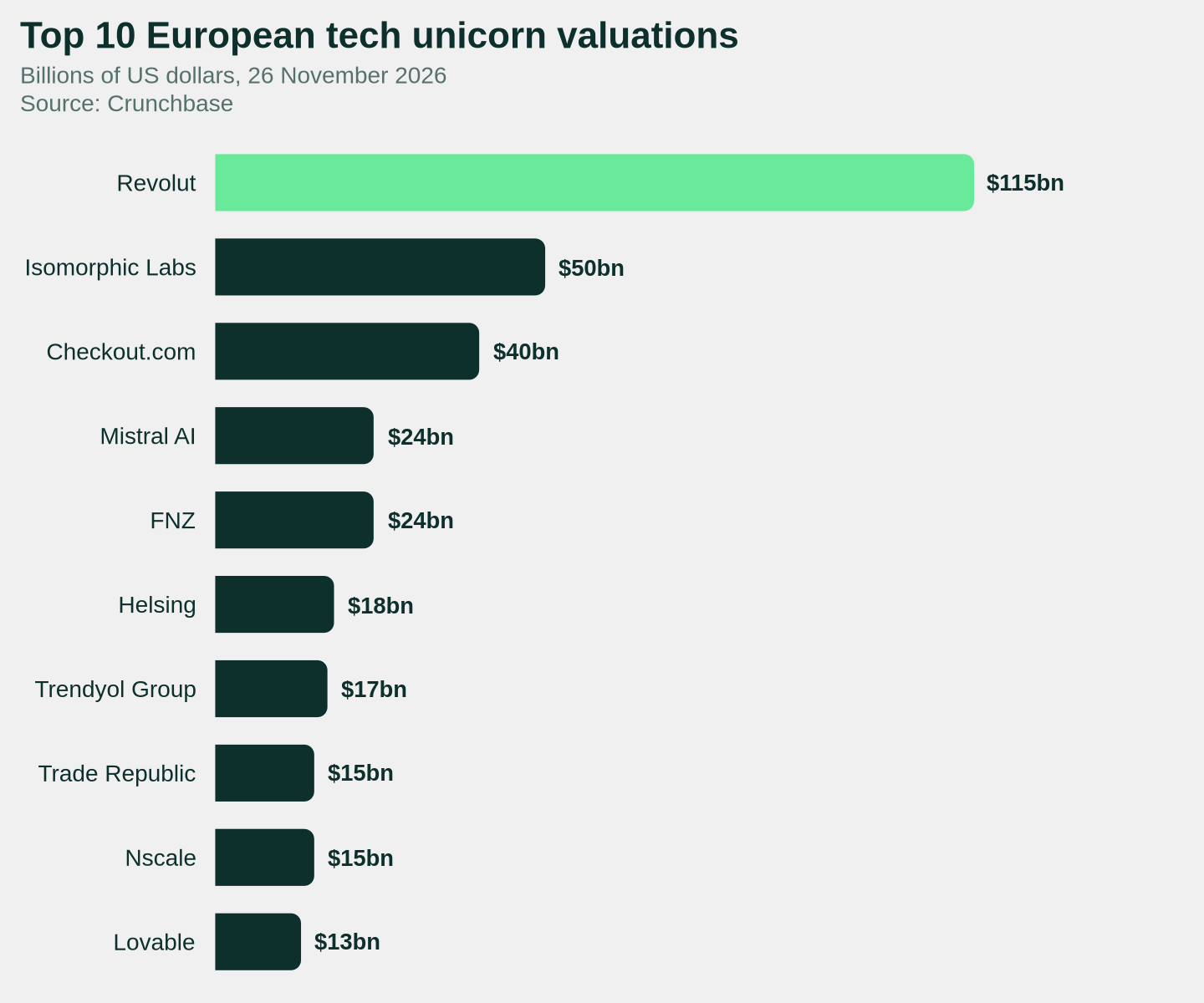
Revolut ranks first in Crunchbase's Europe-labelled snapshot of 26 November 2026 at $115 billion, ahead of Isomorphic Labs at $50 billion and Checkout.com at $40 billion. This ranking covers private companies only, valued at $1 billion or more. It also shows where the listed figure and the company's own figure disagree.
Key takeaways
- Revolut ranks first: Crunchbase's 26 November 2026 snapshot lists it at $115 billion.
- The list is private companies only, so firms trading on a stock exchange are excluded.
- Lovable, in Stockholm, is in the top ten at $13 billion in that snapshot.
What counts as a European tech unicorn, and how this ranking works
A unicorn is a private company valued above $1 billion. CB Insights uses that definition, and a decacorn is a private company valued above $10 billion.
The order below comes from the Crunchbase Unicorn Board, which states it was last updated on 26 November 2026. The criterion is private companies valued at $1 billion or more, using Crunchbase's Europe-labelled entries. Crunchbase ranks them by valuations set in funding rounds where investors paid a set price.
Two rules keep the list honest. Companies that trade on a stock exchange are out, because a market price and a funding-round price are not the same thing. And where a company has disclosed its own figure, this article gives it next to the listed one.
The 10 Crunchbase Europe-labelled unicorns in the November 2026 snapshot
Source: Crunchbase, 26 November 2026.
1. Revolut: $115 billion
Revolut ranks first on the measure used here, at $115 billion. The company said on 4 November 2026 that it had completed a fundraising process establishing that valuation. Tech.eu described the transaction as a secondary share sale, and Revolut was still private on 27 November 2026.
2. Isomorphic Labs: $50 billion
Crunchbase lists Isomorphic Labs at $50 billion. The company announced a $5 billion Series C on 17 November 2026.
3. Checkout.com: $40 billion
This entry shows why a listed number needs a date. Checkout.com's own latest publicly disclosed valuation is $12 billion, the figure used for an employee share buyback announced on 26 September 2025. The Financial Times reported that the company cut its internal valuation to $11 billion in December 2022, down from its $40 billion investor valuation.
4. Mistral AI: $24 billion
Mistral says it builds AI models. It also provides the computing they run on and products for using them. It announced a €3 billion Series D on 8 September 2026, at a valuation above €21 billion after the new money was included. Deutsche Telekom said on 19 November 2026 that its T.Capital Tech Fund had invested €100 million in that round.
For the detail of that round, see our article on Mistral AI's valuation.
5. FNZ: $24 billion
Crunchbase lists FNZ at $24 billion in the same snapshot.
6. Helsing: $18 billion
Helsing was founded in 2021 and is headquartered in Munich. Its latest publicly disclosed valuation is $18 billion, set in a $1.8 billion Series E announced on 13 July 2026. It had no public stock ticker as of 26 November 2026.
7. Trendyol Group: $17 billion
Trendyol Group appears at $17 billion in the 26 November 2026 snapshot.
8. Trade Republic: $15 billion
Trade Republic is listed at $15 billion on the same board.
9. Nscale: $15 billion
Nscale's own latest publicly disclosed priced valuation is $14.6 billion, set in a Series C announced on 9 March 2026. Its principal executive office is in London. The company filed for a proposed New York Stock Exchange listing on 18 September 2026 and was still unlisted on 27 November 2026. On 25 September 2026, Bloomberg reported that Nscale raised $3.36 billion in pre-IPO convertible financing, including a $1 billion Nvidia commitment.
If you follow listings in the making, see our piece on upcoming IPO candidates.
10. Lovable: $13 billion
Lovable is based in Stockholm and was founded in 2023. It announced a $400 million Series C at a $13.3 billion valuation on 12 August 2026, led by Menlo Ventures and co-led by the EQT-managed Scaleup Europe Fund. Accel, CapitalG, Tencent and Salesforce Ventures were among the named participants.
Nordic names worth knowing
The Hurun Nordic Unicorn Index 2026, published on 20 October 2026, counts 18 unicorns worth a combined US$76.1 billion across Finland, Sweden, Norway, Denmark and Iceland.
Lovable is the Nordic company inside the top ten above. ICEYE is another Nordic company in the research. It is a private company headquartered in Espoo, Finland. The company said its valuation was over €10 billion, or $12 billion. It announced a €450 million Series F funding round on 9 June 2026. That round was confirmed completed on 10 September 2026, after regulatory approvals.
The June 2026 figure followed a €2.4 billion valuation announced on 5 December 2025.
What a private valuation actually tells you
It is a price from one event, on one date. A funding round brings new investor money into the company, and the round's valuation is the implied value of the company's equity before or after that financing. The amount raised and the valuation are two different figures.
Some valuations come from a share sale instead. In a secondary share sale, existing investors sell to other investors. The company does not receive new funding from that sale. Vinted is a clear example. Founded in Lithuania in 2008, with group headquarters in Vilnius, it disclosed an €8 billion equity valuation from a completed €880 million secondary share transaction on 27 April 2026.
This is different from market capitalisation. It is a public-market measure based on the number of shares and their price. A listed company is repriced all day. A private one keeps the same figure until the next deal, which is why a stale number can sit on a list for years.
Frequently asked questions
What is a unicorn company?
CB Insights defines a unicorn as a private company valued above $1 billion. Aileen Lee coined the term in a TechCrunch article on 2 November 2013. A decacorn is a privately held company valued above $10 billion, which covers every company in the ranking above.
How big is Revolut's business, not just its valuation?
Revolut's latest official full-year results, announced on 4 November 2026, reported 2025 revenue of $6.0 billion and pre-tax profit of $2.3 billion.
Is money raised the same as a company's valuation?
No. Money raised is the cash that goes into the company in a round. The valuation is the implied value of the company's whole equity at that moment. A company can raise more than a rival and still carry a lower valuation, which is why rankings built on funding totals give a different order.
Why are listed companies left out of this ranking?
Because the two numbers are not comparable. A listed company has a market capitalisation set by share trading. A private company has a price agreed in one round or one share sale, which may be months or years old. Mixing them would make the ranking look precise while measuring two different things.

Sources
- Crunchbase: The Crunchbase Unicorn Board (26 November 2026)
- Revolut: Revolut completes fundraising process establishing $115 billion valuation (4 November 2026)
- Isomorphic Labs: Isomorphic Labs announces Series C investment round (17 November 2026)
- Mistral AI: Mistral makes sovereign open-weight AI to frontier (8 September 2026)
- Lovable: Series C (12 August 2026)
- Helsing: Helsing raises $1.8bn in Series E (13 July 2026)
- Nscale: Nscale Series C (9 March 2026)
Cover photo by Jacob Diehl on Unsplash.

You might also like
Deepen your knowledge with more articles and inspiration.