
Neither is a universal fit: gold has broader demand, while bitcoin has a fixed supply and sharper price swings. Gold is a physical metal with a huge stock already mined and buyers ranging from jewellers to central banks. Bitcoin is a digital asset with a supply capped at 21 million coins, and a price that can drop hard in days.
Key takeaways
- Bitcoin traded at $74,673.28 and gold futures closed at $4,096.10 an ounce on November 10, 2026.
- Gold has many buyer types, bitcoin has a fixed cap, and the two behave differently in a crisis.
- How you hold either one adds its own costs and risks, from storage fees to lost keys.
Bitcoin vs gold at a glance
Both are scarce. Neither pays you interest or a dividend. Neither is issued by a central bank. That shared story is why bitcoin picked up the "digital gold" nickname, and it's also where the similarity stops.
| Factor | Bitcoin | Gold |
|---|---|---|
| What it is | Digital asset, network started with the genesis block in January 2009 | Physical metal, mined for centuries |
| Supply | Capped at 21 million coins, about 20.11 million in circulation on November 10, 2026 | 224,200 tonnes above ground at end-Q3 2026, plus mining and recycling |
| Price (Nov 10, 2026) | $74,673.28 spot | $4,096.10 per troy ounce, COMEX futures close |
| Market size | About $1.5 trillion market value | US$30.0 trillion of above-ground gold at end-Q3 2026 |
| Who buys it | Investors, funds, exchange-traded products | Jewellery, technology, investors, central banks |
| Income paid | None | None |
The size gap is the first real difference. Gold's above-ground stock was valued at US$30.0 trillion at end-Q3 2026, against about $1.5 trillion of bitcoin on November 10, 2026.
Where the demand comes from
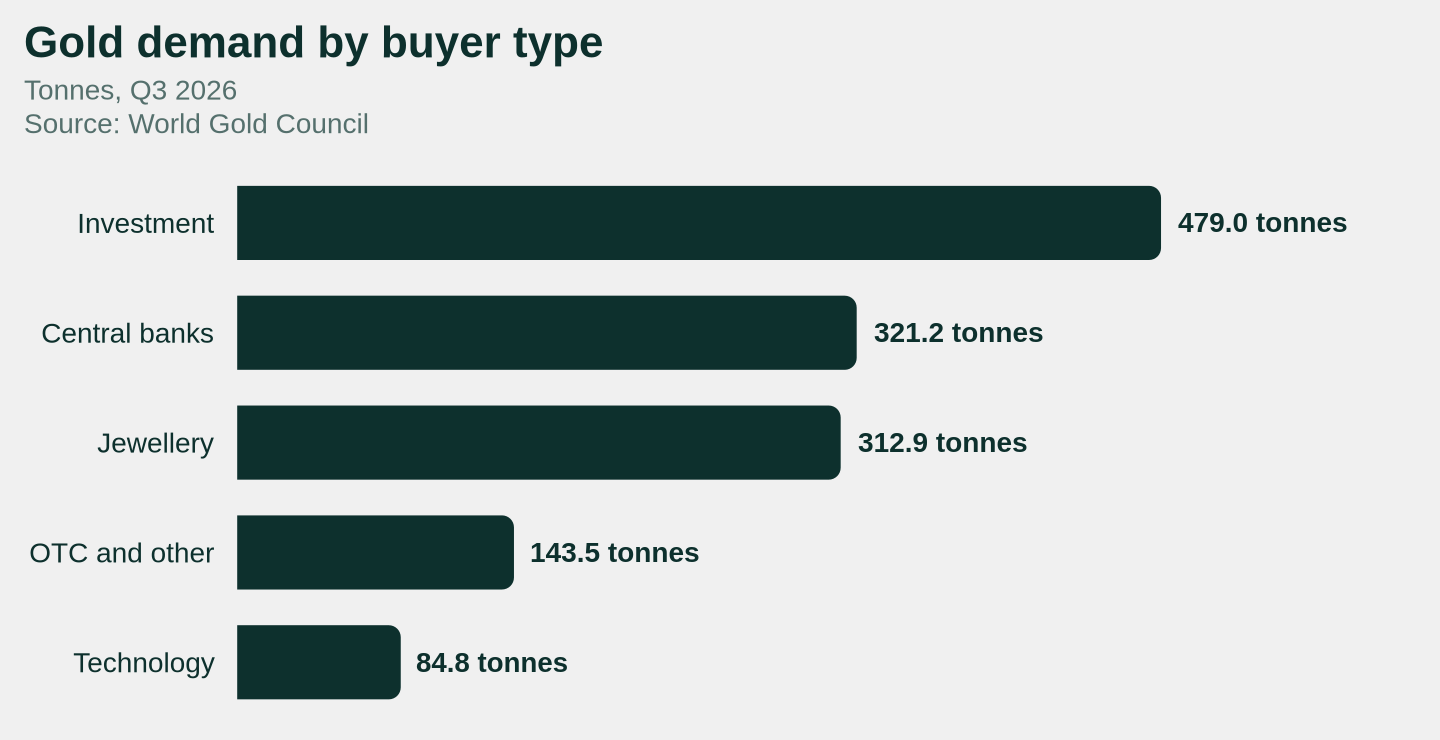
Gold has several separate groups of buyers, and the World Gold Council counts them each quarter. In Q3 2026, it recorded 312.9 tonnes of jewellery consumption and 84.8 tonnes of technology demand. Investment demand was 479.0 tonnes. Central-bank and institutional buying was 321.2 tonnes. Direct trades outside an exchange accounted for 143.5 tonnes. That spread matters: when one group steps back, another can still buy.
Funds built on gold kept adding too. The World Gold Council reported on November 5, 2026 that physically backed gold exchange-traded funds added US$2.7 billion in October, with holdings up 19 tonnes to a month-end record 4,275 tonnes. For full-year 2026, the Council forecasts investment demand will finish around 200 tonnes above 2025. That is a forecast, not a result.
Bitcoin has no equivalent breakdown. Its demand is investor demand, and its issuance is set by code rather than by a mining industry responding to price.
Supply: a hard cap versus a slow trickle
Bitcoin's rule is simple and public. New coins go to miners when they add transaction records to the network. This reward halves every 210,000 records, roughly every four years. The first reward was 50 BTC. The current one is 3.125 BTC. Bitcoin.org says issuance reaches zero around 2140, with total supply capped at 21 million.
Gold is finite but not fixed. New metal keeps arriving: Q3 2026 mine production was 1,070.9 tonnes and recycled gold was 314.5 tonnes. Recycled gold is already part of that stock, not a net addition.
One point worth keeping: a fixed supply caps issuance. It does not set a floor under the price.
Inflation and crises: two different tests
People often mix up two claims. One is that an asset keeps its purchasing power over decades. The other is that it rises when markets panic or when an inflation number lands. They are not the same test.
On the long view, the World Gold Council says gold's US-dollar price has outpaced US and world consumer prices since 1971. Its own earlier analysis found that changes in consumer prices explained only 16% of the variation in the gold price, and described the relationship as inconsistent. A study of monthly inflation releases from 2020 to 2023 found gold returns were insignificantly related to inflation surprises, and the Council notes that real interest rates and the US dollar also move gold.
Two dated episodes show how differently the two assets can behave. On March 12, 2020, during the COVID-19 market shock, bitcoin fell about 40% while gold held up better. A Federal Reserve Bank of Kansas City study found bitcoin behaved like a risk asset that month, and that neither bitcoin nor gold showed statistically significant safe-haven behaviour. Across calendar 2022, as inflation surged and rates rose, bitcoin fell 65% while gold in US dollars ended the year up 0.4%.
Recent weeks were a reminder that bitcoin moves fast. On November 9, 2026, Yahoo Finance published a Reuters report that bitcoin fell to $73,708, its lowest in more than two months, as investors worried about possible tighter US regulation. For more on that move, see our piece on bitcoin's drop below $76,000 in November 2026. On September 15, 2026, Reuters reported that the US Senate failed to advance the CLARITY Act, leaving the proposed crypto framework stalled.
Holding them: custody, costs and the fine print
Custody simply means who physically holds the asset for you.

With gold, bars and coins give you direct possession, but you handle secure storage and insurance yourself. Vaulted gold can stay your property with insurance included, though it brings in a custodian, service costs and terms you need to read. A gold exchange-traded commodity gives you price exposure without storing metal. European commodity products of this kind are typically debt instruments, so the issuer and the custody setup add risks beyond the gold price itself.
With bitcoin, keeping coins at an exchange or another third-party custodian spares you key management but ties you to that provider's security and solvency. Self-custody puts the keys in your hands, and losing them or having them stolen can mean permanent loss of access. A bitcoin exchange-traded product gives indirect price exposure instead of direct ownership, and moves custody to the product's service providers. It does not remove bitcoin's price swings. If you want the mechanics of buying a crypto asset in Europe, our step-by-step guide to buying Ethereum covers the same process.
Verdict
There is no single winner: it depends on what you want.
Gold has demand from jewellery, technology, investors and central banks.
Bitcoin has a supply capped at 21 million coins and sharp price swings.
Risks
- Bitcoin fell about 40% in a single day on March 12, 2020, and 65% across calendar 2022.
- Gold is not a one-way street either: in US dollars it ended 2022 up just 0.4%.
- Regulation can move the price. Yahoo Finance published a Reuters report that the November 9, 2026 drop to $73,708 came with worries about tighter US rules.
- Holding bitcoin yourself means lost or stolen keys can end access permanently. This article is for information only and is not investment advice.
Frequently asked questions
Why is bitcoin called digital gold? Because both are scarce and neither is issued by a central bank. Bitcoin's supply is capped at 21 million coins. Gold's stock grows slowly through mining and recycling. The nickname stops at the story. Gold is also bought by jewellers, industry and central banks, while central banks and other institutions added a net 321.2 tonnes in Q3 2026.
How much bitcoin is left to mine? About 20.11 million coins were in circulation on November 10, 2026, out of a 21 million maximum. New coins arrive through the block reward, now 3.125 BTC, which halves every 210,000 blocks. Issuance reaches zero around 2140.
Does gold protect against inflation? Over the long run, the World Gold Council says gold's US-dollar price has outpaced US and world consumer prices since 1971. Month to month it's far less reliable: its earlier analysis found consumer-price changes explained only 16% of gold-price variation.
Can I own both? Yes, and the two have behaved very differently in stress. In 2022 bitcoin fell 65% while gold in dollars ended the year up 0.4%. But in March 2020 a Federal Reserve Bank of Kansas City study found neither showed statistically significant safe-haven behaviour.
Which is bigger as a market? Gold, by a wide margin on the figures available. Above-ground gold was estimated at 224,200 tonnes, worth US$30.0 trillion at end-Q3 2026. Bitcoin's market value was about $1.5 trillion on November 10, 2026.

Sources
- World Gold Council: Gold ETF holdings and flows (November 2026)
- Bitcoin.org: Bitcoin halving
- World Gold Council: Gold as a strategic asset 2026 edition (February 2026)
- Reuters: Bitcoin falls during coronavirus market shock (March 2020)
- Reuters via Yahoo Finance: Cryptocurrencies slide to two-month lows (November 2026)
- Reuters: US Senate vote on crypto bill (September 2026)
- CoinMarketCap: Bitcoin market data (November 2026)
- FT.com: COMEX Gold historical market data (November 2026)
Cover photo by Kanchanara on Unsplash.

You might also like
Deepen your knowledge with more articles and inspiration.