
Bitcoin dropped below $76,000 on 5 November 2026, its lowest level since 16 September. The fall came on the same day as a sharp drop in US technology shares, money leaving US spot bitcoin funds and hundreds of millions of dollars of forced selling in crypto.
Key takeaways
- Bitcoin fell to a low of $75,463 on 5 November 2026, its weakest since 16 September.
- The same day, the Nasdaq-100 closed down 6.36% and US spot bitcoin funds lost $430.2 million.
- A seven-week low describes past trading, not a floor or a forecast.
What happened to Bitcoin on 5 November 2026
Bitcoin traded below $76,000 during the day. Cointelegraph reported a low of $75,463 based on TradingView data from Bitstamp. Nasdaq's Bitcoin history shows a low of $75,607.90 from a different price feed. So the exact bottom depends on which venue you look at. That is normal for crypto, which trades on many exchanges at once, with no single official price.

The seven-week label has a precise meaning here. Cointelegraph reported the $75,463 low as Bitcoin's lowest level since 16 September 2026.
For the general picture of what drives the price, see our explainer on what moves the bitcoin price.
Why Bitcoin fell on a bad day for tech stocks
Bitcoin and US technology shares sometimes move together when investors turn cautious. That happened on 5 November, but moving together is not the same as one causing the other.
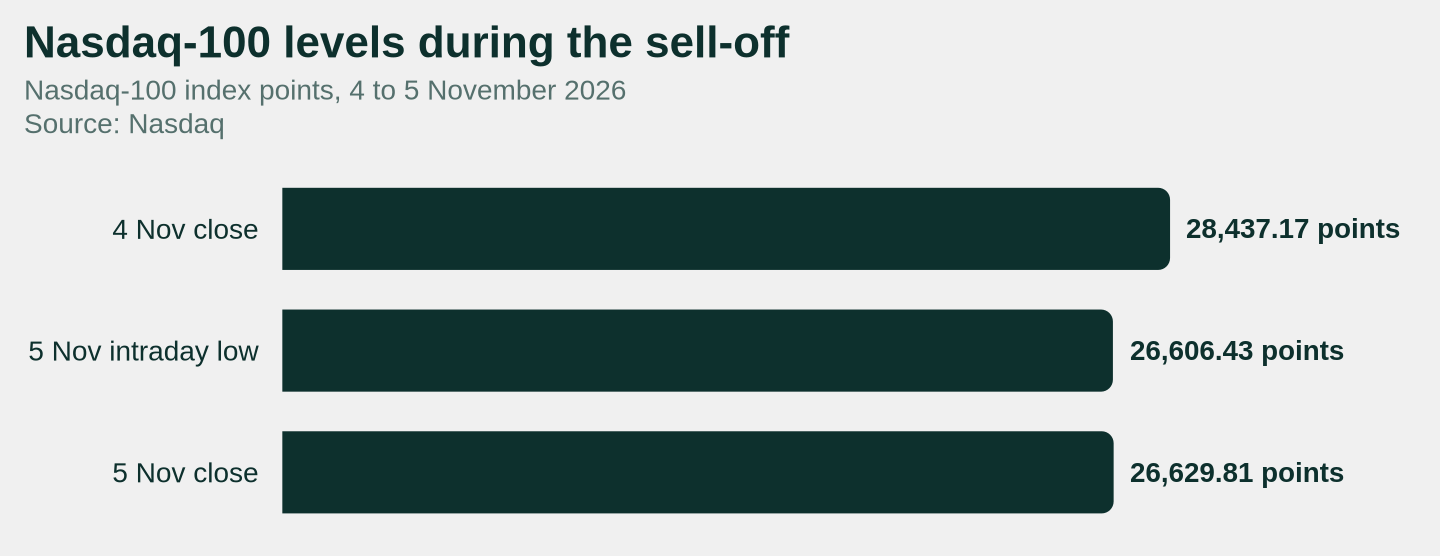
The equity side of the day was brutal. The Nasdaq-100 fell 6.44% from its 4 November close of 28,437.17 to the 5 November intraday low of 26,606.43, then closed at 26,629.81, down 6.36%. That is the kind of session where investors cut the holdings that swing the most.
During market stress, the International Monetary Fund says crypto and financial markets can affect each other more strongly. They can also move in opposite directions during stress. CME Group puts numbers on it: crypto assets' correlation with the Nasdaq-100 was positive but variable, around 0.35 to 0.6 at times in 2025 and early 2026. A correlation of that size means the two often drift in the same direction, not that one follows the other step for step.
So the stock market is part of the picture, not the whole of it.
What the bitcoin ETF outflows mean
An ETF is a fund traded on an exchange. An outflow means more money left a fund than came into it over the period. It measures the behaviour of fund investors, not a fixed amount of Bitcoin sold at a fixed moment.

On 5 November 2026, Farside Investors recorded a net outflow of $430.2 million from US spot bitcoin ETFs. US spot Ether funds also lost $99.9 million that day.
Those are real numbers, but they are a single day. On 20 October 2026, The Block reported that FINMA approved Switzerland’s first retail ETF holding Bitcoin directly, which BIT Asset Management expected to list on SIX in November.
Did forced selling make the fall sharper?
Some traders borrow to take a bigger position than their own money allows. When the price moves against them, their deposit is no longer enough to cover the loss, and the position is closed automatically. That automatic closing is called a liquidation, and it sends more selling into a market that is already falling.
There was plenty of it on 5 November. A later CoinGlass snapshot cited at 19:22 UTC the same day put the rolling 24-hour total at $1.09 billion.
Most of the pain was on one side. In the rolling 24 hours reported at 9 p.m. EST on 5 November, CoinGlass data showed $282.37 million in Bitcoin liquidations, 89.4% of them long positions. Long positions are bets that the price goes up.
The Binance hack in the background
Crypto was already dealing with its own problem. Binance said its 29 October 2026 security incident involved about $6.34 billion in digital assets.
Binance has been refilling what was taken. Its recovery update said about 98% of impacted assets had been replenished as of 31 October, with the remaining less-liquid assets still being purchased, and that Binance would cover the loss rather than users.
What a seven-week low does and does not tell you
A seven-week low means one thing: the price was lower than at any point in the previous seven weeks. Here, it was the lowest since 16 September 2026.

It is a description of the recent past. It is not a floor, not a fair value and not a signal about what comes next. Traders often watch previous lows as reference points, but a price that has fallen through one level can keep falling or turn around, and nothing in a date comparison settles which.
This article makes no forecast. One day of trading, however violent, is not evidence of a trend.
Risks
- Bitcoin is highly volatile and can move sharply in both directions, as the move from $81,130 on 4 November to $75,463 on 5 November shows.
- Crypto and technology shares can fall on the same day, so holding both may give less spread of risk than expected during stressed markets.
- Borrowing to trade can force a position to close automatically at a loss, with no say from the holder.
- Exchanges can be attacked: Binance's 29 October 2026 incident involved about $6.34 billion in digital assets.
- Flow and liquidation data is published after prices move, so it explains context rather than predicting anything.

This article is for information only and is not investment advice.
Frequently asked questions
Why do price reports for the same day differ?
Bitcoin trades on many exchanges at the same time, and each has its own order book. On 5 November, Bitstamp data showed a low of $75,463 while Nasdaq's Bitcoin history showed $75,607.90 from a different feed. Comparing a high on one venue with a low on another mixes sources, so it does not give an exact single-market change.
How strongly does Bitcoin track the Nasdaq?
Not perfectly, and not always. CME Group reports crypto's correlation with the Nasdaq-100 was positive but variable, roughly 0.35 to 0.6 at times in 2025 and early 2026. The IMF adds that spillovers tend to rise during market stress and can even reverse direction.
Did Ether funds also lose money that day?
Yes. US spot Ether ETFs saw $99.9 million of net outflows on 5 November 2026.
Has Binance repaid what was stolen?
Binance said about 98% of impacted assets had been replenished as of 31 October 2026, with the remaining less-liquid assets still being purchased. It said it would cover the loss rather than users.

Sources
- Cointelegraph: Bitcoin price crashes to 7-week low as stocks erase election gains (5 November 2026)
- Nasdaq: Nasdaq-100 Index historical data
- International Monetary Fund: New evidence on spillovers between crypto assets and financial markets (30 September 2023)
- Farside Investors: US spot Bitcoin ETF flow update (5 November 2026)
- The Block: Swiss regulator FINMA approves country's first spot Bitcoin ETF for retail investors (20 October 2026)
- Binance: Recovery update on impacted assets
- CME Group: Can crypto world break free from Bitcoin's undertow? (28 October 2026)
- Yahoo Finance: Bitcoin liquidations report (5 November 2026)
Cover photo by Kanchanara on Unsplash.

You might also like
Deepen your knowledge with more articles and inspiration.