A side hustle here means real work for a real customer, done next to your main job. Start by freelancing a skill you already use at work. It can cost little extra to begin. A 2025 freelancer survey reported an average hourly rate of €100. The survey mainly covered experienced technical and managerial professionals.
This article is about active work, not money that arrives while you sleep. For that side of the question, see our guide to passive income ideas.
Key takeaways
- Freelancing an existing professional skill ranks first because it can cost little extra to start.
- Experienced technical and managerial freelancers in a 2025 survey averaged €100 an hour.
- Work found through apps or websites can pay below the country's net minimum wage.
- Check your contract, register before the first invoice, and put money aside for tax.
How to choose before you read the list
Three things decide your shortlist: the free hours you actually have, the money you can put in, and the skills you can sell today. Money matters less than people expect. KfW's Entrepreneurship Monitor 2026, a representative German survey of 50,000 respondents, found that half of part-time business starts in 2025 used €2,000 or less in startup funds.
A few plain rules of thumb:
- Very little free time: one narrow service, sold to one type of customer.
- A few free hours a week: freelance work in your day-job skill, one or two clients.
- A free weekend and no professional skill to sell yet: local and platform work.
The 8 side hustles for 2026
The list below focuses on someone who already holds a professional job: how little you need to buy, and how directly your existing skill turns into a paying customer.
| No. | Side hustle | What you sell |
|---|---|---|
| 1 | Freelance your day-job skill | Professional work, by the hour or the project |
| 2 | Part-time operations and admin | A few hours a month keeping a small firm in order |
| 3 | Bookkeeping, invoicing and payroll support | Recurring administrative work |
| 4 | Writing, editing and translation | Text with subject knowledge behind it |
| 5 | AI-assisted services you check yourself | A finished, correct document or dataset |
| 6 | Tutoring, training and workshops | Teaching hours, one to one or in groups |
| 7 | Digital templates and small tools | Files you already built, sold again |
| 8 | Weekend and local work | Shifts, bookings and completed studies |
1. Freelance the skill you already use at work
You sell what you already do: design, code, marketing, legal, finance, project work or translation, to firms too small to hire full time. The 2025 freelancer survey reported a €100 average hourly rate, in a sample heavily weighted towards experienced, technical and managerial professionals. Startup cost is low because you already own the skill and the tools.
2. Part-time operations and admin support
You keep a small company's suppliers, scheduling and internal systems in order for a few hours a month. The work repeats, so one client can fill your whole side-hustle time without constant selling. It suits operators, office managers and consultants.
3. Bookkeeping, invoicing and payroll support
Small firms need books kept, invoices sent and payroll checked every single month. Rules differ by country: in Norway, external accountants and accounting firms must be authorised by Finanstilsynet to provide external accounting services. In Denmark, bookkeeping businesses must follow the Danish Bookkeeping Act, and statutory audit work is reserved for registered or approved auditors.
4. Freelance writing, editing and translation
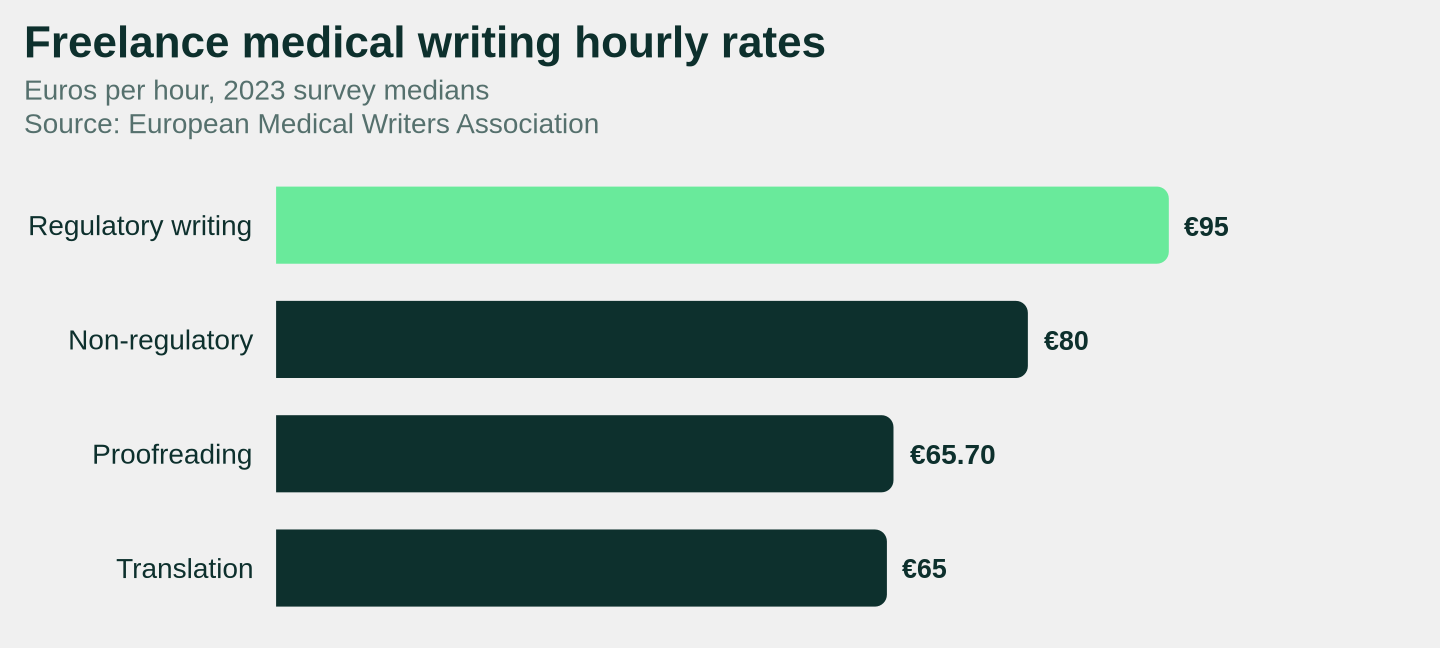
Specialist work still carries a price: a 2023 European Medical Writers Association survey found median hourly rates of €95 for regulatory writing and €65 for translation. Demand has shifted, though. Imperial College Business School's analysis of 1,725,587 global freelance job posts found writing postings fell 30% after ChatGPT's release.
5. AI-assisted services you still check yourself
Workflow documents, data clean-up, internal knowledge bases, research preparation and slide decks, drafted with AI help and verified by you. The client is paying for a correct, usable result, not for the tool that helped produce it. For what the main tools cost, see our guide to AI chatbots in 2026.
6. Tutoring, training and short paid workshops
Evenings and weekends, online or local, teaching a professional tool or a school subject. The same hour of your time can serve one person or a small group. It fits people who already explain things for a living.
7. Digital templates and small tools from your own work
Spreadsheets, contract templates, Notion systems and design files you built for real work, sold again to strangers. Nobody buys until someone finds you, so this needs an audience or a marketplace first. Treat it as a second income stream rather than your first one.
8. Weekend and local work: reselling, pet care, event staffing, paid research
These need no professional background. An EU estimate cited by the European Commission found platform workers spent an average 8.9 hours weekly on unpaid tasks against 12.6 paid hours. About 55% earned below their country's net minimum wage.
What the earnings research actually shows
Most published numbers cover platform work, not side hustles in general, and they disagree. A 2021 survey across 14 EU countries reported mean monthly earnings of about €350 for internet work and €250 for platform work. Its median of around €150 a month applies to remote professional work only, and the sample excluded the Nordic countries.
Closer to home, a spring 2024 Finnish membership survey had 325 members with a side hustle respond: half said they earned under €500 a month and one in ten over €2,000. A May 2026 Eurofound study of 3,830 online platform workers in 15 EU Member States reported average annual platform earnings of €20,000, hiding large differences by country and task type.
Five steps to your first paying client
- Pick one service and one type of customer, then describe it in a single sentence.
- Decide the pricing model before the first conversation: hourly, per project or a monthly fee.
- Prepare one example of past work that you are allowed to show.
- Write down the people who already know you: former colleagues, suppliers, local business owners.
- Send short direct messages, agree one small first job, deliver it and ask for the next.
Contracts, registration and VAT in the Nordics
Your employment contract comes first. In Finland, employees may do outside work in their free time if it does not harm the employer or impair performance in the main job, and competing work that manifestly harms the employer is prohibited. In Sweden, outside work is generally constrained by loyalty, conflicts and competition, and state employees must provide information about secondary work when the employer asks. Never use employer equipment, accounts or client data.
Then register. In Sweden, someone running a business alone normally registers with the Tax Agency through Verksamt. Someone who is also employed can apply for FA-tax. It is a tax status for people who are both employed and self-employed.
| Country | Value-added tax (VAT) registration |
|---|---|
| Sweden | VAT exemption generally applies at annual turnover of SEK 120,000 or less |
| Norway | Required once taxable sales exceed NOK 50,000 over a rolling 12-month period |
| Denmark | Required when taxable sales exceed DKK 50,000 in a calendar year |
| Finland | Required when calendar-year turnover exceeds €20,000 |
Frequently asked questions
What side hustle can I start with no money?
Service work built on a skill you already have. Consulting in your day-job field can start with a message rather than a purchase. Bookkeeping support for a small firm and tutoring can work the same way. The first step is the same in each case: write one sentence that says what you do and who it is for, then send it to people who already know your work.
Do I have to pay tax on side hustle income in the Nordics?
Yes, in almost every case. In Norway there is no general small-income exemption for a profit-making side business, only a NOK 2,000 annual tax-free threshold for other odd jobs and a separate NOK 6,000 exception for certain work in a private home. In Sweden a hobby surplus is taxable and reported on the T2 attachment, with supporting documents kept for seven years. In Denmark, paid side services are normally B-income and must be reported. In Finland, small side-job income is taxable with no special threshold.
Can a non-compete clause stop my side hustle?
It can, within limits. In Norway, a post-employment non-compete must be written, justified by the employer's particular need for protection, and cannot exceed one year, with statutory compensation when enforced. In Denmark, it generally requires a written agreement, a particularly trusted position, at least six months' employment, compensation and a maximum 12-month term. Read your own contract before you take a client in your employer's market.
Does bookkeeping work for others need a licence?
It depends where you are and what exactly you do. In Sweden, official guidance says a business may handle its accounting itself or choose someone else, and tax agents need the appropriate authorisation to act through the Swedish Tax Agency's e-services. In Finland, an authorised auditor is required for statutory audit when the conditions are met, and representatives handling tax or Incomes Register matters need the relevant client-granted authorisation.
Is freelance writing still worth doing in 2026?
The specialist end still has prices attached. The same 2023 European Medical Writers Association survey put median hourly rates at €80 for non-regulatory writing and €65.70 for proofreading, and noted rates were generally higher than in 2018. On the other side, a Brookings summary of peer-reviewed platform research reported about 2% fewer monthly contracts and 5% lower monthly earnings in exposed text-heavy work.

Sources
- Freelancer Study 2025: Freelancer Study 2025
- Finanstilsynet: External accounting
- Imperial College Business School: How AI is affecting freelance jobs (5 February 2024)
- European Commission: Questions and answers on improving working conditions in platform work
- KfW: KfW Entrepreneurship Monitor 2026 (1 May 2026)
- Eurofound: Online platform work in the European Union: Implications for working conditions and access to information (May 2026)
- Verksamt: Sole trader
- Norwegian Tax Administration: Starting a sole proprietorship
Cover photo by Nick Morrison on Unsplash.

You might also like
Deepen your knowledge with more articles and inspiration.